That $129,000 figure isn't hyperbole—it’s the chilling math revealing how utterly divorced America’s poverty line is from lived reality. Economics Explained doesn’t just diagnose the problem; they autopsy the 1960s-era formula still dictating who counts as 'poor' while millions teeter financially. This matters now because inflation’s bite makes the gap between policy fiction and daily struggle impossible to ignore.
The Ghost of Poverty Past
Economics Explained excavates the shocking simplicity of our poverty metric: 'Food times three.' That’s it—the 1969 threshold born when families spent one-third of income on groceries. The author underscores how 'Oshansky herself described it as measuring how much was too little... Not a definition of enough, a definition of not enough.' This historical framing lands because it exposes a brutal truth: we’ve never updated the benchmark for a world where food is just 8% of budgets. Remember 1960? Median home prices were $20,200—under three times income. Today’s $431,000 median home (five times income!) reveals why clinging to this relic is economic malpractice. Critics might argue updating thresholds would explode welfare costs, but the author wisely notes the real cost is already being paid in deferred homebuying, stalled entrepreneurship, and plummeting birth rates.
They exist entirely in the space between the benchmark and reality.
Modern Math of Financial Fragility
The author’s surgical breakdown of that $83,000 median income is where this piece becomes indispensable. After taxes, housing devours $28,000 for city renters—'down to $37,000 before anything else.' Then transportation ($10,000), healthcare premiums ($6,800), and childcare ($20,000 for two kids) don’t just strain budgets—they 'turn a stable month into a financial crisis.' Economics Explained masterfully argues these aren’t discretionary expenses but 'the baseline price of being a functional participant in the modern economy.' This lands because anyone juggling these costs feels the truth in it. The pandemic’s accidental experiment—when suspended 'participation costs' sent savings rates soaring to 32%—proves how much of our budgets fund mere economic participation. A counterargument worth considering: some economists blame regional cost variations, but the author’s city-specific data (Hawaii/DC housing at 35% of income) shows this isn’t just a coastal crisis.
The Benefits Cliff Trap
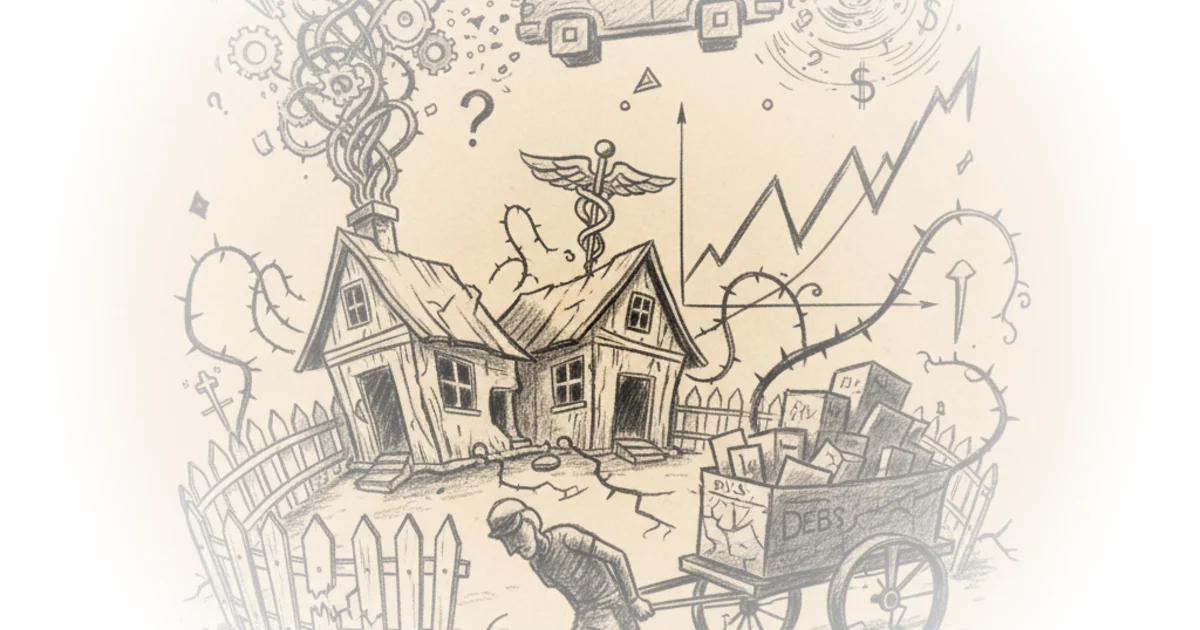
Here’s where policy meets human tragedy. Economics Explained reveals how 'at multiple points on the ladder, earning more means ending up with less' due to sudden benefit losses. That single parent losing childcare subsidies after a $0.50/hour raise? 'Net disposable income down by roughly 25% almost immediately.' This section’s power comes from reframing poverty statistics: those crushed by the 'benefits cliff' 'don’t show up in poverty statistics at all.' It’s a devastating indictment of a system that penalizes upward mobility. I’d add that this design isn’t accidental—it’s baked into 1960s-era logic that never anticipated today’s cost structure. The 2011 Supplemental Poverty Measure tried addressing this, but as the author notes, it remains advisory while real aid clings to the outdated threshold.
Bottom Line
Economics Explained’s greatest strength is transforming abstract policy into visceral financial reality through meticulous cost breakdowns—making $129,000 feel tragically plausible as the 'new poor' line. Its vulnerability? Underestimating how politically radioactive resetting the poverty threshold would be, given the $1 trillion safety net implications. Watch for state-level experiments: California’s recent cost-of-living adjustments for welfare programs may force Washington’s hand.