This piece cuts through the noise of geopolitical posturing to offer a stark, operational reality: the war in Ukraine is being decided not by grand diplomatic gestures, but by the precise, grinding mechanics of logistics and industrial capacity. Phillips P. O'Brien argues that the true pivot point of the conflict lies in a dual-strategy air campaign that simultaneously starves the Russian front lines and bleeds the Russian economy, a nuance often lost in headlines focused solely on battlefield gains or political theater.
The Anatomy of Strangulation
O'Brien begins by dismantling the simplistic view that range is merely a number. Instead, he frames the distinction between long-range and medium-range strikes as a fundamental difference in strategic intent. "Long-range strike could best be compared to strategic bombing in World War II," he writes, describing it as an assault on the deep industrial base that generates new military force. This is not just about hitting targets far away; it is about severing the enemy's ability to replenish itself.
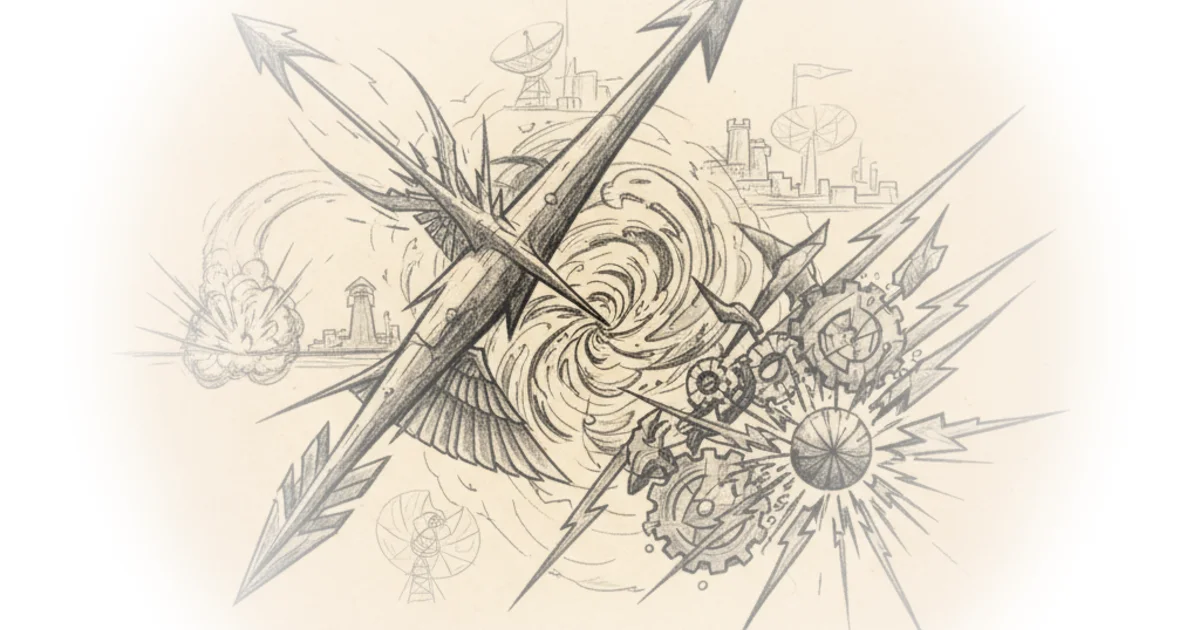
In contrast, he defines the medium-range campaign as a tactical suffocation. "Long-range strike is aimed at limiting/destroying the ability of Russia to generate new military force and medium-range strike is aimed at disrupting/destroying the ability of Russia to deploy already generated force into the fight." This conceptual clarity is vital. It shifts the reader's focus from the glamour of a missile hitting a distant city to the brutal efficiency of a drone disabling a supply truck on a muddy road.
"Long-range strike is aimed at limiting/destroying the ability of Russia to generate new military force and medium-range strike is aimed at disrupting/destroying the ability of Russia to deploy already generated force into the fight."
The author illustrates this with the M-14 highway, the critical artery feeding Russian forces in southern Ukraine. He notes that the intensity of attacks has forced the Russian occupation authorities to ban civilian traffic, leaving the road "littered with destroyed vehicles." While O'Brien hesitates to declare full "fire control," he argues that the current state of "road denial" is already crippling. "If Ukraine can actually control and permanently interdict all road traffic along the M-14, it will be a massive problem for Russian forces," he observes. This echoes the lessons of Operation Spiderweb, where the systematic targeting of bridges and rail nodes previously isolated Russian pockets, proving that mobility is the lifeblood of an occupying army.
Critics might argue that Russia's shift to lighter, infantry-based formations reduces their logistical burden, potentially mitigating the impact of these strikes. O'Brien acknowledges this "second order advantage" for the Russians, noting they do not need to move as much heavy equipment as in previous years. However, he maintains that the cumulative effect of denying reinforcements and resupply remains a "massive problem" that can cripple a force fighting in a basic manner.
The Industrial Bleed
The long-range campaign, O'Brien explains, is a direct assault on the Russian war machine's financial and industrial engine. He details a relentless week of strikes on oil refineries stretching from the Moscow region to the Urals and the Black Sea coast. "The Ukrainians are getting better in both long- and medium-range strike, and that makes it the big story of the week," he asserts, pointing to the strategic depth of these attacks.
The data presented is chilling. Between March and May, Ukrainian strikes disabled between 16% and 25% of Russia's domestic oil refining capacity. "Russia is facing a financial black hole in the future as it has spent down its sovereign wealth fund," O'Brien writes, suggesting that while high oil prices currently mask the damage, the degradation of refining infrastructure is a slow-acting poison. The strikes on the Syzran and Yaroslavl refineries, located hundreds of kilometers from the border, demonstrate a capability that stretches Russian air defenses to their breaking point.
"So many attacks in one week, so far apart distance wise, is the key development. Russian air defense is already struggling, if they are presented with attacks in such different areas every week, it is difficult to see them do anything but get worse."
This analysis holds significant weight, yet it must be viewed through the lens of human cost. The destruction of refineries and chemical plants, while strategically sound, carries the risk of environmental catastrophe and civilian displacement in the targeted regions. The narrative of "precision" often obscures the reality that these strikes occur in populated industrial zones, where the line between military target and civilian hazard is perilously thin.
The Political Pivot
Beyond the battlefield, O'Brien scrutinizes the shifting rhetoric of the American executive branch. He notes a sudden, almost desperate attempt by the administration to "de-Putinize" its public stance, despite a history of hostility toward Ukraine. He highlights the dissonance between Vice President JD Vance's claim that "No US president has done more to save Ukraine than Trump" and the administration's previous actions to cut aid.
The author is particularly critical of Secretary of State Marco Rubio's denial of pressure tactics. "Despite leaks that are not true, despite stories out there about us forcing the Ukrainians to take this position or that position, which are not true," Rubio stated. O'Brien dismantles this by citing President Zelensky's own November 2025 admission of being pressured to accept a "terrible deal." "This is an outright lie by Rubio," O'Brien charges, arguing that the administration is rewriting history to mask a policy failure.
"The interesting thing is that they are being dishonest in their own way, which in and of itself is no shock. However the interesting thing is that they are being dishonest to try and convince the American public that the administration was and is more pro-Ukraine and anti-Putin than in reality it has been."
This section serves as a crucial reminder that military dynamics are inextricably linked to political will. The administration's pivot appears less like a genuine change of heart and more like a reaction to the undeniable reality on the ground: the Ukrainian strategy is working, and the political cost of opposing it is rising.
Bottom Line
Phillips P. O'Brien's most compelling contribution is his reframing of the war as a contest of logistics and industrial endurance rather than a simple clash of armies. His argument that the dual-strategy of medium-range interdiction and long-range economic attrition is pushing Russia toward a breaking point is supported by hard data on refinery outages and supply line disruptions. However, the piece's greatest vulnerability lies in its reliance on the assumption that Russian air defenses will continue to degrade without a significant, unforeseen technological countermeasure. The reader should watch closely to see if the "road denial" on the M-14 evolves into total interdiction, which would mark a definitive turning point in the southern theater.