While the rest of the baseball world braces for a repeat of the 1994 catastrophe, this piece from The Baseball Nerd makes a counterintuitive claim: the financial machinery built since then makes a full-season cancellation almost impossible. By weaving together obscure debt structures and a granular history of labor stoppages, the author argues that ownership's own money is now the greatest firewall against a lost season. For the busy listener, this isn't just a recap of past strikes; it is a forensic look at why the 2027 labor fight will likely look and feel entirely different from the one that killed the World Series three decades ago.
The Financial Firewall
The core of the argument rests on a specific, often-overlooked detail: the league's borrowing capacity is now tied directly to the uninterrupted flow of national media revenue. The Baseball Nerd writes, "Buried in the media contracts themselves is a clause that punishes ownership, both specifically and financially, for letting a work stoppage bleed into the regular season." This is a crucial distinction. The author points out that just months before the salary cap proposal, the league quietly increased its borrowing power against these very contracts, signaling a high-stakes bet that the games will be played.
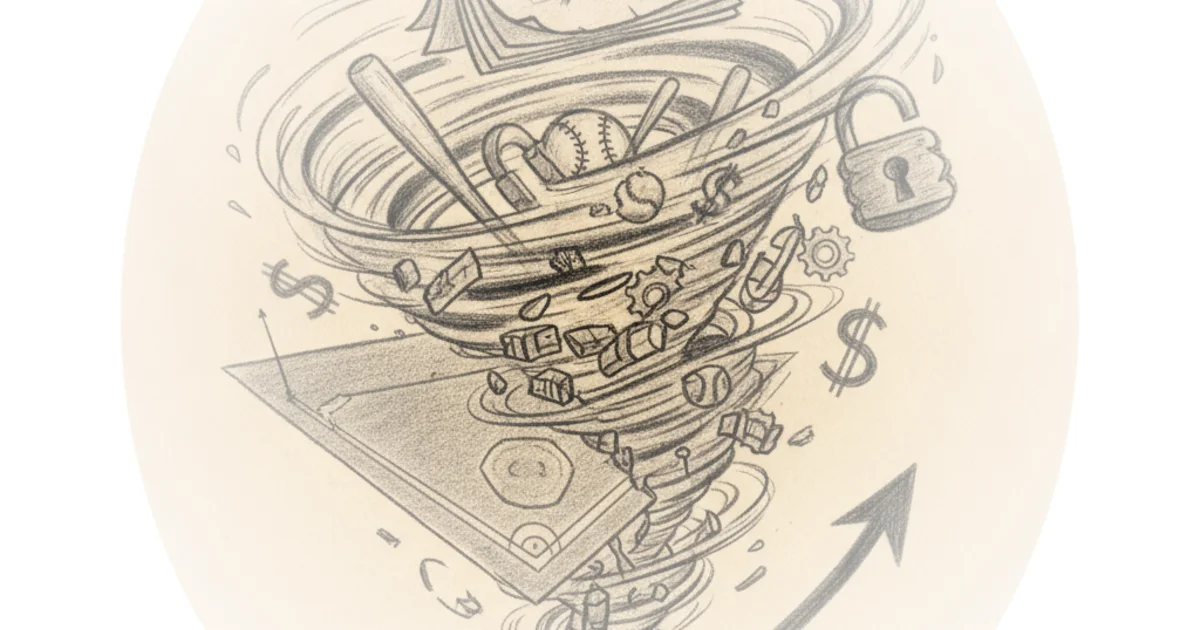
The piece highlights that the debt is housed in "bankruptcy-remote securitizations," a technical term that essentially means the league's central revenue is walled off from individual team failures but heavily leveraged against the promise of a full season. The Baseball Nerd notes, "The Trust's per-club borrowing limit went from $125 million to $150 million in April 2026. That's roughly $750 million in new aggregate borrowing capacity across the league, opened up against the same national media pool that a prolonged lockout would disrupt." This reframes the salary cap fight not as a plea for solvency, but as a strategy to protect existing cash flow.
Critics might argue that financial pressure doesn't always prevent irrational behavior, especially when pride or ideology is on the line. However, the author's reliance on hard numbers from Fitch Ratings and specific contract clauses provides a sturdier foundation than the typical speculation about owner greed. The logic holds: when you have mortgaged your future revenue to fund current operations, you are the last person who wants to pull the plug on the engine.
The people running this sport, whatever else you think of them, have too much of their own money riding on Opening Day actually happening to let this be 1994 twice.
The History of Control
The article then pivots to a historical deep dive, dismantling the lazy comparison to 1994 by categorizing the nine labor stoppages since 1972 into two distinct groups: strikes and lockouts. The Baseball Nerd observes, "Every lockout in this sport's history, 1973, 1976, 1990, and 2021-22, has resolved before a single regular season game disappeared, four for four." This pattern is presented not as luck, but as a function of control. In a lockout, the owners hold the keys; they decide when the doors open and close.
The author contrasts this with the two disasters that actually cost games: the 1981 strike over free agent compensation and the 1994 strike over a salary cap. In both cases, the players initiated the walkout mid-season, removing the owners' ability to simply wait out the opposition. The Baseball Nerd explains, "Owners are expected to run the same playbook they ran in 2021-22: lock players out the moment the CBA expires on December 1, use the offseason as leverage, and get a deal done before Opening Day actually slips away." This distinction is vital for understanding the 2027 outlook. The mechanism of the fight dictates the outcome.
The piece also touches on the 1981 strike, noting that it was the only time insurance failed to protect owners because the strike ran long enough to burn through the policy's deductible. The Baseball Nerd writes, "It didn't save them. The strike ran long enough to burn through a meaningful chunk of that policy before both sides settled." This serves as a grim reminder of what happens when a dispute shifts from the negotiating table to the field, a scenario the current financial architecture is designed to prevent.
The Structural Stakes
Why does this matter now? Because the 2027 fight is being framed as a battle over a salary cap, the same issue that destroyed the 1994 season. Yet, the context has shifted dramatically. The Baseball Nerd points out that the financial landscape of the 1990s, where CBS was paying roughly $265 million a year, pales in comparison to today's media empire. The author argues that the "financial architecture underneath baseball in 1994 barely resembles what exists now, and that gap explains part of why that one strike went all the way when the four lockouts didn't."
The argument suggests that the owners pushing for the cap are distinct from the owners who would actually allow a season to die. The Baseball Nerd asserts, "The owners pushing hardest for a salary cap are not the same as the owners who'll actually let the games stop. Those are two very different appetites, and the second one is the one that matters for whether we get to watch baseball in April 2027." This nuance cuts through the noise of the public relations war, focusing instead on the internal dynamics of the ownership group.
A counterargument worth considering is that the union, facing a potential cap, might feel so threatened that they refuse to budge, turning a lockout into a strike by default if the owners overplay their hand. However, the author's emphasis on the 2021-22 precedent suggests that the union is also aware of the public relations disaster of a lost season and has a strong incentive to settle before the lights go out.
Bottom Line
The strongest part of this analysis is its refusal to rely on emotional nostalgia for 1994, replacing it with a cold-eyed look at debt covenants and the mechanics of labor control. Its biggest vulnerability is the assumption that financial self-interest will always override ideological stubbornness, a gamble that has failed in other industries. Readers should watch whether the owners' increased borrowing capacity actually holds up if negotiations drag past the spring training deadline, as that will be the moment the theory meets reality.