Paul Cooper doesn't just recount the rise of the Mongol Empire; he reconstructs the eerie silence of the cities they left behind, using the travelogue of Ibn Battuta as a haunting entry point to a story usually told only through the lens of military conquest. While most histories focus on the battlefield, this piece argues that the true legacy of the steppe nomads is found in the architectural ghosts of Central Asia and the linguistic DNA that still binds half the world's population today.
The Architecture of Ruin
Cooper opens not with a battle, but with a traveler's disappointment. He introduces us to Ibn Battuta, the 14th-century North African explorer who arrived in cities like Bukhara and Samarkand expecting the opulent jewels of Islamic learning he had heard about in stories. Instead, he found silence. Cooper writes, "We traveled for a whole day through contiguous Orchards with streams trees and habitations and arrived at the city of bukara this city was formerly the capital of the Lands Beyond the river J but was laid in Ruins so at the present time its mosques colleages and bazaars are in Ruins all but a few." This vivid description sets the stage for a narrative that prioritizes the human cost of empire over the strategic brilliance of its generals.
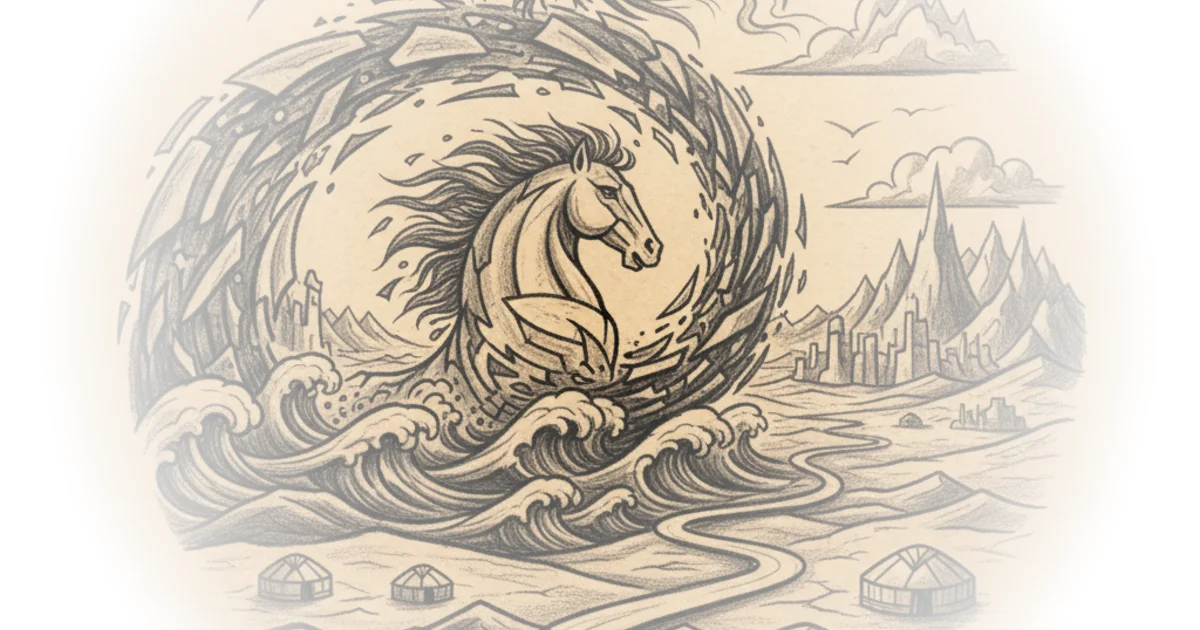
The author's choice to frame the Mongol impact through the eyes of a witness who saw the aftermath is striking. It forces the listener to confront the scale of the devastation before ever hearing the name of the conqueror. Cooper notes that in Balkh, a former Zoroastrian hub, "there was no smoke of cooking fires no animals in the fields no traffic of people in its streets." The silence is deafening. This approach effectively shifts the focus from the "terror" of the steppe to the fragility of civilization itself. It suggests that the greatest empires can be reduced to jagged ruins in a single generation.
"Everywhere across this region the cities bore the scars of one of the Middle Ages most momentous and World Chang ing events this was the uniting of a nomadic people who called themselves the Mongols from their Homeland far away in the step grasslands of East Asia."
Critics might argue that focusing so heavily on the destruction overlooks the Mongols' role in facilitating the Silk Road and connecting distant cultures. Cooper does acknowledge this duality, noting that "in places they also laid the foundation for our modern world," but the emotional weight of the piece remains firmly on the collapse of the old order. This is a deliberate narrative choice that resonates deeply with modern anxieties about societal fragility.
The Horse That Changed History
Moving from the ruins to the origins, Cooper pivots to the environmental and technological catalyst that made the Mongol machine possible: the domestication of the horse. He paints the Eurasian steppe not as a barren wasteland, but as a "vast Corridor of seasonal savanas" where the climate dictated a unique way of life. "The low rainfall on the step means that trees cannot survive and even species of long grasses find it difficult to take root," Cooper explains, forcing humans to adapt by herding rather than farming.
The argument here is that the horse was the ultimate game-changer, transforming a herder's range from 30 kilometers a day to over 100. Cooper writes, "when they did [ride the horse] they changed the course of human history." This is the core of his thesis: the Mongol Empire wasn't just a political phenomenon; it was a technological inevitability born of geography. The ability to move entire communities, including the elderly and children, on wagons pulled by horses created a mobile society that settled civilizations could never hope to contain.
He traces this lineage back to the Proto-Indo-Europeans, who rode out of the western steppe 4,000 years ago, leaving a linguistic legacy that survives in half the world's languages. "It's believed the Proto Indo Europeans had two words for horses which have been reconstructed to something like EOS and Marcos," Cooper notes, connecting the ancient steppe to modern English words like "equestrian" and "mare." This linguistic thread is a brilliant way to make a 6,000-year-old history feel immediate and personal to the listener.
The Paradox of the Nomad
Despite their mobility and military prowess, Cooper highlights a profound weakness in the steppe culture: the lack of a written language. "While the settled peoples of the world developed alphabets and writing systems that allowed them to keep records and recount their histories the peoples of the step did not develop their own system of writing," he observes. This creates a historical paradox where the most destructive force in medieval history is known primarily through the writings of its enemies.
He quotes the Greek historian Herodotus, who described the Scythians (early steppe nomads) as a people who "all carry their homes around with them on wagons practice their archery from horseback and depend for their living on cattle rather than the fruits of the plow." Cooper uses this to illustrate the settled world's fear of the nomadic lifestyle. The argument is that the nomads were not just conquerors, but a mirror image of civilization—mobile, unbound by walls, and impossible to pin down.
"How then could they fail to defy every effort made to conquer them or to pin them down?"
This framing is powerful because it reframes the Mongols not as mindless barbarians, but as a highly adapted society that exploited the limitations of the settled world. However, one might argue that the lack of written records also means we are missing the internal logic of their society, relying too heavily on the biased perspectives of the conquered. Cooper hints at this by noting that the steppe people were often "feared and hated" by those who wrote about them, but he doesn't fully explore how this bias distorts our understanding of their governance.
Bottom Line
Paul Cooper's narrative is a masterclass in using environmental history to explain geopolitical upheaval, proving that the rise of the Mongols was as much about grass and horses as it was about swords and strategy. The piece's greatest strength is its refusal to glorify the conquest, instead focusing on the silence of the ruins and the linguistic echoes that remain. Its vulnerability lies in the inevitable reliance on external sources to tell the story of a people who left no written record of their own, but Cooper navigates this by making the absence of their voice a central theme of the tragedy. For the busy listener, this is a reminder that the world we inhabit today was forged in the dust of the steppe, and the scars of that forging are still visible in our languages and our landscapes.