More Perfect Union delivers a scathing indictment of the modern meat industry, arguing that the disappearance of family farms isn't an inevitable market correction but the result of a deliberate corporate strategy to capture value while offloading risk. The piece's most startling claim is that the industrial model pioneered for chickens was weaponized against hog farmers, turning a once-competitive market into a monopoly where three giants control the supply chain and dictate terms. This isn't just a story about agriculture; it is a case study in how vertical integration can dismantle local economies and poison the environment, all while keeping grocery prices high.
The Architecture of Control
The narrative begins by contrasting the past with the present, painting a vivid picture of rural Iowa's transformation. More Perfect Union writes, "back in the day one square mile would have as many as four different Farm families on one now all of a sudden you have to go four five or six miles to find a farmer." This stark statistic sets the stage for the central thesis: the consolidation of the industry has hollowed out communities. The author notes that while the number of hogs raised has exploded and profits have surged by 300%, that wealth has not trickled down to the people living on the land.
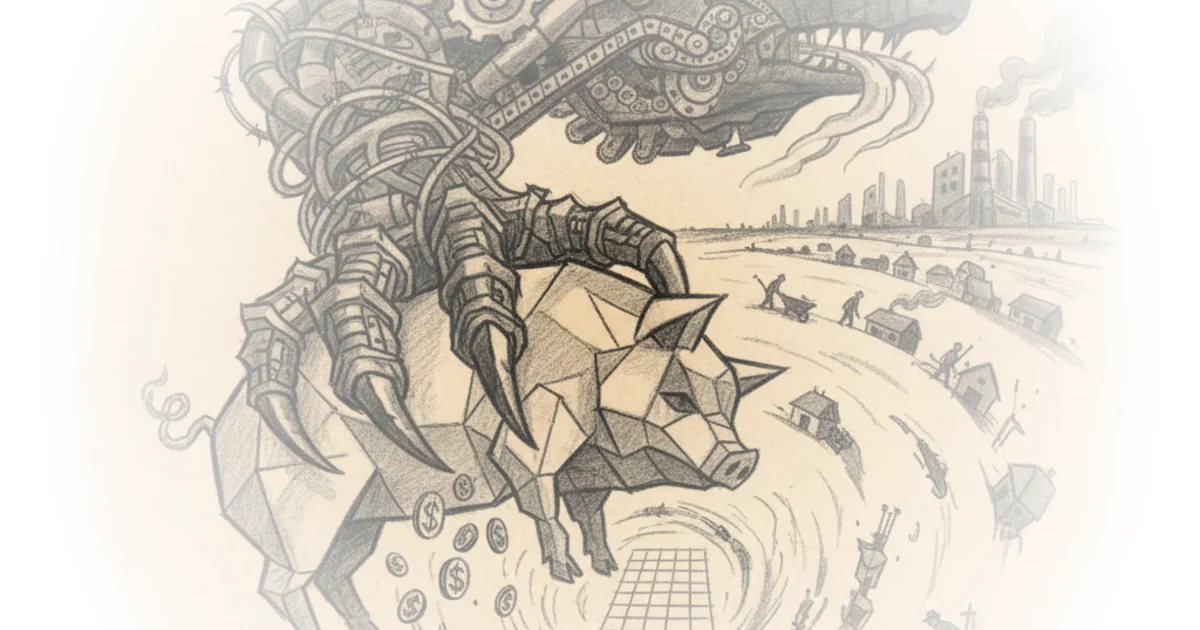
The commentary effectively traces the origin of this model to Tyson Foods, detailing how the company applied the "chicken-ization" of agriculture to hogs. More Perfect Union explains that the core DNA of the business model is the ability to promise massive, consistent volume to retailers like Walmart. To achieve this, Tyson shifted the burden of capital investment onto the farmers. As the piece puts it, "the farmer is the one that takes out a mortgage for the land who buys and builds the Barns and who cares for the animals during their short life." This is a crucial distinction. The corporation owns the supply chain, but the individual farmer owns the debt and the risk.
"It really was a true corporate takeover Tyson created a closed contract controlled system and it destroyed the open and competitive system."
This framing is powerful because it reframes the farmer's struggle not as a failure of business acumen, but as a structural trap. Once a farmer invests hundreds of thousands of dollars in buildings designed to Tyson's specifications, they are locked in. They cannot easily switch buyers or convert to other crops. Critics might argue that these contracts offer farmers a guaranteed market in a volatile industry, but the evidence presented suggests the power dynamic is so skewed that the "guarantee" comes at the cost of autonomy and fair compensation.
The Environmental and Economic Toll
The piece widens its lens to examine the ecological devastation caused by this concentration of animals. The sheer scale of waste production is staggering. More Perfect Union highlights that Iowa alone houses 25 million hogs, generating waste equivalent to the human population of Texas, California, and Illinois combined. The text describes the waterways as an "open sewer," noting that "more than half of Iowa's lak streams and rivers are contaminated with cancer-causing phosphorus and nitrates."
The argument connects the economic model directly to environmental harm. Because the industry prioritizes efficiency above all else, the waste management systems are overwhelmed. The author points out a disturbing policy response: "just last year Governor Kim Reynolds cut funding for a program that monitors nitrates in Iowa's waterways." This suggests a political alignment with the industry that ignores the long-term health of the region's residents. The piece argues that the pollution is not an accidental byproduct but a direct consequence of the decision to pack animals into concentrated animal feeding operations (CAFOs) to maximize profit margins.
The Death of the Open Market
Perhaps the most damaging impact described is the erosion of the open market. The piece details how auction barns, once bustling community hubs, have vanished. More Perfect Union writes, "a lot of folks have been forced to just take them to a weekly sail Barn you know they're just not as many auctions around because they're just it's a kind of a dying dying breed anymore." With less than 2% of hogs sold on the open market, farmers have no leverage. They are forced to sell to the few dominant buyers who set the price.
The result is a paradox where pork prices at the grocery store remain high while farmer income plummets. The commentary notes that "as the industry Consolidated Tyson was able to charge customers more and pay Farmers less." This disconnect highlights the monopoly power at play. The author argues that the loss of independent farmers has a cascading effect on the entire community, from local churches to schools. "For every farmer we keep on the land we have another reason for a local grocery store to stay open," the piece asserts, linking agricultural policy directly to the viability of rural civic life.
"The core DNA of Tyson's business model is that it can go out to Mass massive industrial scale customers Walmart like the grocery chains and it can promise them consistent high volume products."
This quote underscores the motivation behind the consolidation: it wasn't about feeding people better or cheaper, but about satisfying the logistical demands of massive retailers. The human and ecological costs were externalized.
Bottom Line
More Perfect Union makes a compelling case that the current state of the meat industry is the result of a calculated corporate strategy that prioritizes scale and control over community resilience and environmental stewardship. The strongest part of this argument is its clear demonstration of how financial risk was systematically shifted from corporations to individual farmers, creating a dependency that is nearly impossible to escape. The biggest vulnerability is the lack of detailed discussion on potential regulatory solutions or how consumers might effectively push back against this monopoly power. Readers should watch for how state and federal antitrust enforcement evolves, as the status quo described here is unsustainable for both the environment and the rural economy.