Cory Doctorow delivers a chilling diagnosis of how digital lock-in transforms everyday devices into tools of financial coercion, arguing that the real innovation isn't in lending, but in the technology that makes defaulting on a loan physically impossible for the borrower. This piece is notable because it connects the abstract mechanics of high-interest finance to the tangible, terrifying reality of a car that refuses to start or a phone that deletes your apps when you're broke. It forces the reader to confront the idea that our most personal technologies are increasingly designed not to serve us, but to serve the balance sheets of lenders.
The Economics of Predation
Doctorow begins by dismantling the standard justification for high interest rates: the "risk premium." He argues that lenders don't just charge more for risk; they actively engineer situations where that risk becomes a profit center. "Lenders are always seeking the highest possible return on their loan-books, which makes that 'risk premium' awfully tempting," Doctorow writes, highlighting the perverse incentive to lend to those least likely to repay. The core of his argument is that financial "innovation" is often just a mechanism to shift risk away from the lender while keeping the high fees. He draws a sharp parallel to the subprime mortgage crisis, noting that "'Financial innovation' is often just a project to decrease the risk in risky loans, but without decreasing the risk premium you get paid for issuing those loans." This framing is powerful because it reframes complex derivatives not as sophisticated risk management, but as a deliberate strategy to extract value from the vulnerable.
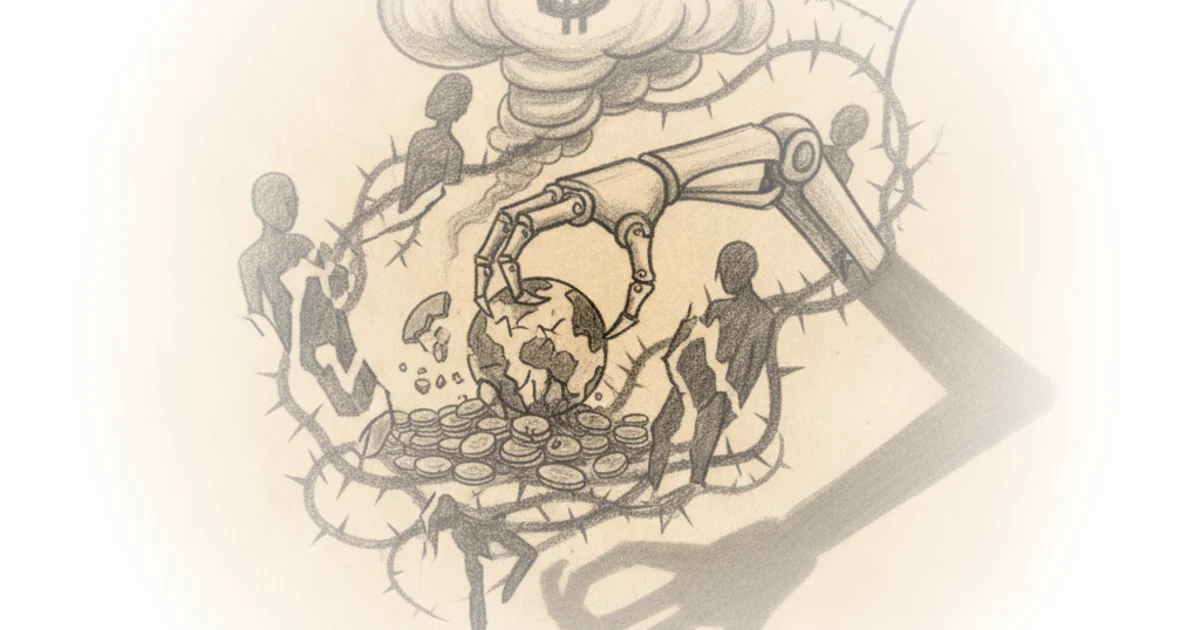
The historical context Doctorow weaves in is particularly striking. He reminds us that this isn't new; it's a modernization of "contract buying," a racist practice from the mid-20th century where Black families were evicted from homes they had nearly paid off, losing all their equity. Similarly, he points to the long-haul trucking industry, where drivers have been effectively indentured, forced to "contract buy" their trucks under terms that guarantee they will lose the vehicle if they miss a single payment. "Wherever you find a desperate, disfavored group who are locked out of the credit system, you'll find scumbag contract lenders running this scam," Doctorow asserts. This historical continuity suggests that the current crisis isn't an accident of the market, but a feature of a system designed to exploit those with no other options.
The cheaper the repo, the riskier the loan can be; the riskier the loan, the higher the risk premium.
Critics might argue that lenders need these mechanisms to manage the inherent uncertainty of lending to high-risk borrowers, or that consumers are simply making poor financial choices. However, Doctorow's evidence of "teaser rates" that balloon into unpayable sums, combined with the ability to remotely seize assets, suggests a rigged game rather than a fair market transaction.
The Digital Arm-Breaker
The piece takes a darker turn when Doctorow introduces the concept of the "digital arm-breaker." He explains how ubiquitous connectivity has lowered the cost of repossession, allowing lenders to target even riskier borrowers. "Ubiquitous digital networks and computing make it much easier to repo a car," he notes, detailing how lenders now use remote immobilizers, loudspeakers that blare threats, and even autonomous vehicles to back themselves out of parking spots for repossession agents. The most disturbing examples come from the phone lending sector in India, where lenders pre-install software that disables a user's favorite apps, escalating the punishment until the most essential functions are locked.
Doctorow describes this escalation as a digital version of physical violence: "It's the digital version of the mob loan-shark who breaks a finger, then your hand, then your arm. The more graduated the threat matrix is, the more payments you can capture." This analogy is visceral and effective, translating abstract code into a tangible threat to personal autonomy. He argues that these systems work because the devices are designed to be immutable; the borrower cannot simply delete the malicious software. "If your phone is running a program that disables your apps, then you can install another program that disables that program," he points out, but the law prevents this.
The Legal Lock-In
The final piece of the puzzle, according to Doctorow, is the law itself. He identifies the Digital Millennium Copyright Act (DMCA) of 1998 as the legal mechanism that enforces this power imbalance. Section 1201 of the DMCA makes it a felony to bypass access controls, effectively criminalizing the act of fixing or modifying your own property. "DMCA 1201 criminalizes anything the manufacturer dislikes," Doctorow writes, calling it "felony contempt of business model." This legal shield allows companies like Apple to lock down their ecosystems, preventing users from neutralizing the "usury-tech" embedded in their devices.
He argues that this creates a paradox where the very laws intended to protect intellectual property are being used to enforce financial predation. "That's where the law comes in," he explains, noting that without the ability to modify the software, the borrower is at the mercy of the lender's remote controls. The argument is compelling because it exposes how a law designed for the digital age has been weaponized to create a new form of debt peonage.
Bottom Line
Doctorow's strongest contribution is his ability to connect the dots between obscure financial engineering, historical patterns of exploitation, and the specific legal frameworks that enable digital coercion. The piece's biggest vulnerability is its reliance on the assumption that consumers are aware of these mechanisms, which may not be true for many vulnerable borrowers. Ultimately, the reader must watch for how the intersection of IoT (Internet of Things) and debt law will reshape the concept of ownership in the coming decade.
DMCA 1201 is the reason you can't neutralize the digital arm-breakers by deleting or blocking the usury-tech in your car, phone or other device.