Perun cuts through the diplomatic noise of 2026 to expose a stark contradiction: the United States is demanding the annexation of Greenland while its own official defense documents explicitly state that ownership is unnecessary. This is not merely a story of diplomatic bluster; it is a forensic dissection of how a superpower risks overextension by confusing its ability to coerce with the wisdom of doing so. For the busy strategist, the insight here is critical: when a nation's public rhetoric diverges from its written strategy, the result is often a "strategic folly" that alienates allies without gaining tangible security benefits.
The Gap Between Rhetoric and Strategy
The piece begins by establishing a historical pattern of great powers forgetting the distinction between being powerful and being all-powerful. Perun writes, "Historically speaking, a major risk for decision-makers in great powers is forgetting the difference between being very powerful and all powerful and risking overextension as a result." This framing is essential because it contextualizes the Greenland crisis not as an isolated incident of presidential whimsy, but as a recurring structural failure in American statecraft. The author notes that while the US successfully pressured allies on NATO spending and trade deals in 2025, the demand for Greenland in 2026 crossed a line where coercion backfired.
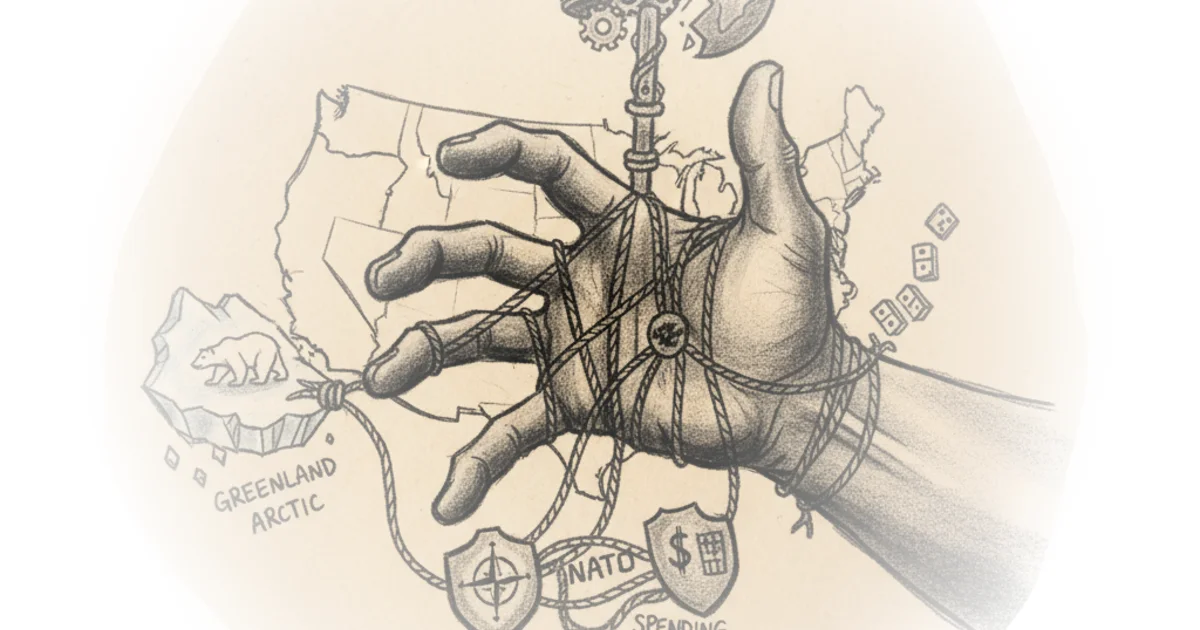
The argument gains traction by contrasting the public demands with the actual text of the 2025 National Security Strategy and the 2026 National Defense Strategy. Perun points out that these documents do not call for annexation. Instead, the author highlights a specific directive: "The Department of War will therefore provide the president with credible options to guarantee US military and commercial access to key terrain from Arctic to South America, especially Greenland, the Gulf of America, and the Panama Canal." The distinction is vital. The US already had the access it needed through existing treaties and NATO alliances. By demanding full ownership, American leaders were pursuing a goal that their own strategists had deemed unnecessary.
Ownership of Greenland, along with other pieces of key terrain around the world, is never mentioned as a strategic objective. Instead, what these documents say the United States needs with relation to places like Greenland is access.
This move to demand ownership rather than access is where the author's critique bites hardest. Perun argues that this shift represents a "strategic bridge too far," turning a manageable diplomatic relationship into a crisis. The author suggests that the US is willing to risk the cohesion of the very alliance structures its strategy documents say are essential for its defense. As Perun puts it, "Obviously, that's only going to work if those alliance structures that the documents explicitly reference hold together." Critics might note that in high-stakes geopolitics, leverage often requires pushing boundaries beyond the written text, but Perun's counter is that doing so without a clear strategic metric is self-destructive.
The Geography of Misconception
To understand why the demand for Greenland is so flawed, Perun dissects the geography and history of the island, stripping away the cartographic illusions that often distort strategic thinking. The author notes that map projections make Greenland look massive, but the reality is "a tad more humble" with a population of only 56,000. The historical context provided is equally revealing: Greenland's name was a "real estate scam" by Eric the Red to attract colonists, and its modern status as an autonomous province was the result of decades of reform, not a territory up for grabs.
The strategic value of Greenland is real, but it is nuanced. Perun explains that while the island offers a vantage point for projecting power into the Arctic and Atlantic, the infrastructure required to exploit it is immense. "Climactic conditions are harsh. The distances are long. Infrastructure is very, very sparse." The author reminds readers that the US already maintained a significant military presence there during the Cold War, including the nuclear-powered Camp Sentry, yet downscaled it significantly after the Cold War ended. The current push for ownership ignores the fact that the US military presence was already sufficient for the stated strategic goals of deterrence and access.
The idea of doing something like that in order to provide a surviable second strike option was ultimately overcome by a variety of factors including the sheer difficulty of building and maintaining infrastructure in Greenland and the emergence of a much better solution, the ballistic missile submarine.
This historical perspective serves to undermine the urgency of the 2026 annexation demand. If the US could achieve its Cold War objectives with a smaller footprint and without sovereignty, why is full ownership now presented as a necessity? Perun suggests that the arguments for annexation are largely political posturing rather than strategic necessity. The author writes, "Even by the standards of 2026, demanding an ally sell you their territory and refusing to rule out the use of military force if they don't, if you look at it coldly, is an absolutely wild strategic move."
The Cost of Overreach
The core of Perun's commentary lies in the evaluation of the US approach through the lens of its own stated objectives. The author argues that the US strategy relies on "soft power" and the "glue" of alliances, yet the Greenland crisis actively erodes both. Perun writes, "The NSS saying that we want to quote maintain the United States unrivaled soft power through which we exercise positive influence throughout the world that furthers our interests end quote." By threatening an ally with force over a territory the US doesn't need to own, the administration is undermining the very influence it claims to want to maintain.
The author also addresses the common defense that "countries never rule anything out" in negotiations. Perun rejects this as a convenient excuse for bad strategy. "For good strategic reasons, countries will often agree to give up some of their strategic freedom of action," the author notes, citing NATO's Article 1 which requires peaceful dispute resolution. The refusal to rule out force in this case signals a lack of commitment to the rules-based order that the US claims to champion.
In a similar sense, today when we're evaluating the Greenland Folly, I'm going to mostly focus on assessing it through the goals and metrics the United States itself has set out in its own national security and defense strategies.
This methodological choice is the piece's greatest strength. By holding the US to its own metrics, Perun reveals the hollowness of the annexation demand. The argument is not that the US should never act aggressively, but that this specific action fails to advance its stated goals while actively damaging its long-term strategic position. The author concludes that the crisis is a "monumental US strategic error" because it sacrifices alliance cohesion for a territorial gain that offers no additional security value.
Bottom Line
Perun delivers a devastating critique of the Greenland crisis by exposing the disconnect between American strategic documents and political rhetoric. The strongest part of the argument is the demonstration that the US already possessed the access it claimed to need, rendering the demand for sovereignty a purely political maneuver with no strategic payoff. The biggest vulnerability of this approach is that it assumes rational actors will always prioritize written strategy over political posturing, a gamble that has clearly failed in this instance. Readers should watch for whether the US retreats from this position or doubles down, as the outcome will signal whether American foreign policy is guided by long-term strategy or short-term coercion.