Peter Gray delivers a stinging, necessary takedown of a foundational myth in modern education: the belief that Jean-Jacques Rousseau was a champion of child freedom. While many educators revere Rousseau as the father of "natural" learning, Gray argues his actual blueprint was a masterpiece of behavioral engineering disguised as liberty. This is not a dry historical critique; it is a direct challenge to the assumptions driving today's progressive classrooms, suggesting that the very methods meant to liberate children are often just more sophisticated forms of control.
The Illusion of Freedom
Gray begins by dismantling the romantic image of Rousseau's Émile, a fictional boy raised in isolation to preserve his "natural goodness." The author points out the absurdity of the setup: a single, brilliant tutor devoting his entire life to manipulating one child's environment so perfectly that the boy believes he is choosing his own path. "Émile spends the first 25 years of his life in the company of his tutor, referred to as the master, who is presented by Rousseau in the first person," Gray writes. The master does not issue orders; instead, he "manipulates Émile's environment in such a way that the boy always chooses to do exactly what the master believes is good for him."
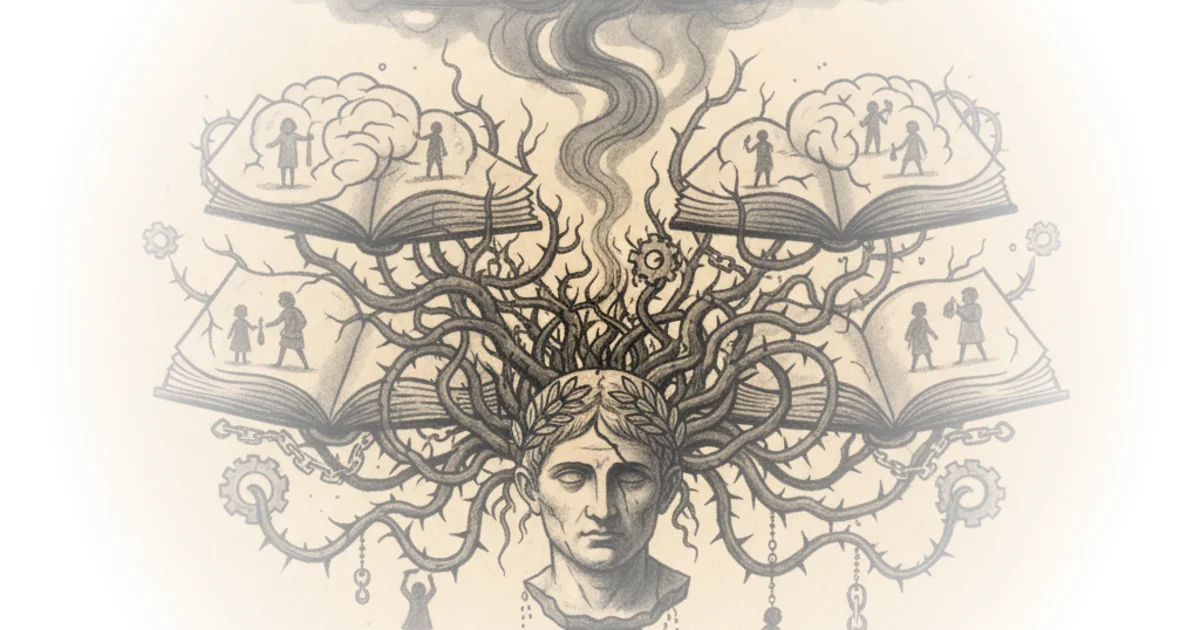
This framing is crucial because it exposes a paradox often missed by modern admirers of Rousseau. The "freedom" offered to the child is an illusion constructed by an all-seeing adult. Gray notes that for this to work, the child must be "isolated from other social forces, including other children," and restricted to a single book, Robinson Crusoe, for fifteen years. The author argues that this is not a celebration of the child's natural inclinations but a "cleverly controlled" regime where every lesson is pre-determined by the "brilliant master."
Far from trusting the natural inclinations of the child, Rousseau's vision is one in which every decision of the child, and every lesson learned, is cleverly controlled by the brilliant master, who gladly devotes his brilliance, full time, for most of his adult life, to the education of just one boy!
Gray's critique here is sharp: the modern education system often tries to replicate this impossible standard with ordinary teachers and large class sizes, expecting educators to be "superheroes" capable of subtle, total control over a child's development. Critics might argue that Rousseau was writing a philosophical ideal rather than a practical manual, but Gray insists that the text has been treated as a serious foundation for centuries, leading to real-world policies that prioritize adult control over genuine autonomy.
The Four Fallacies of Control
The core of Gray's argument rests on identifying four specific fallacies that persist in educational theory today. First is the vulnerable-child fallacy, the belief that children must be shielded from "corrupting" societal influences. Gray traces this back to Rousseau's opening line: "God makes all things good; man meddles with them and they become evil." This logic justifies isolating children from the real world, a practice Gray sees in modern age segregation and the curation of media consumption.
Gray counters this by asserting that children are not passive vessels to be protected but active social beings. "Children don't just blindly mimic what they see in others. They think about what they see," he explains. By depriving children of a broad range of social interactions, we actually stunt their ability to cope with reality. The author suggests that the best way to prepare children for a flawed world is not to hide the flaws, but to let them "experience its warts (though there are limits to this) as well as its roses."
The second error is the stage-of-development fallacy, the idea that children cannot reason logically until a specific age (often cited as twelve). Gray notes this view, shared later by Jean Piaget, leads adults to dismiss children's voices. "This premise--which is contradicted by the experience of every child and every person who ever was a child--provides a rationale for failing to listen seriously to what children have to say," Gray writes. This is a powerful observation for busy parents and policymakers who often underestimate the cognitive capacity of younger children.
Third, Gray attacks the lone-child-in-nature fallacy, which assumes children learn primarily through physical interaction with objects rather than language and social exchange. He argues this is "absurd" in a human context where language is the primary tool of the environment. "At least in our society, when children want to know something, their most frequent route to finding the answer is to ask someone who might know," he points out. This highlights a fundamental misunderstanding of how human learning actually occurs: it is deeply social, not solitary.
Finally, the controllability fallacy suggests that a teacher can know a child well enough to guide their learning through subtle manipulation. Gray rejects this entirely, stating that the secret to education "lies in the capacities of the children," not the teacher. He contrasts the "traditionalist" approach of direct power with the "progressivist" approach of indirect control, noting that both assume the adult must dictate the outcome.
The great insight of advocates of Self-Directed Education, as practiced in democratic schools such as the Sudbury Valley School — an insight understood for millennia earlier by hunter-gatherers — is that you don't need a curriculum.
Gray uses the example of the Sudbury Valley School, which has operated for over 50 years, to prove that children can educate themselves when given a safe environment, access to tools, and freedom to interact across age groups. This stands in stark contrast to the "pipe dream" of Rousseau's isolated master.
The Reality of Self-Directed Learning
Gray concludes by challenging the academic community to actually read the works they cite. He suggests that many scholars pay "homage to past famous works without reading those works," passing down interpretations of Rousseau that treat the text as a serious blueprint rather than a "farce." The author's tone is one of frustration with a system that prioritizes theoretical control over the observed reality of how children learn.
The argument gains weight when Gray contrasts the high cost and low joy of traditional schooling with the success of democratic schools. He notes that Sudbury Valley operates at a "cost per student much less than that of the local public schools and at far less trouble and more joy for all involved." This practical evidence undermines the theoretical defenses of controlled education.
It's high time that the education professors of the world took a serious look at schools like this.
Critics might argue that Self-Directed Education is difficult to scale or that not all children thrive without a structured curriculum. However, Gray's point is that the current system, which relies on the "controllability fallacy," is already failing to produce engaged, capable citizens. The alternative is not chaos, but a trust in the child's innate drive to learn.
Bottom Line
Gray's most compelling contribution is exposing the hypocrisy of "child-centered" education that is actually adult-centered in disguise. His strongest evidence lies in the historical record of Rousseau's own text, which reveals a level of control that modern educators would find dystopian. The piece's biggest vulnerability is its reliance on the success of niche democratic schools, which may not immediately translate to the complexities of mass public education, yet the core argument—that we must trust children's capacity to navigate their own learning—remains a vital correction to decades of over-managed schooling.