More Perfect Union exposes a financial trap disguised as a lifeline, revealing how "earned wage access" apps are not a progressive innovation but a regressive loophole exploited by billionaires. The piece is notable not just for its investigative depth, but for its ability to dismantle the slick marketing of these fintech giants, showing how they have successfully convinced lawmakers and workers that predatory lending is actually "access to your own money." In an era where inflation is squeezing families, this coverage is urgent: it explains why the very tools marketed as financial freedom are actually accelerating the debt spiral for millions.
The Illusion of Choice
The author begins by painting a stark picture of American financial fragility, noting that "two-thirds of Americans live paycheck to paycheck." This context is crucial because it explains the vulnerability these apps target. More Perfect Union writes, "This is not some scrappy fintech startup scene. This is an industry that's backed by billionaires like Larry Ellison and Mark Andre to make profits off people who are struggling." The commentary here is sharp and necessary; it strips away the narrative of the "disruptive underdog" to reveal the capital behind the curtain. By highlighting the involvement of figures like Mark Cuban and Jason Derulo, the author effectively shows how celebrity endorsement and political lobbying have sanitized a predatory business model.
The piece then dissects the user experience, revealing the psychological manipulation baked into the apps. More Perfect Union writes, "At one point, Ernon made you click 13 times to opt out of tipping." This detail is damning. It transforms the concept of a "voluntary tip" into a forced fee. The author points out that while users feel deceived, the data shows these apps receive tips 73% of the time. The argument is bolstered by the emotional manipulation described, where reducing a tip makes an animated child look sad. This is a powerful critique of the user interface design, proving that the "choice" to pay is an illusion engineered by dark patterns.
They say they're fighting for the underdogs, like David slaying Goliath. Goliath being predatory big banks. But people who have actually used these apps have a different take.
Critics might argue that these apps provide a necessary service for those excluded from traditional banking, offering a faster alternative to waiting for a bi-weekly paycheck. However, the author dismantles this by showing that the speed comes at a prohibitive cost, effectively trapping users in a cycle of dependency rather than offering a bridge to stability.
The Math of Predation
The core of the investigation lies in the financial mathematics, where the author reveals the true cost of these "loans." More Perfect Union writes, "So, she only has one day to repay, which means her APR is 1,456.35%. Insane. That's a lot. My mind is blown. Jesus Christ." This moment of raw reaction from the narrator underscores the absurdity of the situation. By calculating the Annual Percentage Rate (APR) for a single-day advance, the author proves that these apps are far more expensive than the payday loans they claim to replace. The argument is logically sound: if a fee is charged for borrowing money, it is interest, regardless of what the company calls it.
The author then tackles the legal loophole that allows this to exist. More Perfect Union writes, "Lending laws technically only apply to loans... These are not loans. WA is access to earned wages, not a loan." This semantic gymnastics is the linchpin of the industry's defense. The commentary effectively highlights the absurdity of this distinction, noting that lobbyists claim "there is no interest charged ever because these are not loans." The author's use of Andy Morrison's testimony to debunk these claims is particularly effective, using the analogy of a speed limit to explain why annualizing a short-term fee is a standard and necessary metric. As Morrison notes, "It's just the standard of measurement for loans everywhere."
The Political Capture
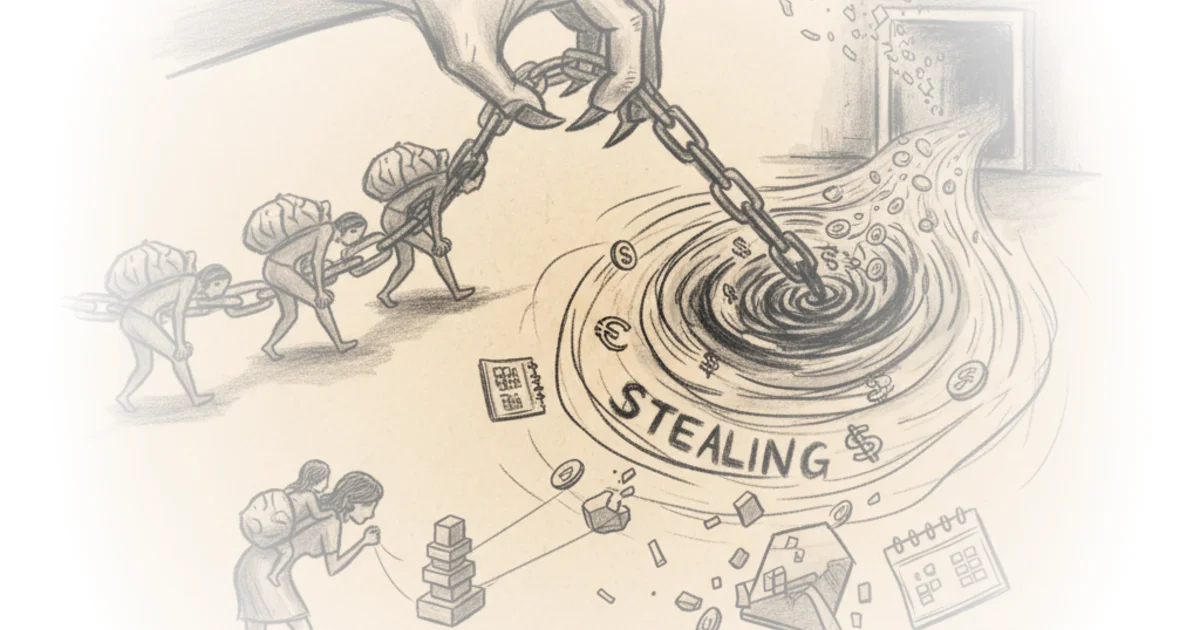
The piece concludes by examining how these companies have secured their position through political maneuvering. More Perfect Union writes, "Meanwhile, the legislation was written by [ __ ] ALEC, the guys that are secretly behind tons of conservative state laws." This revelation connects the dots between corporate lobbying and the erosion of consumer protections. The author argues that these companies are not just exploiting a loophole but actively working to codify it into law, ensuring they won't have to disclose APRs or cap fees. The evidence that the average user takes out 36 advances a year, compared to eight for payday loans, supports the claim that these apps are designed to create chronic dependency.
Once people start using these apps to help pay the bills, they quickly become dependent on them. The average EWA user takes out 36 advances a year.
A counterargument worth considering is that some workers genuinely prefer the flexibility of daily pay, even with fees, over the rigidity of traditional payroll. Yet, the author's evidence suggests that this "preference" is often born of desperation rather than genuine choice, driven by wages that are too low to cover basic living costs.
Bottom Line
More Perfect Union delivers a devastating indictment of the earned wage access industry, successfully reframing a "fintech solution" as a sophisticated, billionaire-backed extraction machine. The piece's greatest strength is its rigorous breakdown of the APR math, which leaves no room for the industry's semantic defenses. However, the argument's biggest vulnerability is the lack of a concrete legislative roadmap for closing the loophole, leaving readers with a clear diagnosis of the problem but a murkier path to the cure. The takeaway is clear: until the legal definition of a loan catches up with economic reality, these apps will continue to drain wealth from the very people they claim to help.