Noah Smith delivers a stinging economic autopsy of the current administration's trade policy, arguing that the administration's plummeting approval ratings stem not from cultural grievances, but from a fundamental violation of a 50-year-old economic theorem. The piece is notable for its refusal to treat the manufacturing slump as a political mystery, instead pinpointing a specific, avoidable error: the taxation of intermediate goods. In an era where economic sentiment often feels decoupled from data, Smith provides the missing link, showing how policy choices are actively shrinking the economic pie before it can be distributed.
The Vibecession Explained
Smith begins by dismantling the assumption that voters are simply irrational or misinformed about their own financial well-being. He points to a stark disconnect between macroeconomic indicators and public sentiment, noting that "Americans are deeply unhappy with their economy" despite employment and growth figures that appear stable on paper. The author argues that this "vibecession" is not a psychological glitch, but a rational reaction to policy. "People must have an intuitive sense that the AI boom is the main thing propping up the macroeconomy right now, and that this could end at any moment," Smith writes, suggesting voters see the fragility of the current recovery.
The evidence Smith marshals is compelling because it isolates the variable causing the pain: tariffs. He highlights that while service jobs remain robust, the goods-producing sectors have collapsed. "Employment in goods-producing industries has plunged since 'Liberation Day'," he notes, referencing the administration's recent tariff announcements. This framing is effective because it shifts the blame from abstract market forces to concrete administrative actions. The data shows that construction and transportation jobs, which were booming under the previous administration, have "basically collapsed" under the current one, directly correlating with the implementation of trade barriers.
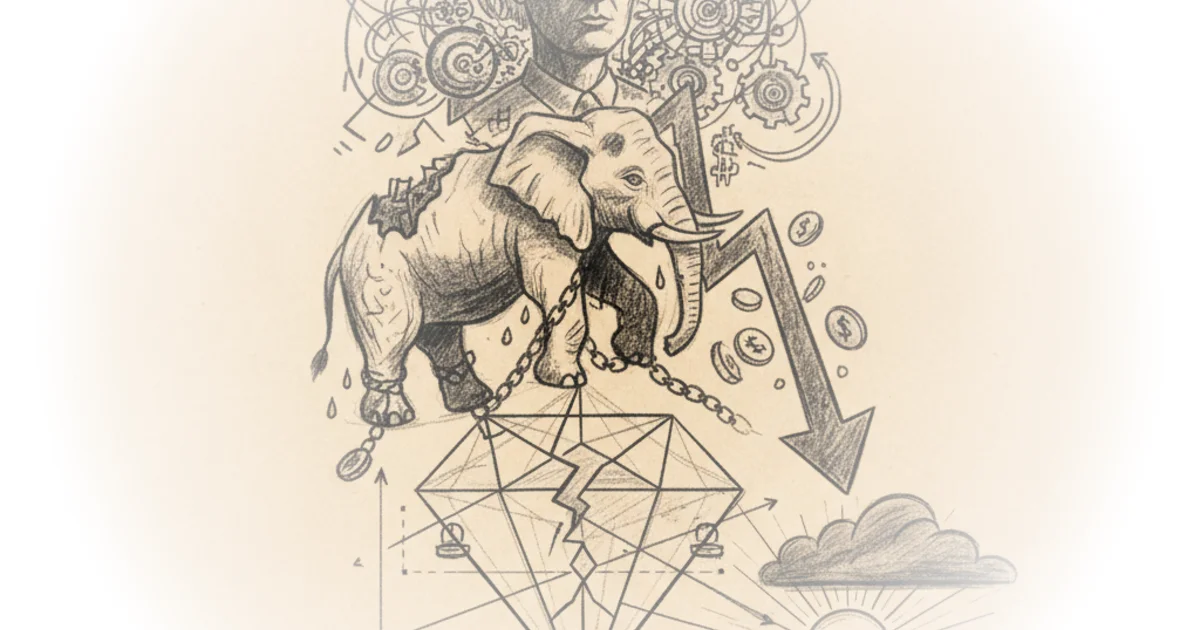
"Trump's tariffs absolutely violate the Diamond-Mirrlees principle."
Critics might argue that the administration is prioritizing long-term strategic autonomy over short-term economic pain, a trade-off Smith acknowledges but ultimately dismisses as poorly executed. The administration's defense often rests on the idea that tariffs are a necessary tool for leverage, yet the immediate data suggests they are acting as a blunt instrument that harms the very industries they aim to protect.
The Theory of the Shrinking Pie
The core of Smith's argument rests on the 1971 paper by Peter Diamond and James Mirrlees, a foundational text in public finance that the administration appears to have ignored. Smith explains that the Diamond-Mirrlees theorem demonstrates that taxing intermediate goods—inputs like steel, auto parts, and computer chips that businesses buy to create final products—is economically destructive. "If the purpose of taxes is to redistribute the economic pie, you want to redistribute as big of a pie as you possibly can," Smith writes. By taxing the ingredients rather than the cake, the administration has ensured there is less cake to go around.
This is not merely theoretical; Smith connects the math to the real-world struggles of American manufacturers. He cites a startup founder who notes that protectionist tariffs have increased local steel prices by 50%, making domestic manufacturing less competitive despite the intent to boost it. "Protectionist tariffs have increased local steel prices by 50%, reducing the advantages of domestic manufacturing," the business owner tells Smith, illustrating the paradox where policies designed to help industry end up strangling it. The administration's approach treats imports as final consumer goods, failing to recognize that nearly half of U.S. imports are intermediate inputs.
Smith contrasts this with the Value-Added Tax (VAT) systems used in Europe, which are designed to avoid taxing business-to-business transactions. "Europe does this much better — their value-added tax (VAT) is basically a sales tax that doesn't get charged on the things businesses buy," he observes. The U.S. system, by contrast, creates a cascade of inefficiencies that the administration seems unaware of. "Because neither Trump nor any of his people understood the basic insight of Diamond-Mirrlees (1971), they are trying to redistribute a pie that they've already shrunk," Smith concludes. This is a devastating critique of the administration's economic literacy, suggesting that the pain is entirely self-inflicted.
"If Trump's people had allowed themselves to understand that fact — if they had listened to the economists — Trump's approval ratings might not be nearly so low as they are."
The Cost of Willful Ignorance
The piece takes a sharp turn toward the political consequences of ignoring expert consensus. Smith notes that the administration prides itself on rejecting the economics profession, with figures like JD Vance declaring that "the economics profession doesn't fully understand tariffs." Smith counters this arrogance with the reality of the data: "And yet this willful ignorance comes with real political costs." The administration's disapproval among its own base is rising precisely because the economic pain is being felt by the very workers they promised to champion.
Smith is careful not to frame this as a personality flaw but as a systemic failure of policy. He warns that the lesson extends beyond the current administration. "The right lesson here isn't that 'Trump is dumb' (though that is probably true). The right lesson here is that although there are lots of things they don't know... economists are worth listening to," he argues. This is a crucial distinction, urging readers to focus on the mechanics of governance rather than the theatrics of leadership. The failure to heed warnings about the "vibecession" under the previous administration serves as a cautionary tale for future Democratic leadership as well.
Bottom Line
Smith's strongest contribution is his ability to translate a complex 1971 economic theorem into a clear explanation for current political turmoil, proving that the administration's trade war is not just a political maneuver but an economic error with measurable human costs. The argument's vulnerability lies in its assumption that the administration could have easily pivoted to a more nuanced approach, given their ideological commitment to protectionism. However, the data on manufacturing contraction and the testimonies of business owners provide a robust foundation for the claim that ignoring the Diamond-Mirrlees principle has shrunk the economy and eroded public trust.