In a literary landscape saturated with shock for shock's sake, The Metropolitan Review poses a devastating question: does the modern obsession with transgression actually illuminate the human condition, or merely replicate our deepest pathologies? David Polonoff's analysis of Timothy Atkinson's new novel, Help Me I Am in Hell, cuts through the noise of contemporary "edgy" fiction to ask whether we are witnessing a genuine artistic breakthrough or just a feedback loop of despair. This is not a standard book review; it is a philosophical autopsy of why we keep reading about people who are falling apart, and whether that reading does any good for anyone.
The Transgressive Trap
The piece opens by dismantling the romanticized notion that breaking taboos is inherently virtuous. Polonoff argues that what was once a radical act has calcified into a mandatory genre convention. "The duly anointed modern writer must begin their work with an invocation of the transgressive muse," he writes, noting that without "shock value, envelope-pushing, norm-busting, taboo-shattering, bourgeois-épatering," the modern canon would be "seriously bereft." This framing is crucial because it shifts the blame from the individual author to the entire ecosystem of modern publishing, suggesting that the "transgressive muse" is no longer a wild force but a corporate requirement.
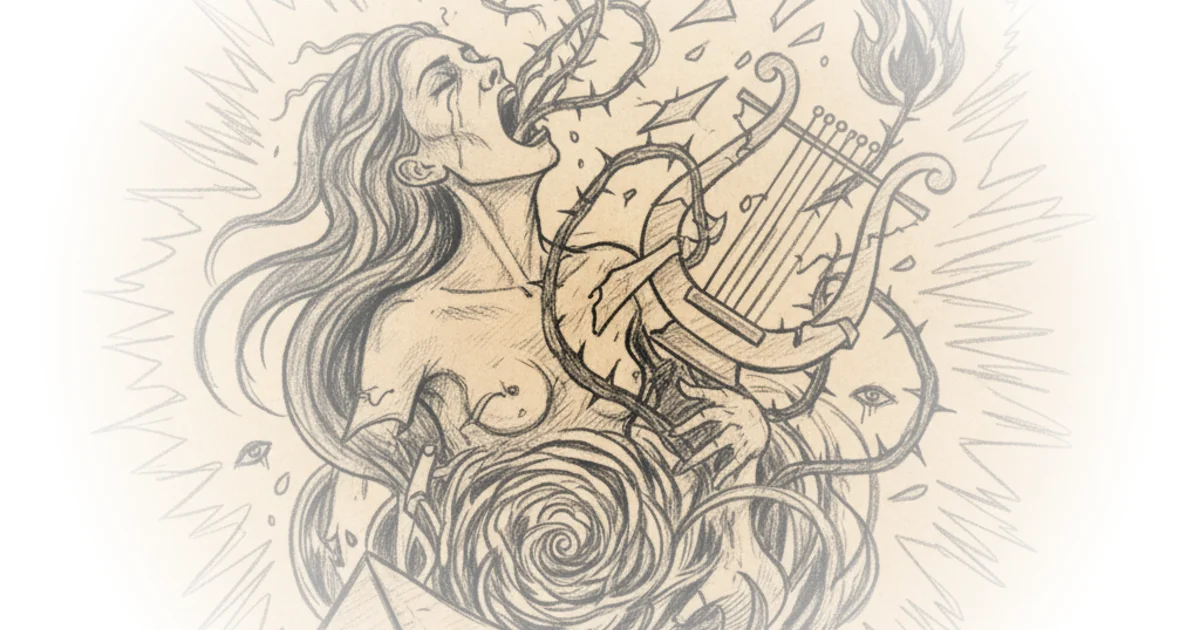
Polonoff traces this lineage from Norman Mailer to Irvine Welsh, showing how the "morality of the bottom" has become the default setting for serious literature. He notes that while Mailer sought to elaborate a morality through "perversion, promiscuity, pimpery, drug addiction, rape, razor-slash, bottle-break," the current iteration often lacks the philosophical weight of its predecessors. The argument holds up well when applied to Atkinson's work, where the protagonist, a hypochondriac meth addict, seems less like a rebel and more like a prisoner of the genre's expectations. Critics might argue that this critique is too harsh on the genre itself, as transgressive fiction has historically given voice to marginalized experiences that polite society ignores. However, Polonoff's point is that the repetition of these tropes has drained them of their power to surprise or enlighten.
The Anatomy of Anomie
At the heart of the review is a deep dive into Atkinson's protagonist, a character Polonoff dubs "Fyodor 2.0" in homage to Dostoevsky's Underground Man. The review highlights a specific historical parallel: just as the Underground Man was paralyzed by his own hyper-consciousness, Atkinson's character is trapped by a "nagging fear of death that causes the pain to manifest." Polonoff writes, "His terror of dying is paralyzing, reaching beyond the inevitability of his own annihilation to the moment several billion years hence when the 'red giant' sun will swallow the Earth, and beyond that, to the eventual heat death of the universe." This escalation from personal hypochondria to cosmic nihilism is the book's central tension.
The commentary suggests that the character's violence and misogyny are not acts of rebellion but symptoms of a profound inability to connect. "The sex that ensues tends toward the repulsive and the depraved, leaving 2.0 angry and ashamed," Polonoff observes. The review effectively argues that the character's descent into "abject depression" is not a cause of his obsession with nothingness, but a result of it. He is not a tragic hero; he is a man who has confused the feeling of being alive with the act of destroying himself. The Metropolitan Review notes that the protagonist's rage is not about sex, but about a desperate, unfulfilled need for love: "What he truly craves is not sex, which he gets plenty of, but someone to love him, to prove he exists and that this existence matters."
"Does the value its expression holds for the tormented individual unburdening themself imbue it with value for us, the readers?"
The Limits of Body Horror
Polonoff is particularly sharp when critiquing the novel's stylistic choices, specifically its reliance on graphic, visceral descriptions. He contrasts Atkinson's approach with that of Charles Baudelaire, whose poem "Carrion" linked the sexual body to decay in a way that "poetically sears the mind rather than assaults it." In contrast, Atkinson's prose is described as a "literary version of the cinematic 'body horror' genre," filled with "foulest language imaginable" and "disgusting descriptors." The review points out that this reductio ad genitalium—where every interaction is reduced to a biological function—feels less transgressive and more like a reflection of a "disenchanted, socially-mediated world whose pervasive pornography has already transgressed our sensibility."
This is a bold claim, suggesting that the book's attempt to shock us with the raw guts of being has already been done by the internet and the porn industry. The review argues that the novel's "operatic fever pitch" and fragmented syntax, while technically impressive, ultimately serve to alienate the reader rather than draw them in. "Too bad so much of it is unquotable," Polonoff writes, noting that the constant coupling of obscenities with grotesque imagery creates a barrier to empathy. The argument here is that true transgression should expand our understanding of humanity, not just make us recoil in disgust. A counterargument worth considering is that the discomfort is the point—that the book is meant to be an unflinching mirror of a specific kind of modern alienation that polite literature refuses to show. But Polonoff insists that without a redeeming quality, the mirror is just a funhouse distortion.
The Unanswered Question
The review concludes by returning to the central dilemma: is the protagonist a diagnosable aberration or an indictment of the human condition? Polonoff notes that Atkinson refuses to answer this, leaving the reader to wonder if the character "wants our help getting out of hell or wants instead to pull us in." The review suggests that the novel's "Sopranos-like cut-to-black ending" is a fitting metaphor for the genre's inability to offer resolution. The Metropolitan Review writes, "Alienation and the anguish of existence do not vanish as a result of their literary expression, even by the great transgressive masterworks we know so well." This is the piece's most haunting insight: that writing about pain does not necessarily heal it, and that reading about it does not necessarily save us.
Bottom Line
The strongest part of this argument is its refusal to accept "transgression" as a default virtue, forcing the reader to question whether the shock value of modern fiction is a sign of artistic courage or a symptom of cultural exhaustion. Its biggest vulnerability is the assumption that literature must always offer a path to redemption, a standard that some might argue is unfair to the chaotic, unresolved nature of real human suffering. Readers should watch for how this critique of the "transgressive muse" influences the next wave of literary fiction, as authors may feel pressured to either double down on the shock or find a new way to be radical.