The Sports Weekend That Became a Culture War Battlefield
Sarah Longwell, Tim Miller, Bill Kristol open with a observation that captures the peculiar fusion of athletics and political theater in contemporary America. What should have been celebratory — Super Bowl LX, the Winter Olympics — became instead another arena where national identity gets contested, where halftime performances and athlete interviews trigger administrative fury and grassroots backlash.
Bad Bunny's Hemispheric Appeal
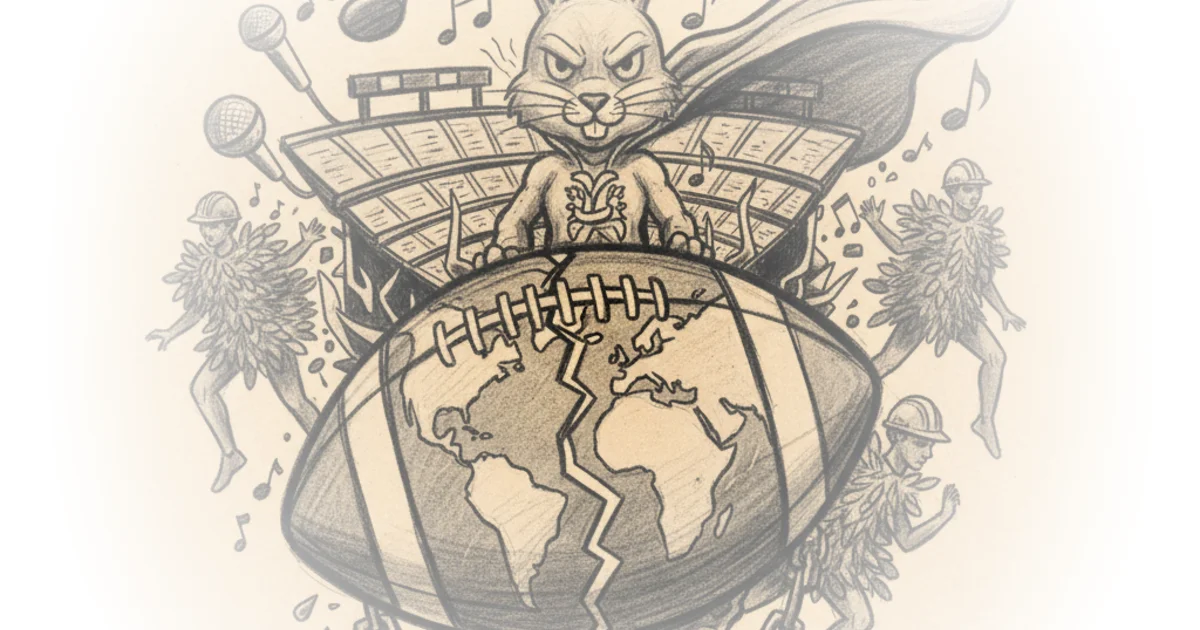
The halftime show featured Ricky Martin and Lady Gaga, dancers dressed as bushes and electrical linemen, and a football inscribed with "Together, We Are America." The authors note the apparent wedding, the flags of every American country, the appeal to hemispheric unity. Not everybody was impressed. Sarah Longwell, Tim Miller, Bill Kristol writes, "The Super Bowl Halftime Show is absolutely terrible, one of the worst, EVER!" The administration's response came swiftly on Truth Social, declaring the performance an affront to American greatness and excellence.
"Patriotism has become the first refuge of scoundrels."
Bill Kristol's contribution reframes the sports disappointment into something sharper. He observes that curling — yes, curling — returned to the Olympics after a seventy-four-year absence, and suggests it might be time for another timeout. But the cultural warfare proved more entertaining than the athletic competition. When Bad Bunny's Spanish-language set triggered administrative denunciation, and when American Olympians distinguished their love of country from support for the administration, the response was predictable. MAGA-types attacked. Samuel Johnson's office remains busy.
The DHS Funding Fight
The authors shift from stadium spectacle to congressional strategy. Senate Democrats are positioned for a fight over Department of Homeland Security funding legislation. Sarah Longwell, Tim Miller, Bill Kristol argues that Democrats should separate out the non-problematic components — Federal Emergency Management Agency, Coast Guard, Secret Service, Transportation Security Administration — and fund them immediately. This would leave only Immigration and Customs Enforcement and Border Patrol unappropriated.
"The less new funding that goes to Immigration and Customs Enforcement and the Border Patrol, the better."
The reasoning is pragmatic rather than symbolic. Last year's reconciliation bill already allocated five billion dollars to ICE and five billion to Customs and Border Protection through 2029. But denying an additional six billion would put a dent in their built-in growth. Sarah Longwell, Tim Miller, Bill Kristol writes, "It will be much harder for the Trump administration to spend money it doesn't have than to evade restrictions it doesn't like." The advice to Democrats is blunt: "Politics in the age of Trump isn't like curling. Don't spend all your time sweeping and maneuvering. Speak out and fight. Be like Bad Bunny."
Critics might note that defunding specific agencies within a cabinet department creates operational chaos that could affect legitimate security functions beyond immigration enforcement. The Coast Guard and Secret Service separation is sound, but the authors' confidence that only ICE and Border Patrol would suffer may underestimate how appropriations battles create collateral damage.
When Investigations Stop at Political Orders
The piece turns darker with the Minneapolis killings. After federal officers killed Renee Good and Alex Pretti, federal law enforcement prevented local authorities from investigating — while insisting they would conduct full investigations themselves. Sarah Longwell, Tim Miller, Bill Kristol reports that FBI agents preparing routine forensic analysis received orders from senior officials to stop. Kash Patel, the FBI director, worried that a civil rights investigation would contradict the president's claim that Good "violently, willfully, and viciously ran over the ICE Officer" who fired at her.
"Law enforcement refusing to investigate a crime scene because it would prove the president is lying about it is the sort of thing that tends to happen in failed and failing states."
The authors note that top Justice Department officials presented alternative approaches: investigate whether the ICE agent had been assaulted, or investigate Good's partner instead. Law enforcement refusing to investigate a crime because it would prove official claims false is the sort of thing that tends to happen in failing states.
Grievance as a Lifestyle Brand
The right-wing grievance industry now sells phone service through Patriot Mobile, coffee through Black Rifle Coffee, gym wear through XX-XY Athletics. The Turning Point USA alternative halftime show featured Kid Rock gyrating and forgetting what song he was supposed to lip-sync to. Lee Brice's debut song "Country Nowadays" distilled the mood: "if I tell my own daughter that little boys ain't little girls / I'd be up the creek in hot water in this cancel-your-ass world."
The Olympic athletes faced similar pressure. Freestyle skier Hunter Hess told reporters, "Just because I'm wearing the flag doesn't mean I represent everything that's going on in the U.S." The response was swift: "U.S. Olympic Skier, Hunter Hess, a real Loser, says he doesn't represent his Country." The authors ask: does anyone know if Kid Rock can ski?
Critics might argue that the authors conflate legitimate cultural anxiety with authoritarian overreach — that some Americans genuinely feel their values are under assault, not merely that they're manufacturing grievance as a lifestyle product. The grievance may be real even if the merchandising is exploitative.
Bottom Line
Sarah Longwell, Tim Miller, Bill Kristol offer a clear verdict: starve the beast, fight like Bad Bunny, and recognize that patriotism has been hijacked by scoundrels. The money matters most. The investigation interference reveals institutional decay. The grievance industry profits from perpetual outrage. The authors' advice to Democrats is simple and uncompromising: deny funding, demand accountability, and stop sweeping when you should be fighting.