Then & Now challenges the comfortable assumption that fascism is merely a trick played by charismatic dictators on gullible crowds. Instead, the author argues that the rise of authoritarianism was fueled by a deep, cultural intoxication with violence that many ordinary people, including veterans of the First World War, actively embraced. This is not a story of mind control, but of a generation that found meaning in the very chaos that destroyed it.
The Spiritualization of Violence
The piece anchors its argument in the life of Ernst Jünger, a German soldier who survived the trenches with fourteen wounds and emerged not as a broken man, but as a writer who celebrated the war. Then & Now writes, "His experience, he said, if he raised it and gave it some kind of meaning." The author uses Jünger's memoir, Storm of Steel, to illustrate a terrifying psychological shift: the transformation of trauma into a source of pride. The text notes that Jünger described the "matter-of-fact joy in danger" and the "chivalrous urge to fight" as a form of spiritual elevation.
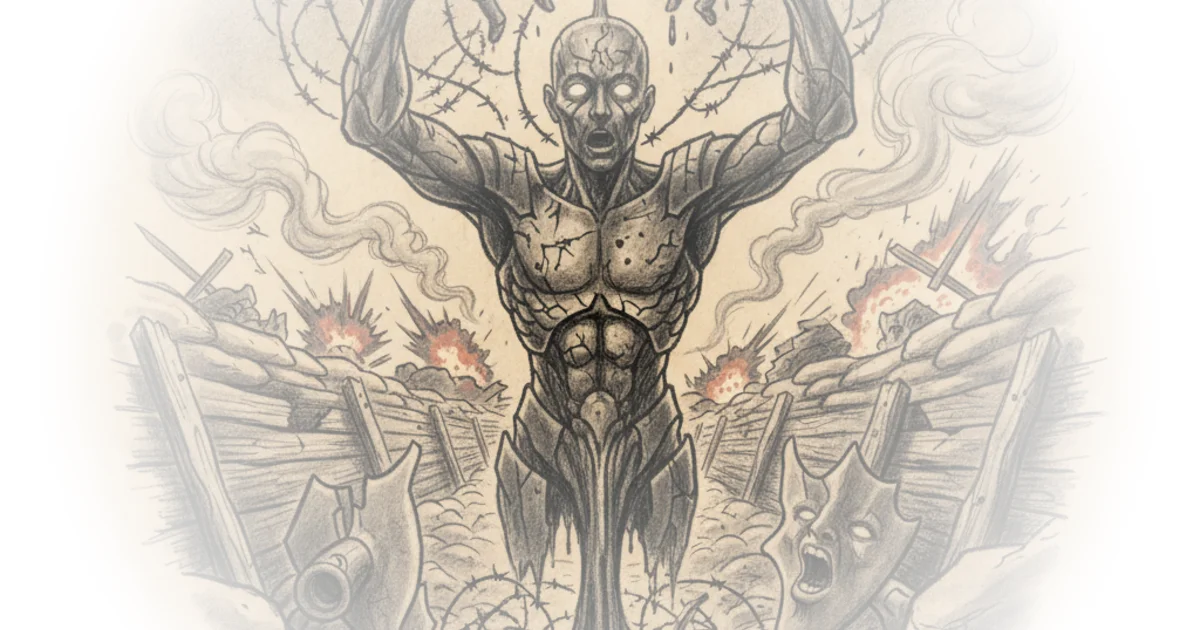
This framing is crucial because it forces the reader to confront a disturbing truth about human nature. The author suggests that we are all capable of this mindset, noting, "We're culturally hooked on war games, war podcasts, movies, and documentaries about war and other types of violence." By linking the modern fascination with conflict to the historical reality of the trenches, Then & Now dismantles the idea that fascists were simply "bad people" or victims of propaganda. Instead, they were people who, like Jünger, believed that "the blood of the great war cannot have flowed for nothing."
The enthusiasm of manliness bursts beyond itself to such an extent that the blood boils as it surges through the veins and glows as it foams through the heart.
Critics might argue that focusing on Jünger, who ultimately rejected the Nazis, risks romanticizing a figure who was deeply flawed and anti-Semitic. However, the author uses this ambiguity precisely to make a point: fascism did not require total ideological purity to take root, only a shared desire for a "soldierly nationalism" that rejected the "lying, divided parliamentary talking shop."
The Revolutionary Conservative
The commentary then pivots to the intellectual roots of this movement, tracing a line from Otto von Bismarck to the revolutionary conservatives of the 1920s. Then & Now describes Bismarck as a "revolutionary conservative, or at least a proto one, a white revolutionary, using the past to strongarm the future." The author argues that while Bismarck represented a traditional, top-down order, the new fascists took this model and injected it with the dynamism of modern technology and mass mobilization.
The piece effectively contrasts Bismarck's elitism with Hitler and Mussolini's innovation: "their innovation was not to just rule, to control, to preside over the masses, but to accept, to shape, to invite them into a movement and to use them." This distinction is vital. It explains how fascism could appeal to the working class and the middle class alike, offering them a sense of purpose in a world that felt increasingly chaotic and unmoored. The author captures the zeitgeist of the era, describing a "new scary, fast-moving, chaotic, migratory, scientific, God is dead world."
The narrative suggests that the fear of "atomization"—being uprooted from family, church, and village—drove people toward the certainty of authoritarian order. As Then & Now puts it, "Chaos and nostalgia together are a dangerous combination." This synthesis of old-world hierarchy and new-world speed created a potent political force that promised to restore dignity through action.
The Myth of the Simple Villain
Ultimately, the author insists that understanding fascism requires a "recalibration" of our own souls. The piece rejects the simplistic view that fascism was an external evil that tricked Europe. Instead, it was an internal response to the perceived decay of liberal democracy and the materialism of the modern age. Then & Now writes, "To understand fascism, this narrative has to turn what you know upside down. It's a story in which enlightenment philosophers are evil, order is sacred, violent struggles are actually inevitable and progressive."
This is the most challenging part of the argument. It asks the reader to empathize, however uncomfortably, with the mindset of the fascist: the belief that violence is a necessary, even progressive, force for history. The author warns against the arrogance of thinking, "You think it's all about being captured by Hitler's spell... This interpretation of how you might become a fascist is wrong." The real danger, the text implies, lies in the boredom and alienation that make the "ecstasy" of violence so appealing.
You're much more likely to be someone who was already tough, expecting of more war, either experienced or know someone who experienced those First World War trenches.
Critics might note that the piece occasionally glosses over the specific economic crises that fueled the rise of fascism, focusing heavily on psychological and cultural factors. While the emotional appeal is undeniable, the material conditions of the Great Depression were also a critical catalyst that the text mentions only in passing.
Bottom Line
Then & Now delivers a powerful, if unsettling, corrective to the standard history of fascism, shifting the focus from propaganda to the human desire for meaning in a violent world. Its greatest strength is the refusal to demonize the fascist as an alien monster, instead presenting them as a mirror to our own capacity for finding purpose in destruction. The argument's vulnerability lies in its heavy reliance on cultural psychology, which risks underestimating the role of economic desperation, but the core insight remains vital: fascism thrives not because people are tricked, but because they are convinced that violence is the only path to transcendence.