The Freedom Question
A Vancouver father lets his children ride public transit alone. A stranger calls it neglect. The Walrus asks whether safety culture has gone too far.
When Statistics Meet Vibes
Adrian Crook knows what danger looks like. A friend died in a car crash during his teenage years. His grandmother was run over by a truck at a crosswalk in 2006. When his first son was born two months after that accident, Crook carried a certainty: if this boy met an early death, it would almost certainly involve a car. Vehicular accidents are, by far, the leading killer of children and teens in Canada.
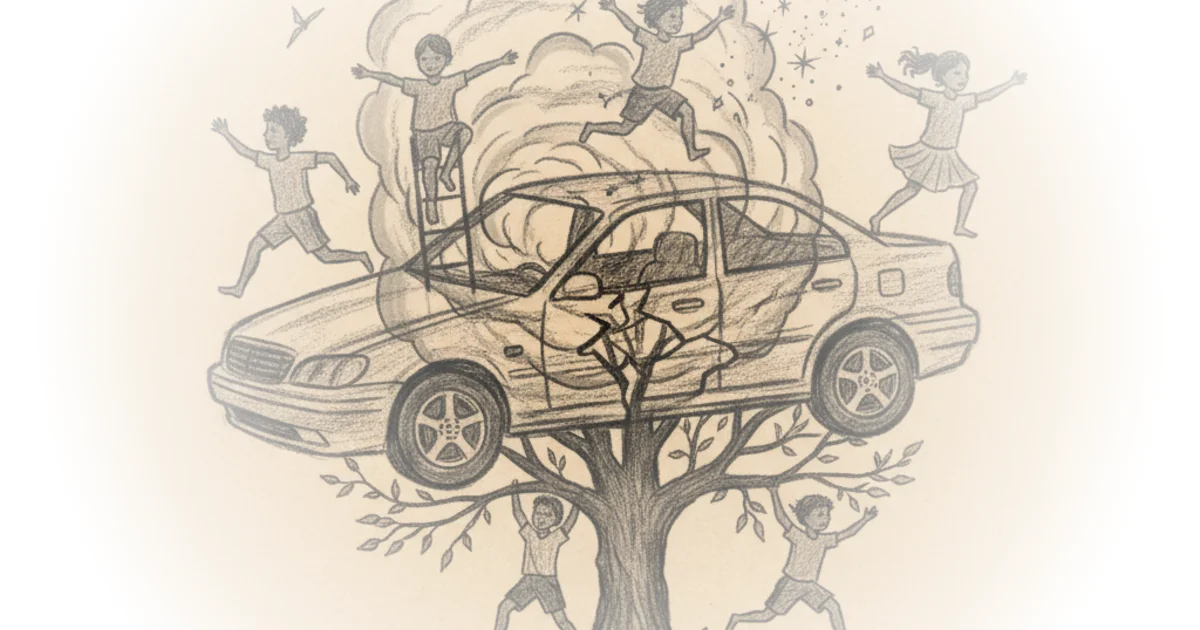
Crook owned a car but avoided driving. He views it as expensive, dirty, and dangerous. To get his four oldest children to school near their mother's home in North Vancouver, he began riding with them on the bus—a forty-five-minute haul across two routes from his downtown condo. The trip took a three-hour bite out of his day. His kids, aged six to ten, were consummate transit users. They knew the routes blindfolded. They travelled in a pack with cellphones tracking their movements.
In early 2017, Crook decided to opt out. He gave his kids transit safety lessons, did trial runs with him sitting silently at the back of the bus, then let them do the trip alone. They returned from school triumphant. "Kids feel empowered when they get to navigate the world," Crook says.
His victory was short lived. A social worker from BC's Ministry of Children and Family Development called. Somebody had spotted his kids on the bus and notified the department. The ministry's view: children under ten should be watched by someone at least twelve years old.
Crook appealed to data. He cited a 2013 study showing bus passengers are the safest travellers on the road. A 2018 study of Montreal bus routes found the risk of injury for car occupants was nearly four times higher than for bus passengers. Riding a bus is far safer than travelling by car. The ministry, Crook argued, was asking him to increase his children's risk exposure in the name of safety.
The conversations went nowhere. "When Crook spoke statistics, the social workers spoke vibes." Didn't he just know his kids were too young to be left alone? In desperation, Crook asked: Had he done anything illegal? A social worker explained that questions of legality weren't the only issues at stake. The ministry was enforcing a guideline, not an actual law—but in practice, that distinction seemed to make little difference. To Crook, the message was clear: "We don't necessarily think you're a criminal. But we still might think you're a lousy dad."
"When Crook spoke statistics, the social workers spoke vibes."
The Playground Has Changed
The Walrus turns personal. As an elementary school kid in the '90s, the author lived much of his life away from the gaze of hovering parents. He and his best friend would walk to and from school together. On weekends, they'd bike around their suburban Toronto neighbourhood. They'd search for abandoned properties to explore. In his friend's basement, they'd grind charcoal, mix it with sulphur and potassium nitrate to make gunpowder, stuff it into homemade fireworks. Their world felt rich and mysterious. They saw themselves as swashbuckling adventurers, not the prepubescent rugrats they so clearly were.
As the world has come to seem scarier, the tech industry has found ingenious ways to draw kids indoors. iPad games micro-targeted to every age level. YouTube channels with unlimited slop. Offline spaces where kids once congregated have emptied out. Jean M. Twenge, a leading US psychologist studying generational change, catalogues the differences: "While 10-year-olds once had the free range of their neighborhoods, many kids these days are not allowed to go anywhere by themselves." She adds, "While 13 was once considered old enough to be a babysitter, many now think 13-year-olds need a babysitter."
In the residential Ottawa neighbourhood where The Walrus now lives, kids rarely play pick-up sports or roam the streets in packs. The adventure playgrounds of the '70s—with their hammers, nails, and planks of wood—have been replaced by prefabricated climbing structures with catalogue-ordered parts. Notices tell parents to supervise their children's play. The parents obey, following a foot behind their kids and issuing instructions in that cloying voice adults use for babies and animals.
The Judgment
The Walrus has a toddler. Together, they constantly search out new spaces to explore—ravines, splash pads, brew pubs with big outdoor patios. He lets her wander as far as she wants, so long as she doesn't go near roads or escape his peripheral vision. Frequently, they travel to Toronto by train. He refuses to anesthetize her with a screen. Instead, she runs up and down the aisles, climbs into baggage compartments, has imaginary tea parties with stuffed animals on vacant seats.
His hands-off approach gets mixed reactions. Some praise him. Some are fascinated by his toddler, who strides through public spaces, arms swinging confidently. Others are appalled.
In the fall of 2024, his daughter fell from a climbing structure. He was reading on a nearby bench and didn't realize the crying was coming from her. After about thirty seconds, he looked up, saw what had happened, came running. His daughter calmed down in his arms, but another parent at the park was furious. She told him to take his daughter to the ER and request a cognitive assessment for brain injury. He ventured that the accident had been minor—the ledge was a mere foot and a half above the ground. The woman said he was in no position to judge the fall since he hadn't actually seen it. "We have different parenting styles," he offered, trying to defuse her anger. "This isn't about parenting styles," she shot back. "This is about neglect."
Like many journalists, The Walrus has a thick skin, but this stranger's words destroyed him. For a week, he walked around in a funk, wondering if she'd seen something in him that he'd failed to see in himself. In the future, when he ran into her at the park, he stood close to his daughter, performing attentiveness. He feared another blow-up or a call from child services.
What the Science Says
If The Walrus could detach from emotions and focus on data, he'd probably feel less internally conflicted. The science has his back. Today, across the world, researchers in education, pediatric health, and developmental psychology are making the strongest case yet for childhood independence and risk.
Research reveals that children allowed to wander alone play longer, burn more energy, and build richer social lives than sedentary, house-bound peers. Researchers at the University of Bristol found that ten- and eleven-year-olds trusted with wider roaming rights were vastly more active, especially on school days, than those kept close to home. Shrinking freedom, it seems, helps explain shrinking fitness.
In 2010, researchers in Sydney outfitted playgrounds at twelve local schools with car tires, milk crates, and weighted boxes. These objects created mild dangers—they could be dropped, thrown, or stacked into rickety climbing structures—but they also got students moving. Physical activity levels increased by 12 percent.
The benefits go beyond friendship and exercise. One might view childhood as a kind of rehearsal for adulthood. By this reasoning, when adults intervene unnecessarily in children's lives—supervising their play, mediating their disputes—they effectively call the rehearsal off, increasing the odds that things will go poorly later on. Even the school playground may be a site where adult life skills are formed. In a forthcoming study, Mariana Brussoni, a health scientist at the University of British Columbia, found that kids more prone to engage in risky scenarios were better at navigating a virtual-reality road-crossing game than their peers. They made faster decisions about when to cross, with fewer near accidents. Low-stakes risk taking on the playground, Brussoni theorizes, may help build up the instincts and intuitions needed to avoid serious injury throughout our lives.
Childhood isn't only about skills acquisition. It's about developing cognitive capacity and mental resilience too. A study out of the University of Colorado Boulder and the University of Denver shows that children who engage in unstructured activities tend to have better executive functioning—a suite of cognitive skills that includes planning, self-control, and flexibility—relative to children whose time is regimented and monitored. Good executive functioning contributes positively to a variety of life outcomes, from higher earning potential to greater longevity.
Critics might note that research on free-range parenting often comes from privileged contexts where neighborhoods are safe and parents have flexibility. The Vancouver transit system Crook relied on is among the most developed in North America. TransLink's network, with its frequent service and safety features, enables independence that wouldn't be possible in car-dependent cities. Road safety infrastructure in British Columbia—protected bike lanes, pedestrian-priority crossings, lower speed limits in school zones—creates conditions where independent mobility is genuinely viable. In places without these investments, "free-range" parenting may not be a realistic option.
Critics might also argue that the social costs of free-range parenting are not merely busybody interference. When other parents see a child alone, they may genuinely worry. The judgment Crook faced—and The Walrus faced—is not always malicious. It reflects a cultural consensus that children should be supervised, and that consensus has enforcement mechanisms beyond law.
Critics might further note that the research on independent play, while compelling, does not address all risks. The benefits of executive functioning and physical activity are real. But parents also weigh rare but catastrophic outcomes. Data may show buses are safer than cars. Yet a single incident—on a bus, on a playground, on a train—can undo a family.
Bottom Line
The Walrus makes a case that safety culture has overcorrected. Children need room to wander, to risk, to build the instincts adulthood requires. Adrian Crook's children knew their bus routes blindfolded. They travelled in a pack. They returned from school triumphant. The ministry asked Crook to increase their risk exposure in the name of safety. Statistics backed Crook. Vibes backed the ministry. The science is clear: independent play builds cognitive capacity, physical fitness, and social resilience. The social cost is real: judgment, investigation, the word "neglect." Parents who choose freedom must carry both.