In an era where political discourse is often reduced to blaming specific ideologies for societal decay, Stephen West of Philosophize This! offers a startling pivot: the root of our modern malaise isn't a recent political figure or a specific party platform, but a two-thousand-year-old philosophical error initiated by Socrates. This piece is notable not for its biography of Friedrich Nietzsche, but for its radical reframing of Western history as a long, spiraling decline caused by the rejection of human chaos in favor of an impossible rational order.
The Socratic Error
West begins by dismantling the common assumption that Nietzsche's primary target was Christianity. While the "God is dead" proclamation is famous, West argues that Nietzsche held a surprising degree of respect for the historical figure of Jesus, viewing him as a victim of institutionalization rather than a villain. The true antagonist in Nietzsche's narrative, according to West, is Socrates. "Nietzsche seems to have a considerable level of respect for Jesus as a historical figure... but as it turns out, not very much for your boy Socrates." This distinction is crucial; it shifts the blame from religious dogma to the very structure of Western rationalism.
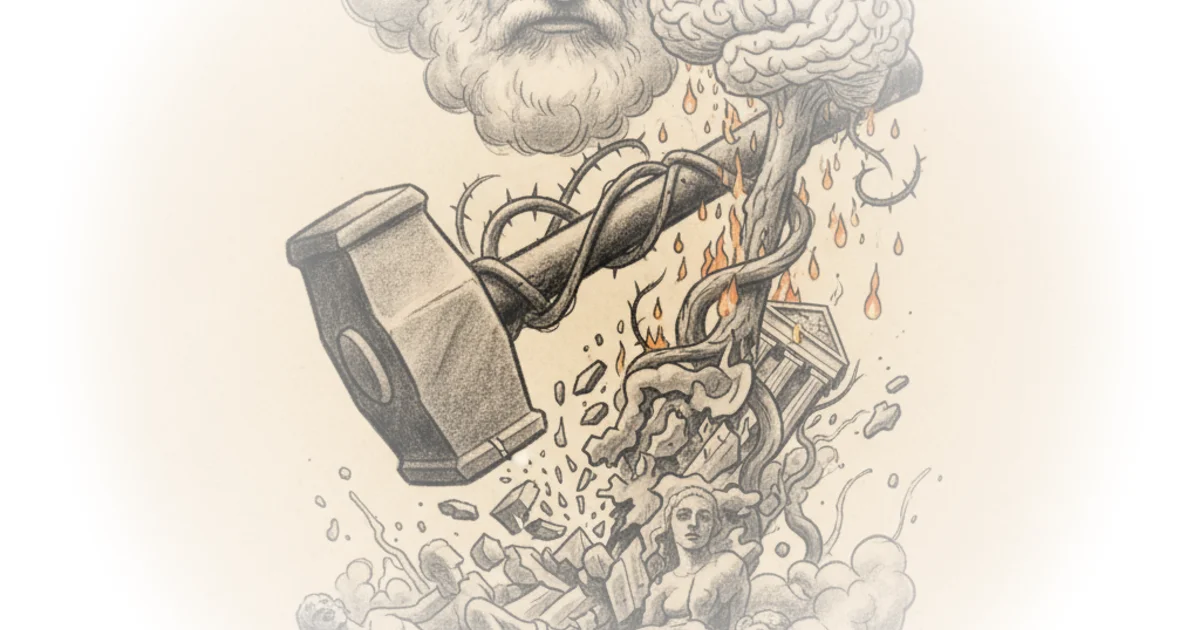
The core of West's argument rests on Nietzsche's concept of the tension between the Dionysian and the Apollonian. In The Birth of Tragedy, Nietzsche posits that a full human life requires both the chaotic, passionate energy of Dionysus and the ordered, rational harmony of Apollo. West explains that Socrates' fatal mistake was attempting to excise the Dionysian entirely. "The first mistake of Socrates, in the eyes of Nietzsche, is going to be removing the Dionysus side of this — the passionate, chaotic energy — and then steering western thought completely into the Apollo side of existence." This is a compelling critique of modern policy-making, which often tries to engineer social outcomes through pure logic, ignoring the volatile, emotional realities of the people involved.
Critics might argue that this binary oversimplifies the complexity of Socratic thought, which also valued the examined life and ethical rigor. However, West's framing effectively highlights a specific blind spot in modern governance: the belief that if we just reason our way through a problem, the solution will be obvious and universally accepted.
The Illusion of the "True World"
West then tackles the metaphysical dualism that Socrates popularized, which Nietzsche termed the Hinterwelt or "other world." This is the idea that the world we experience is merely a shadow of a perfect, ideal reality. "This true world theory is, I think, how I put it years ago when I talked about Nietzsche... the concept that we have this world that we live in. This world is but an earthly shadow. And then there's the ideal world, the world of forms." West traces how this logic migrated from Plato's Forms to Christian Heaven, and even to Kant's distinction between the phenomenal and noumenal worlds.
The danger of this dualism, as West articulates, is that it renders the actual world we inhabit as inherently flawed and unworthy of our full attention. It creates a mindset of renunciation rather than affirmation. "The basic idea is: look, this world sucks, and this other world is where things really matter. So where should our focus be going? Obviously on this other world." This historical analysis provides a powerful lens for understanding why modern institutions often struggle to address immediate, tangible suffering; they are frequently obsessed with abstract, idealized futures or theoretical purity rather than the messy reality of the present.
This idea that we're going to have more quality conversations with each other about morality and political realities, and that those conversations are going to make the world a better place — that delusion, he thinks, is the evidence of a decay that's gone on in people's thinking.
The Myth of Moral Progress
Perhaps the most provocative claim West presents is the rejection of the linear narrative of moral progress. Nietzsche, through West's voice, argues that history is not a straight line toward a better society, but a "spiroid"—a spiral moving between abundance and scarcity, strength and weakness. "Human history is not linear to Nietzsche. It is cyclical. Or more accurately as a metaphor: history to him was like a spiroid." This directly challenges the modern executive branch's tendency to view policy as a cumulative march toward a utopia.
West connects this to the Socratic belief that "all evil is born of ignorance," implying that if people just reasoned correctly, they would be virtuous. Nietzsche sees this as a dangerous delusion. "To talk about morality at the level of the universe, to Nietzsche, is beyond ridiculous." Instead, Nietzsche suggests that what philosophers call "truth" is often just a mask for the "will to power." "When a philosopher arrives at a fully devised system of philosophy, a worldview, the contents of it say much more about the individual bias, drives, and personality traits of the philosopher than it says anything about the truth of the universe."
This is a sobering reminder for busy leaders who rely on ideological frameworks to justify policy. It suggests that the "moral conversations" we hold in the public square may be less about discovering objective truth and more about asserting power dynamics. A counterargument worth considering is that while moral progress may not be linear, the expansion of rights and reduction of suffering in the last few centuries suggests some form of genuine improvement that Nietzsche's cyclical view might underestimate.
Bottom Line
Philosophize This! delivers a rigorous and unsettling critique of the rationalist foundations of modern Western thought, arguing that our obsession with order and abstract morality blinds us to the chaotic reality of human existence. The piece's greatest strength is its ability to trace current political frustrations back to a specific, ancient philosophical pivot, offering a deeper context than typical punditry. However, its greatest vulnerability lies in its potential to induce fatalism; if history is merely a spiral and morality a construct of power, the path to effective governance becomes significantly more ambiguous. Readers should watch for how this perspective influences their own approach to policy: are we trying to solve problems, or are we just performing a ritual of rationality that denies the world as it is?