When a Billionaire's Newspaper Becomes Disposable
Matt Stoller's piece cuts through the mythology surrounding Jeff Bezos's ownership of the Washington Post. What began as a celebrated rescue mission in 2013 has become a cautionary tale about oligarchy and institutional decay. The paper that once championed "Democracy Dies in Darkness" now faces layoffs that gut its core reporting capacity.
The Sanders Warning
In 2019, Bernie Sanders raised an uncomfortable question about media ownership and political coverage. Matt Stoller writes, "I talk about that all of the time. And then I wonder why The Washington Post — which is owned by Jeff Bezos, who owns Amazon — doesn't write particularly good articles about me. I don't know why. But I guess maybe there's a connection."
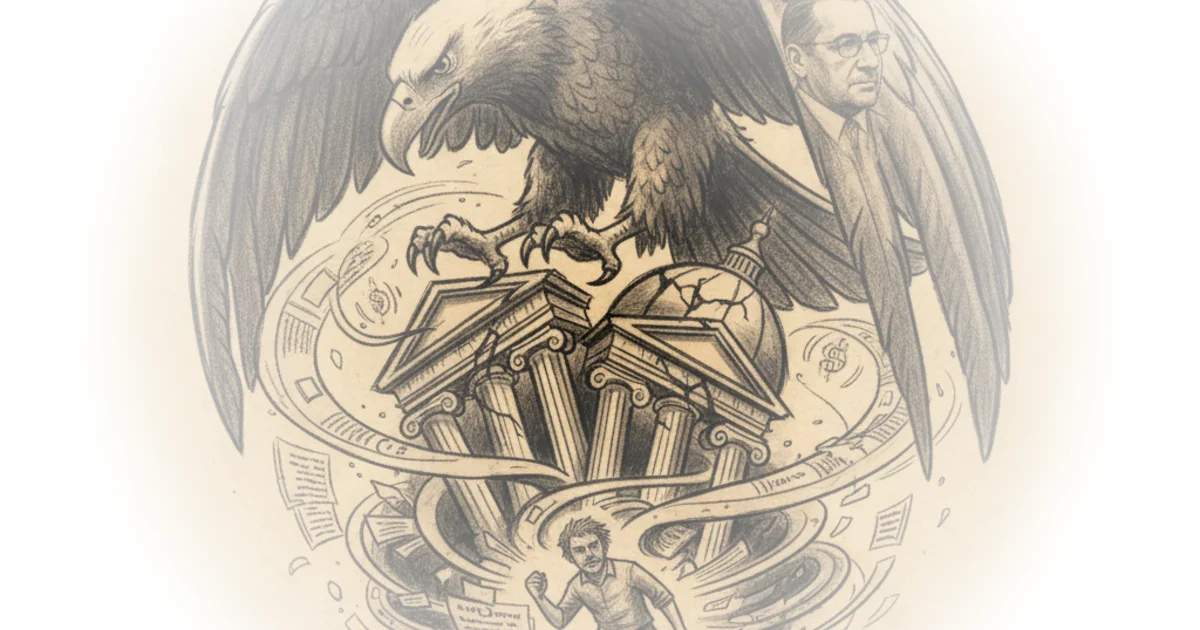
The reaction from Washington's elite was swift and dismissive. As Matt Stoller puts it, the executive editor Marty Baron responded by calling Sanders a conspiracy theorist, asserting that "Jeff Bezos allows our newsroom to operate with full independence."
Critics might note that Baron's defense assumed benevolent intentions from a billionaire purchaser — an assumption that six years later looks increasingly fragile.
"Those 200,000 subscribers are clearly willing to pay for news, they are just not willing to pay for news delivered in an untrustworthy manner."
The Bloodbath
The layoffs announced yesterday tell a different story. Matt Stoller writes, "It's an absolute bloodbath," said one employee. Three hundred reporters out of eight hundred are being eliminated. The Middle East team, war correspondents, the entire sports department, and the West coast office covering big tech — all gone.
Importantly, the reporter tracking Amazon was fired.
The stated rationale centers on financial pressure. Matt Stoller notes that management explained The Post was "too rooted in a different era, when we were a dominant, local print product" and that online search traffic had fallen by nearly half in three years due partly to generative AI.
But the numbers suggest other choices were available. The Washington Post still draws 40 million monthly visitors. Before Bezos intervened in 2024 to prevent an endorsement of Kamala Harris, the paper had roughly 2.5 million subscribers. That intervention triggered 200,000 cancellations.
Matt Stoller writes, "Most observers don't think the layoffs are some sort of inevitable choice, but a discrete decision to destroy the paper."
The reaction from Washington's establishment has turned hostile. The Atlantic called these layoffs "The Murder of the Washington Post." The New Yorker titled their article "How Jeff Bezos Brought Down the Washington Post." Even Marty Baron, now retired, called it "one of the darkest days" in the history of one of the world's greatest news organizations and attacked Bezos for being "gutless."
Critics might argue that newspaper decline is an industry-wide phenomenon, not unique to Bezos's ownership. Since 2005, newspaper employment has dropped 75 percent, and a third of U.S. counties have no daily newspaper.
The Antitrust Shield
Matt Stoller offers a darker interpretation of Bezos's original 2013 purchase. At the time, Amazon faced growing scrutiny from regulators and media over its consolidation of the book industry and sales tax advantages. The acquisition looks, retrospectively, like part of a campaign to curry favor with political and media elites in Washington.
Matt Stoller writes, "the purchase of the Washington Post in retrospective appears like part of a campaign to curry favor with political and media elites in D.C. in order to get government contracts, protect Amazon's business, ward off scrutiny, and manipulate politics."
That strategy worked for years. But when the FTC sued Amazon for monopolization in September 2023, the Washington Post's utility diminished. The political value disappeared.
Google's Monopoly
The second factor is financial. Matt Stoller explains that the Washington Post is being pillaged by Google's illegal adtech monopoly. Many media outlets — Vox, The Atlantic, Business Insider, McClatchy Media Co., Slate, and Advance Publications — are suing Google over this situation.
The Washington Post, owned by a foe of antitrust law, is not.
Matt Stoller writes, "Google has been systematically monopolizing the technology and process for selling advertising on the open web, exactly the kind of ads the Post sells." Google controls ad revenue and distribution, diverting money from publishers to its own properties.
Critics might note that Bezos's refusal to sue Google while Amazon faces its own antitrust litigation suggests conflicting interests between the publisher and its owner.
Bottom Line
Jeff Bezos bought the Washington Post to protect Amazon from scrutiny. When that protection failed and the political climate shifted, he discarded the asset. The real story isn't about journalism's inevitable decline — it's about how oligarchs weaponize media institutions and then abandon them when they're no useful. Democracy doesn't die in darkness. It dies in the light, while everyone watches.