Duncan Stuart delivers a startling thesis: the modern city was never meant to be understood through order, but only through chaos. While most histories of urbanization focus on demographics or infrastructure, Stuart argues that the true breakthrough in capturing the metropolis came when writers abandoned the attempt to make sense of it. By juxtaposing the rigid, gothic horror of 19th-century poetry with the fragmented, cinematic prose of the 1920s, Stuart reveals that the city's essence lies in its inability to be contained by a single narrative.
The Gothic Hangover
Stuart begins by establishing the historical weight of urban anxiety. He notes that as the Industrial Revolution forced millions into dense centers, the city became a source of dread. He points to the Berlin Conference of 1884, where imperial powers carved up Africa, as a backdrop to this era of expansion and centralization. Friedrich Engels had already described London's "colossal centralisation" by 1844, but it was the sheer scale of growth that terrified the literary imagination. Between 1880 and 1900, the United States saw an urban population boom of 15 million people. By 1925, over 75% of the United Kingdom lived in cities.
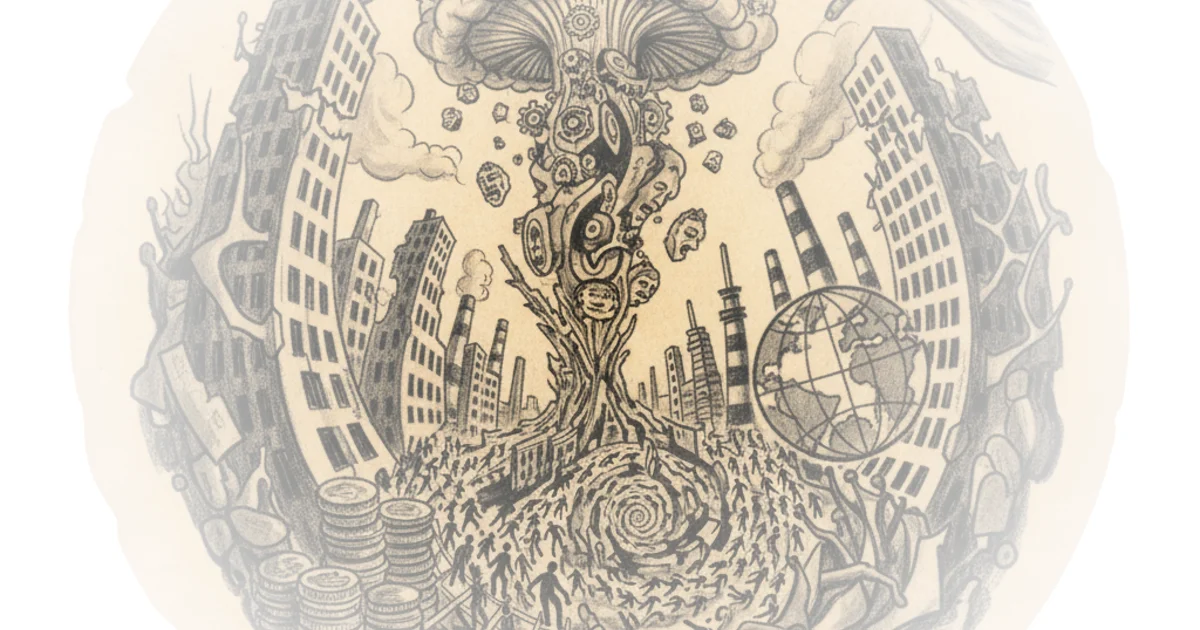
Stuart writes, "It is around 1900, indeed 1903 to be exact, that the growth of these cities begins to become an active problem for us." This specific dating anchors his argument: the moment the city became a problem was the moment it became a subject for art. He contrasts the pessimistic view of Georg Simmel, who saw the metropolis as an "alienating, unnatural nightmare," with the early optimism of Robert Walser. Walser's 1908 story "In The Electric Tram" captures a fleeting joy: "Riding the 'electric' is an inexpensive pleasure. When the car arrives, you climb aboard, possibly after first politely ceding the right of way to an imposing gentlewoman, and then the car continues on. At once you notice that you have a rather musical disposition."
However, Stuart argues this charm was short-lived. By 1916, Walser's tone darkened, reflecting a city that had become sinister. The author notes that this shift mirrors a broader literary trend where poets like James Thomson and Émile Verhaeren depicted the city as a place of death. Thomson's "The City of Dreadful Night" presents a vision where "The City is of Night; perchance of Death." Stuart observes that these poets were meticulous, constructing carefully metered verses that ultimately failed to capture the city's true nature. They were trapped by a "Romantic hangover," trying to impose order on a force defined by disorder.
"Thomson and Verhaeren present powerfully the image of the city, but they fail to capture its immensity, its chaos, its full splendor."
Critics might argue that the gothic register was not a failure but a necessary moral critique of industrial capitalism, a warning rather than a descriptive attempt. Stuart acknowledges the power of their imagery but insists it remains "incomplete" as a document of urban life because it lacks the vibrancy of the living city.
The Breakthrough of Fragmentation
The piece pivots to 1922, a year Stuart identifies as the turning point where literature finally caught up with the metropolis. He highlights James Joyce's Ulysses and Mário de Andrade's Hallucinated City as the first works to successfully render the city's immensity. Unlike the poets who sought a single, unified image, these authors embraced chaos. Stuart explains that Joyce, writing in exile, reconstructed Dublin not through clarity, but through a "chaotic, stream of consciousness character."
The author writes, "The immensity and sheer vibrancy of city life are best conveyed by a lack of order and meticulousness." This is a crucial distinction. Stuart argues that the city's reality is found in the "messier, harder to follow chapters," such as the "Lestrygonians" episode in Ulysses, where overlapping conversations and inner dialogues create a sense of overwhelming presence. Similarly, Andrade's Hallucinated City abandons rhyme for "impressionism and juxtaposition." Andrade describes São Paulo as "the great mouth with a thousand teeth; and amidst the trifid tongue the torrents / Of pus and more pus of distinction."
Stuart's analysis here is sharp: he notes that the jarring transition from a "mouth" to "monkeys" is not a logical error but a deliberate artistic choice to capture the "contingency of the city." The city is defined by "so many things happening at once for no particular reason." This approach rejects the "dead" cities of Thomson and Verhaeren in favor of a living, breathing, and often terrifying reality.
"What unites these images is their location. This is Andrade's insight into the question of how to write the city, that what must be captured is the immensity and the contingency of the city."
The Symphony and the Montage
Stuart extends his argument to the novel form, examining how writers attempted to scale their work to match the city's magnitude. He discusses Thomas Mann's The Magic Mountain, noting that Mann conceived the book as a "grand symphony or opera" to achieve a sense of grandiosity. Mann's structural ambition was to blend mediums, using the organization of music to structure the narrative of a sanatorium that still felt the "specter of urbanization."
However, Stuart identifies John Dos Passos' Manhattan Transfer as the true successor to the city's chaotic spirit. Dos Passos turned to cinema, specifically the technique of montage, to solve the problem of scale. Stuart quotes Dos Passos directly: "The artist must record the fleeting world the way a motion picture film recorded it." Inspired by D.W. Griffith, Dos Passos realized that a series of brief, interlocked images could convey the magnitude of New York better than a single, continuous narrative.
The author describes the book's cast as immense and often disconnected: "The fates of these characters diverge and intertwine and some never meet." Some die in despair, others rise to wealth, and some simply vanish. Stuart highlights the book's opening, which combines claustrophobia and immensity as a ferry crashes into Manhattan, disembarking passengers who "press through the manure smelling wooden tunnel." This imagery, Stuart suggests, is the ultimate realization of the modern city: a place of collision, noise, and relentless movement that defies simple categorization.
"Passos ventured that a series of brief interlocked images, shifting quickly from moment to moment, might be a better way to convey the magnitude of life in New York."
Critics might note that the cinematic montage risks reducing human experience to mere visual spectacle, stripping away the interiority that Simmel and others feared was lost in the crowd. Yet, Stuart's argument holds that this fragmentation is the only honest way to depict a world where millions of lives intersect without ever truly connecting.
Bottom Line
Duncan Stuart's most compelling contribution is his assertion that the city cannot be written about with the tools of order; it demands a literature of fragmentation and collision. The piece's greatest strength lies in its ability to trace a clear lineage from the gothic failures of the 19th century to the modernist breakthroughs of the 1920s, proving that the form of the art must match the chaos of the subject. The argument's vulnerability is its near-total focus on the aesthetic, potentially underplaying the material suffering and systemic inequality that drove the urbanization process in the first place. Readers should watch for how contemporary urban writers are now grappling with the digital city, which may require yet another new form to capture its unique, invisible immensity.