Matt Stoller delivers a striking revelation that cuts through modern political noise: the most valuable technology on earth runs on a model of public ownership that critics claim would destroy the economy. He argues that the Global Positioning System, a $2 billion annual government expense that underpins trillions in private wealth, is the ultimate proof that state-run infrastructure can be more efficient than private enterprise. For busy readers navigating a world of rising costs and corporate consolidation, this piece offers a crucial historical lens to separate fact from the fear-mongering surrounding public goods.
The Invisible Backbone
Stoller begins by dismantling the myth that the free market invented our digital reality. He points out that "Google Maps is basically just a skin and database running on top of GPS," a system maintained by the state for free. The author highlights the sheer scale of this public utility, noting that "6 billion GPS-enabled devices worldwide" rely on a network that costs Americans just "$6 per year" to maintain. This framing is effective because it forces the reader to confront the absurdity of the current political debate: we accept the government as the silent partner in every smartphone and shipping container, yet we treat any new public initiative with suspicion.
"If Elon Musk ran the GPS system, you'd hear about it nonstop, valorizing this great man who built something so remarkable and valuable. But since it's government invented, owned, and operated, it just works, quietly and without fanfare."
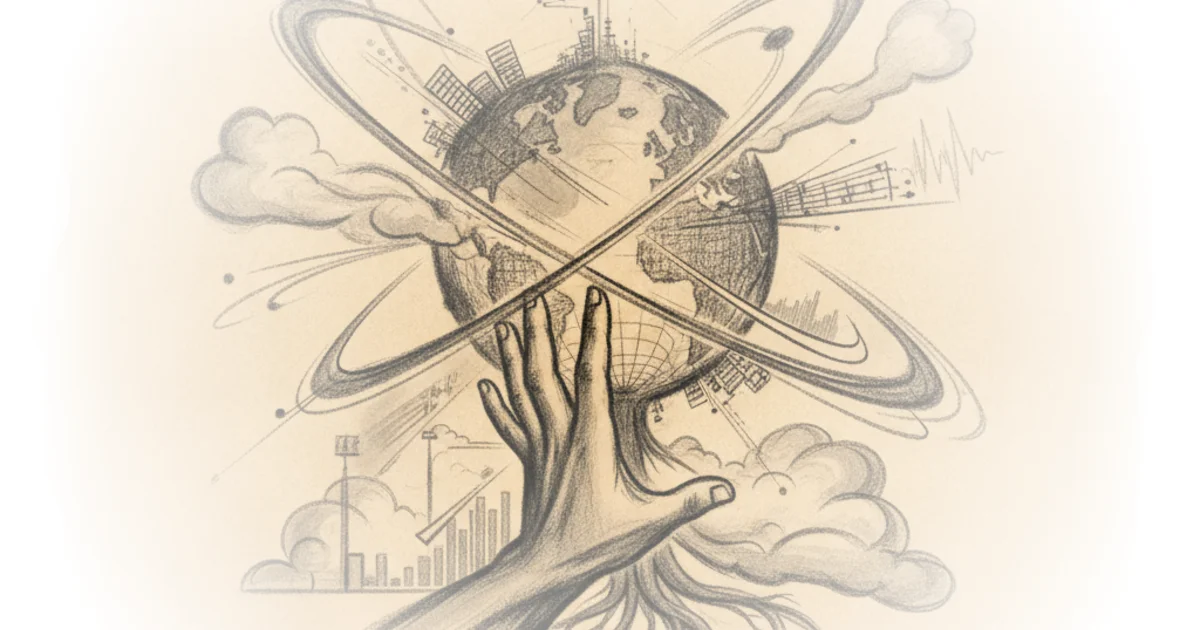
This observation lands hard. It suggests that our ideological aversion to public ownership is performative, rooted in a desire to attribute success to individual genius rather than collective investment. Stoller argues that the silence around GPS success is a function of ideology, specifically the refusal to acknowledge that the state can build things that work better than corporations. He notes that while the system is a "lighthouse in the sky," the political right has recently pivoted to buying stakes in private firms like Intel and MP Materials, while the left proposes sovereign wealth funds for AI giants. Both sides are engaging in public ownership, but only one faces the label of "totalitarian Communist takeover."
The Selective Outrage
The commentary shifts to the hypocrisy of the current political moment. Stoller contrasts the muted reaction to federal interventions in high-tech manufacturing with the "feral" backlash against New York City Mayor Zohran Mamdani's plan to open subsidized grocery stores. He writes that the reaction to Mamdani's proposal was "sort of feral," with critics alleging a slide into totalitarianism. Stoller finds this response illogical, given that the U.S. government has long managed critical infrastructure, from the Post Office to the Federal Reserve.
He draws a parallel to the historical development of navigation, reminding us that "Boston Light, the first lighthouse on the east coast, was built by the Massachusetts colony in 1715, paid for by a tax on shipping." This historical context is vital; it grounds the argument in centuries of precedent rather than abstract theory. Stoller argues that the government's role in navigation is so entrenched that no one calls highway signs "socialism," yet a city-run grocery store is treated as an existential threat.
"To speak of a banking system or economy without state enterprises, in fact, makes no sense."
This is the piece's most provocative claim. Stoller suggests that the entire economy is a hybrid of public and private, and the debate is not about whether the state should exist in the market, but how transparently it operates. He notes that the GPS system avoided political controversy because it was "content neutral," offering the same signal to everyone without political favoritism. In contrast, Mamdani's stores face criticism because they explicitly target food deserts, a move that disrupts existing market dynamics. Critics might note that grocery stores are inherently competitive businesses, unlike the non-rivalrous nature of a satellite signal, which makes direct comparisons imperfect. However, Stoller's point stands: the outrage is disproportionate to the actual economic disruption.
The Real Reason We Don't Call It Socialism
Stoller digs deeper into why the GPS system escapes the "socialism" label while other public goods do not. He argues it is partly because the system "just works," and capital owners do not want to concede that public systems can deliver value without their help. Furthermore, he suggests a cynical reason: "people on the left don't like to concede that American military capacity is useful and that the American state offers genuine public goods to the rest of the world." This dual critique of both the right and the left is a bold move that strengthens his credibility.
He traces the technology back to the Cold War, noting how the "Naval Research Laboratory" and "Air Force Research Laboratory" perfected atomic clocks to ensure nanosecond accuracy. He points out that "high frequency trading on Wall Street is timestamped using the GPS system," a fact that connects the military-industrial complex directly to modern finance. Stoller writes that in 2000, the administration "ended this intentional degrading of the system, and opened it up to all commercial users at zero cost," creating the foundation for the modern gig economy and logistics sector.
"Disrupting the GPS would cost just the agricultural sector a billion dollars a day."
This statistic underscores the fragility of our private economy when stripped of its public foundation. Stoller argues that the lack of debate over GPS is a consensus that "you should be able to tell where you are by getting access to the signal from this network of satellites," and we are happy to pay for it. The contrast with the Mamdani grocery plan is stark: the grocery plan has clear rules, modeled after military commissaries, and aims to provide a "basket of essentials" at 35% below market price. Stoller concludes that if these stores prove popular and functional, the criticism will likely fade, just as it did for GPS.
Bottom Line
Stoller's strongest argument is the exposure of the double standard in how we value public infrastructure; we rely on the state for our most critical technologies while demonizing it for providing basic necessities like food. The piece's biggest vulnerability is the assumption that the political mechanism for managing a grocery store can be as neutral as a satellite signal, which ignores the complexities of local politics and supply chains. Readers should watch for whether the Mamdani stores can achieve the same operational neutrality as GPS, or if the political friction will prove insurmountable.
"If Elon Musk ran the GPS system, you'd hear about it nonstop, valorizing this great man who built something so remarkable and valuable. But since it's government invented, owned, and operated, it just works, quietly and without fanfare."
This piece forces a necessary reckoning: if we can accept the government as the invisible engine of our digital lives, we must ask why we refuse to let it fix our broken food system.