Wes Cecil opens this piece with a provocative premise: what we forget says as much about our culture as what we remember. He's using Cicero as the first case study, and the opening claim is striking: "you won't believe how influential Cicero was and how uninfluential he is today." This is a hook that works because most readers genuinely don't know the extent of Cicero's impact—he essentially gave us our knowledge of Roman history.
"The amazing thing about Cicero if what we know about Roman history around the time of Caesar in the Civil War largely comes from Cicero because Cicero left us 20 to 30 Works complete and partial 800 letters that he wrote still exist."
This is a powerful assertion, and Cecil backs it up with specific numbers: 800 letters survive, plus an additional 100 written to him. The reason this matters, as Cecil explains, is that without these documents, "we don't have nearly as much material" from the period. He's essentially saying Cicero is our primary source on Roman political history—and that's not exaggeration. It's a factual claim backed by evidence.
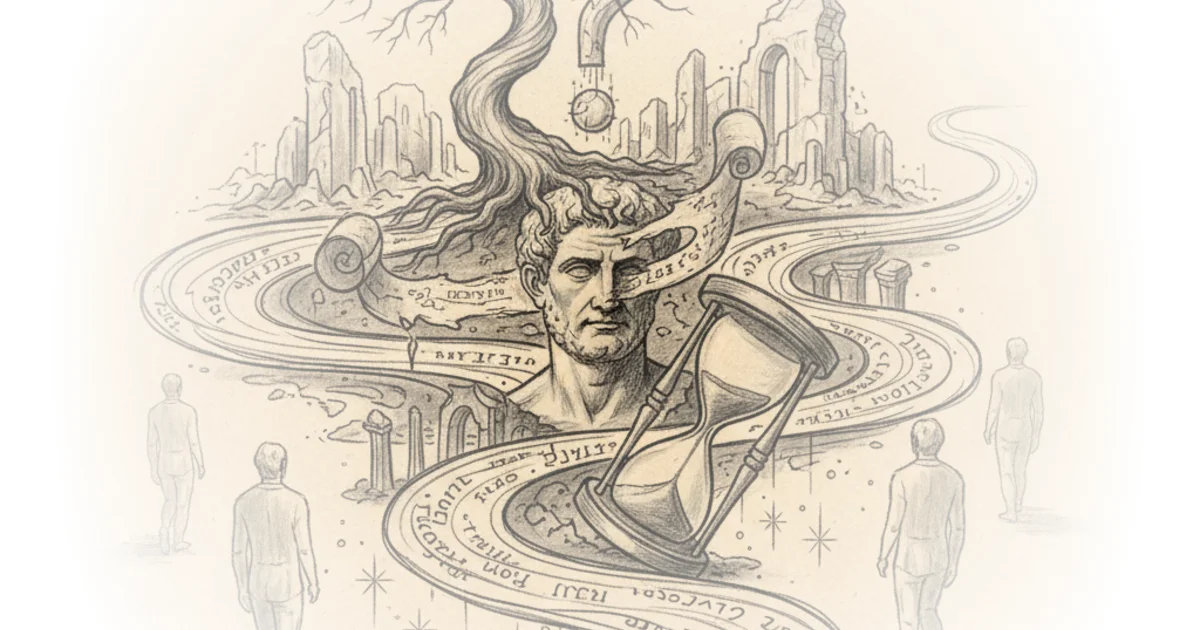
The author then introduces what makes Cicero historically significant beyond just being a source: he was a "new man," meaning he came from outside Rome's aristocratic families, yet rose to become Consul—the equivalent of President. This detail matters because it humanizes someone we often mythologize as an ancient sage rather than a political operator.
The Political Thinker
Cecil frames Cicero as a conservative political thinker who spent his career fighting "the forces of totalitarianism or at least of centralization." He positions the Roman Republic's transition to Empire as the backdrop for Cicero's entire legacy. This is where the piece becomes most interesting—Cicero wasn't just observing this change; he was actively resisting it.
The author distills Cicero's political philosophy into a memorable framework: "there's three kinds of government particularly at that time he says you can have a king or you can have an aristocracy or you can have a democracy." This simplification is effective because it translates ancient political theory into something modern audiences instantly grasp. The argument follows that each system has failure modes—tyranny, oligarchy, mob rule—and Cicero's actual proposal was more nuanced than pure systems.
"He argued VI iously that what you do is you avoid the worst of all three systems by using the best of all three systems as checks and balances."
This is the core of his political thought: a mixed constitution with democratic representation for the masses, aristocratic elements for the wealthy, and consular leadership. The author notes this "may sound familiar"—a clever nod to modern debates about balanced governance that Cicero prefigured.
The Philosopher and Educator
The piece's most substantive contribution is explaining how Cicero "completely revolutionized the Roman mind" through education reform. He coined "humanitas"—the Latin term for what we now call the humanities. This matters because it reframes Cicero as someone who shaped not just politics but intellectual culture itself.
Cicero's philosophical work included opposition to superstition, which the author describes as believing "the universe is ruled by a sort of rational Divine Providence" rather than chaotic mythological forces. He wanted Greeks to reason their way to truth instead of believing in random Gods who "fall in love and rape Mortals." This is vivid language that makes ancient philosophy accessible.
Critics might note that framing Cicero as primarily an opponent of superstition oversimplifies his actual relationship with Roman religious practice—he happily Manipulated augers and priests for political gain. The author acknowledges this: "he wasn't against manipulating them" while also genuinely arguing against superstition's intellectual dangers. This tension isn't fully explored, but it makes Cicero more human.
Bottom Line
Cicero was a transformative figure in ancient Rome who fundamentally shaped how we understand Roman history, political philosophy, and education—and Wes Cecil makes a compelling case that we've largely forgotten him. His core argument is strongest when he demonstrates the breadth of Cicero's influence through specific examples like "humanitas" and surviving letters. The vulnerability is that the piece sometimes conflates description with analysis—we get lots of what Cicero believed but less about why that matters to us today beyond historical curiosity. The conclusion lands: if you're interested in how we got from Rome to modern governance, Cicero is the thinker you forgot mattered.