Tube science video. Derek Muller didn't just explain a physics problem — he rented a helicopter to settle it. That's the kind of commitment that makes people lean in, and it's exactly what makes this piece work. The question comes from a 2014 qualifying exam for the U.S. Physics Team: a helicopter flies horizontally at constant speed with a perfectly flexible uniform cable suspended beneath it. Air friction is not negligible. What shape does the cable take? Five multiple-choice options, and apparently no one could agree on the answer.
The Controversy Behind The Cable
The debate wasn't just among students. Muller pulled YouTube and found the most common answer was C — a beautiful bell curve of disagreement. Then he got in touch with the question's author, Professor Paul Stanley. "There were some creative students who actually constructed their own homemade scenarios," Muller recounts, describing how colleagues built fan setups to mimic helicopter motion. The faculty members looked at it and said different things: one argued it's this design, another insisted it's that answer. They couldn't agree.
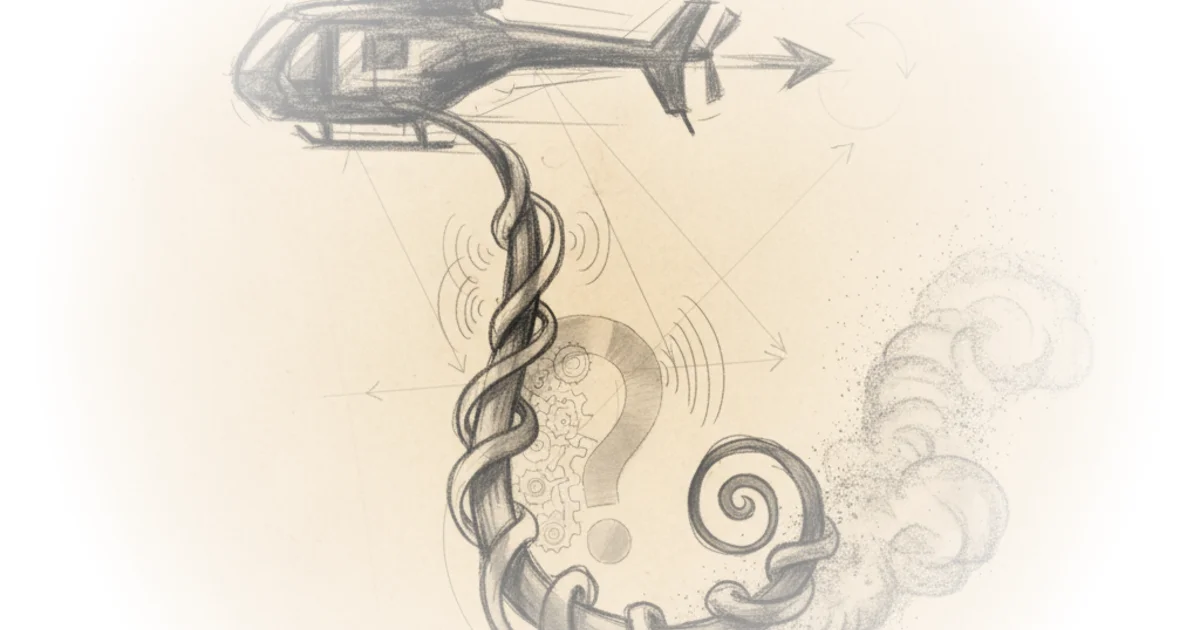
This is the piece's most compelling hook — professional physicists disagreeing in public, unable to resolve a question about something they could just... go test. The controversy itself proves how unintuitive this problem is. And Muller recognizes exactly why: "if we approximated as a Chinese digit link I don't think you can just guess what." The guessing was widespread.
The Experimental Setup
What makes this different from a classroom explanation is the scale. Muller deployed a battle rope — about 15 meters long, weighing 20 kilograms — and hired pilot Craig to keep the rope on their right side so he could watch it. "We're not going straight forward we're actually going diagonally forward and to the left but you can clearly see the Rope is hanging straight diagonally to the left." That's option B.
The experiment tested multiple scenarios: just the rope at constant speed, then adding a weight (a 20-pound kettlebell), then adding a flag with minimal weight but significant air resistance, then a parachute. Each configuration produced different shapes — B, D, or C depending on what was attached to the end.
The Physics Explanation
Muller walks through why this happens: "there are two external forces acting on the Rope — gravity pulling it down and air resistance to the left." At constant speed, these must be perfectly balanced by the tension. When he set out to do this experiment, he wondered if the rope would be affected by air pushed down by the helicopter's rotor wash. But their results showed this wasn't the case: "the rotor wash doesn't extend down below the helicopter all that far it dissipates pretty quickly." So air resistance is entirely due to motion through still air.
The key insight is the tension analysis: for a uniform cable without weight, the ratio of air resistance to weight stays constant throughout. That's why it hangs in a straight diagonal line. But add a weight at the bottom and everything changes — "at the bottom the tension needs to be almost vertical to support the weight of the Kettlebell which has a lot of weight but not much air resistance." The rope turns more horizontal as it goes up.
A uniform flexible cable hangs in a straight diagonal line when pulled at constant speed by a helicopter — and that's only the beginning of the story.
What This Experiment Actually Taught Us
The most interesting part isn't just that Muller found the answer. It's what he discovered about how we think about these problems. The original question came from seeing a helicopter fly with a cable beneath it in Hong Kong — "I saw the shape of the cable and thought to myself that looks a little counter-intuitive." That's where the multiple-choice question originated: from watching something real, then turning it into a theoretical problem.
The experiment confirmed that with weight at the bottom (the inverted J), without weight but flying faster (still diagonal but changing angle), and with high air resistance items like parachutes (J shape). The answers depend entirely on what's hanging from the end of the rope. "Depending on what's on the end of the Rope, you could get answers B, C or D."
Counterpoints Worth Considering
Critics might note that this kind of empirical testing, while dramatic, raises questions about generalizability. The helicopter was flying at nearly a hundred kilometers per hour — would slower speeds produce similar results? Would different rope materials behave differently? Muller doesn't address whether his specific conditions limit the conclusions.
There's also something to the fact that physics professors disagreed without testing. This tells us something about how intuition fails in fluid dynamics problems: even experts guess wrong when they rely on mental models rather than data.
Bottom Line
This piece succeeds because it does what many science communication fails to do: actually test the thing people are arguing about. The biggest strength is the empirical verification — we now know experimentally that option B is correct for a uniform cable at constant speed, and we understand why. The vulnerability is that Muller doesn't fully explore whether this holds across different speeds, rope types, or conditions. But that's fine — the piece never claims to be comprehensive. It just wanted to settle one debate, and it did.
What makes this notable isn't the physics itself — it's the willingness to rent a helicopter rather than keep arguing in circles.