Devin Stone doesn't just watch Kim Kardashian's legal drama; he dismantles it with the precision of a partner reviewing a junior associate's brief. While most reaction videos focus on the fashion or the drama, Stone zeroes in on the impossible legal mechanics that would get the show's writers sued in real life, arguing that the series is less a legal procedural and more a "wish fulfillment on screen" that violates the very laws it pretends to dramatize.
The Fiduciary Fiction
Stone immediately identifies a fatal flaw in the show's premise: the senior partner, played by Glenn Close, casually permits junior associates to leave and start a rival firm within the same building. "It is totally unrealistic for Glen Close to be like, 'Yeah, go right off into the sunset and just represent women,'" Stone writes, noting that such permission would likely constitute a breach of fiduciary duty. He explains that in the real world, a partner cannot simply wave goodbye to competitors; they are jointly liable for the firm's actions, and allowing a spin-off without strict non-compete or non-solicitation agreements is a recipe for disaster.
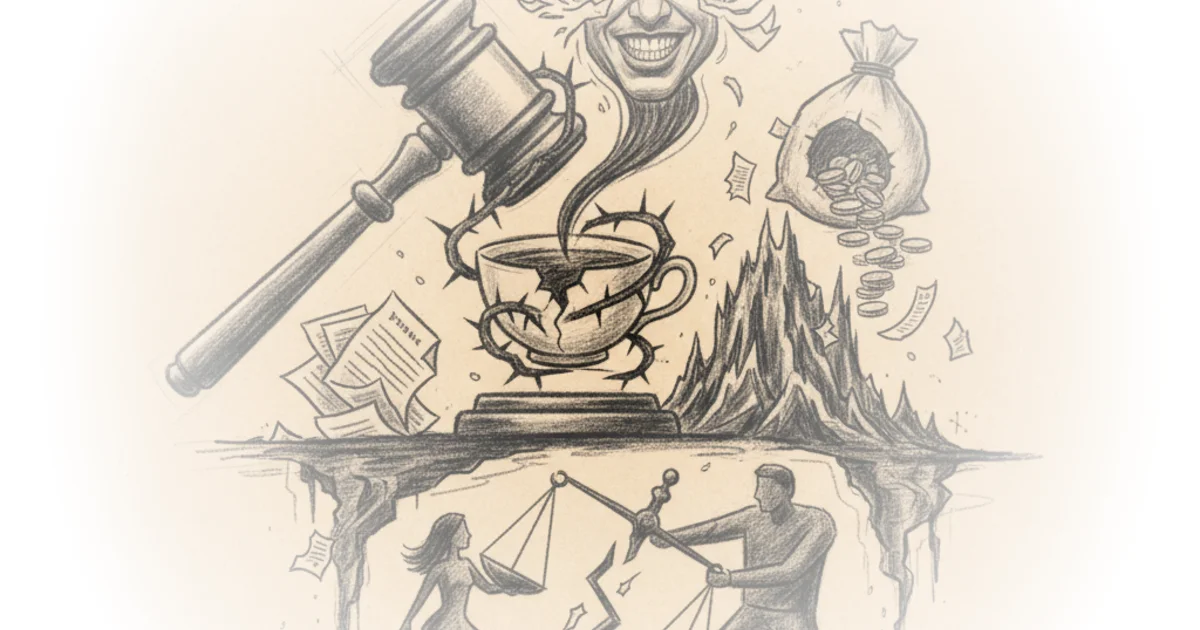
The commentary highlights how the show ignores the "thorny issue" of lawyers leaving one firm to start another, treating complex contractual obligations as mere plot devices. Stone points out that the characters' ability to poach staff and clients without legal repercussions is a fantasy. "That violates her fiduciary duties because she's joint and separately liable to the firm itself," he notes, emphasizing that the drama relies on a fundamental misunderstanding of how law firms actually operate. This framing is effective because it exposes the gap between Hollywood's desire for a clean break and the messy reality of corporate liability.
Critics might argue that television requires narrative momentum over legal accuracy, but Stone's point stands: the show's central conflict collapses if the audience understands that the senior partner is essentially committing malpractice by facilitating the departure.
The Illegal Partnership
The show's legal illiteracy deepens when the new firm attempts to hire a private investigator as a full partner. Stone is blunt about the illegality of this move. "It is literally against the law to offer to make her a partner. You can't form a partnership with non-lawyers if you're starting a an LLP or a law firm," he states. This is not a minor technicality; it is a structural impossibility in the United States legal system, where only licensed attorneys can hold an ownership stake in a law firm.
Stone also takes issue with the hiring logic, noting that "very unusual for a law firm to have an in-house private investigator." He clarifies that big firms typically hire investigators as external contractors to keep costs down, rather than as permanent, salaried partners. The show's decision to make the investigator a partner is not just unrealistic; it is a direct violation of professional conduct rules designed to prevent non-lawyers from influencing legal judgment. "This is completely illegal," Stone asserts, stripping away the glamour of the scene to reveal a legal non-starter.
You can't form a partnership with non-lawyers if you're starting a an LLP or a law firm. This is completely illegal.
The Office Aesthetic and the Prenup
Beyond the legal mechanics, Stone critiques the show's setting, pointing out that the "floor to ceiling walnut and mahogany" offices are a Hollywood trope that doesn't exist in modern American legal practice. He contrasts the fictional set with his own experience working in Century City, noting that while the location is real, the triangular architecture of the "Triangle Towers" makes the show's circular conference room physically impossible. "I don't think literally you could have that room in one of those towers," he argues, using his own career history to ground the critique in reality.
The commentary then shifts to the show's handling of prenuptial agreements. When a character claims a prenup leaves her with nothing but her clothes, Stone questions the enforceability of such a clause. "I would start to question that as potentially unconscionable," he writes, explaining that California law generally protects against agreements that leave one spouse destitute. He notes that while some states are more lenient, California is particularly protective of marital property rights, making the show's "draconian" prenup legally dubious.
Stone also touches on the irrelevance of infidelity in California's no-fault divorce system. "The fact that either or both of them engaged in infidelity in the marriage is really not relevant," he explains, correcting the common misconception that cheating automatically impacts financial settlements. This distinction is crucial for viewers who might assume the affair changes the legal outcome, when in fact, it likely changes nothing regarding the division of assets.
Critics might suggest that the show is aiming for emotional resonance rather than legal precision, but Stone's analysis reveals that the show's dramatic stakes are built on a foundation of legal fiction that undermines the very conflicts it tries to portray.
Bottom Line
Devin Stone's commentary succeeds by treating the show not as entertainment, but as a case study in what happens when legal drama ignores the rules of the profession. His strongest argument is that the show's central plot points—leaving a firm to start a rival one and hiring a non-lawyer as a partner—are not just unlikely, but legally impossible. The biggest vulnerability in the show's narrative is its reliance on these impossibilities to drive the plot, a flaw Stone exposes with surgical precision. Readers should watch for how these legal inaccuracies might influence public perception of the legal profession, turning a serious career path into a backdrop for fantasy.