This midweek update from Phillips P. O'Brien delivers a jarring thesis: the United States is not merely struggling in the Middle East; it has lost the ability to command its closest allies or dictate terms to adversaries, creating a strategic vacuum that accelerates national decline. The piece distinguishes itself by framing current geopolitical chaos not as a temporary stumble, but as an inevitable physical reaction to a leadership strategy that prioritizes personal survival over statecraft. For busy listeners tracking global stability, O'Brien's assertion that "the US does not control its own destiny at this point in the war" demands immediate attention because it suggests the rules of international engagement have fundamentally shifted.
The Illusion of Control
Phillips P. O'Brien opens with a stark assessment derived from a knowledgeable source regarding the administration's inability to extricate itself from conflict: "Right now he cannot get out. It is physics." This metaphor of inescapable physical laws is central to his argument that executive power has become reactive rather than proactive. He posits that the administration is trapped by the very alliances it seeks to manage, specifically noting that "the unbreakable hold that Iran and Israel have over his power/position always sucks him back."
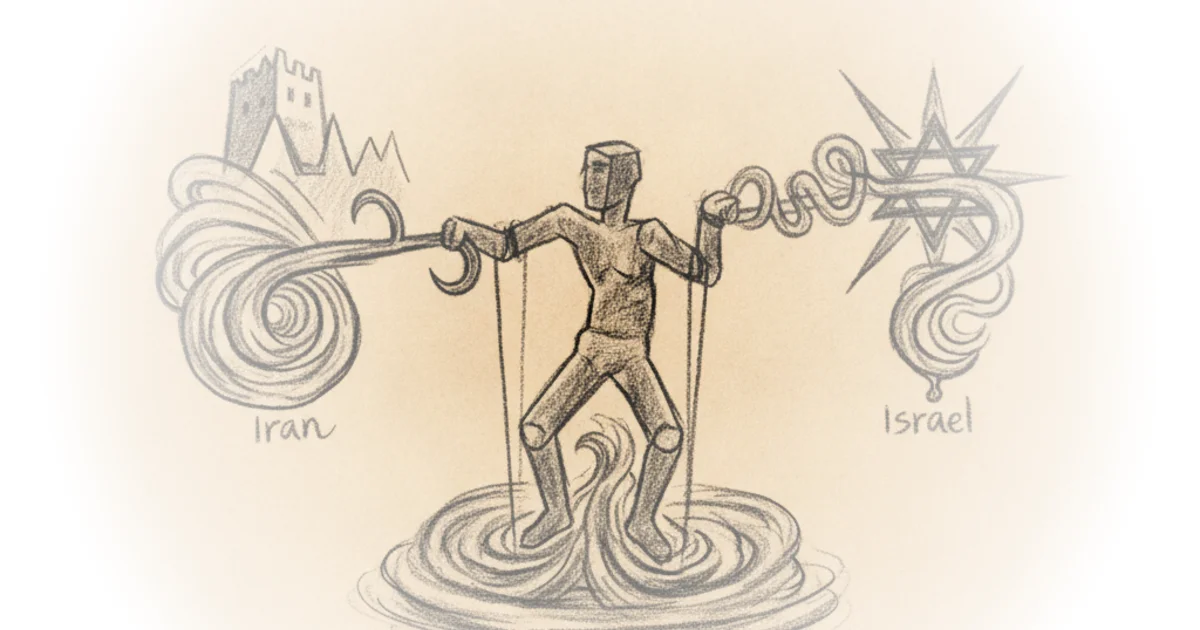
The author contrasts this current paralysis with a specific historical pivot point from June 2025, when the US successfully ordered Israel to halt bombing runs in Iran. Today, however, O'Brien argues that dynamic has inverted. He writes, "Unlike last year, however, Trump cannot simply order the Israelis to turn around—and as such is getting desperate." This loss of leverage is evidenced by Israeli forces expanding their invasion into Lebanon and seizing strategic locations like Beaufort Castle, actions taken despite explicit US objections.
The idea of the USA as either the indispensable partner or unstoppable enemy is gone. It may never come back.
O'Brien's analysis here is compelling because it moves beyond diplomatic friction to suggest a structural collapse in American hegemony. He argues that Israel is no longer concerned with "embarrassing or undermining" Washington, but is instead pursuing its own strategic interests regardless of US pressure. Critics might note that alliance dynamics are complex and that public defiance does not always equate to a total breakdown of private coordination; however, the visible expansion of military operations in Lebanon while negotiations stall suggests a genuine fracture in command authority.
The Theater of Negotiation
The commentary shifts to the administration's diplomatic posture, which O'Brien characterizes as a "public/private farce." He highlights the dissonance between official optimism and on-the-ground reality, quoting the administration's repeated claims that an agreement is imminent: "An Agreement has been largely negotiated… Final aspects and details of the Deal are currently being discussed, and will be announced shortly."
Yet, O'Brien points out that these assertions crumble under scrutiny. He notes that while Secretary of State Rubio sounds optimistic, the Iranian government has publicly declared they are halting serious negotiations. The author argues this reveals a critical power imbalance: "It is the US government that is desperate to keep up the fiction that the negotiations are going well... The Iranians, on the other hand, are happy to project the opposite image."
This framing suggests that the administration's public messaging is no longer a tool of statecraft but a mechanism for self-preservation. O'Brien writes, "Trump has shown that the USA cannot control either Iran or Israel—indeed that he is panicking as those two states are doing what they want regardless of his threats or wishes." The implication is that the administration's narrative is detached from the strategic reality where the US military position is weakening daily compared to the state it held in April.
He is, as always, willing to destroy the country to save himself. And his Iran war is accelerating that.
A Scorched Earth Domestic Strategy
Perhaps the most disturbing element of O'Brien's analysis is the connection he draws between foreign policy failure and domestic institutional decay. He argues that the administration's inability to resolve external conflicts has triggered a "scorched earth" strategy at home, where loyalty is valued over competence or electoral viability. He points to recent appointments, such as Bill Pulte for Director of National Intelligence, noting that Pulte has "no known background in intelligence, defense or national security," but is selected for his willingness to prosecute political enemies.
O'Brien suggests this is not incompetence but a calculated move: "He wants absolute and total control of the GOP, even if that means he might lose a seat here or there." This strategy mirrors the dynamics seen in historical attempts to centralize power, such as the ideological rigidity explored in analyses of Project 2025. The author warns that this creates a federal government staffed by "uber loyalists" who are prepared to "corrupt either the November vote or its results."
Critics might argue that prioritizing loyalty is a standard political maneuver during times of crisis, but O'Brien's evidence regarding the appointment of figures like Todd Blanche—who reportedly set up funds to reward January 6th participants—suggests a deeper erosion of institutional norms. The author writes, "The money matters less than the absolute loyalty in charge of the US government."
People are being too blase about this election. Trump has a party that is completely under his sway and a federal government that will do whatever he wants when he wants, regardless of the slightest scruple.
Bottom Line
Phillips P. O'Brien's strongest argument lies in his synthesis of foreign policy impotence with domestic institutional capture, presenting them not as separate crises but as mutually reinforcing symptoms of a leadership focused on self-preservation above all else. The piece's greatest vulnerability is its reliance on the premise that personal loyalty is the sole driver of these appointments, potentially underestimating other political calculations or factional dynamics within the party. Readers should watch closely for whether the administration can maintain this "scorched earth" posture without triggering a broader collapse in public support or international stability.