Matt O'Dowd delivers a rare narrative feat: transforming the abstract birth of quantum mechanics into a gripping human drama of hay fever, isolation, and existential dread. While many accounts focus on the math, O'Dowd argues that the true revolution wasn't just the equations, but the terrifying philosophical shift that followed—moving from a universe we could compute to one that refuses to be known. This story matters now, as we celebrate the centenary of the theory that underpins our modern technology, because it reminds us that the most profound scientific breakthroughs often require us to abandon our deepest intuitions about reality.
The Illusion of a Knowable Universe
O'Dowd begins by dismantling the comfortable worldview that existed before 1925. He describes how Albert Einstein, despite revolutionizing space and time, actually reinforced the Newtonian dream of a deterministic cosmos. "In the Newtonian worldview, the motion of all particles could be perfectly computed through a simple set of universal laws," O'Dowd writes. He explains that while Einstein merged space and time into a malleable fabric, the resulting universe was still a "crystallized" block where the past and future were just as real as the present. This framing is effective because it highlights the irony: the greatest physicist of the era was still clinging to the idea that if you knew the present, you could calculate everything that ever was or ever will be.
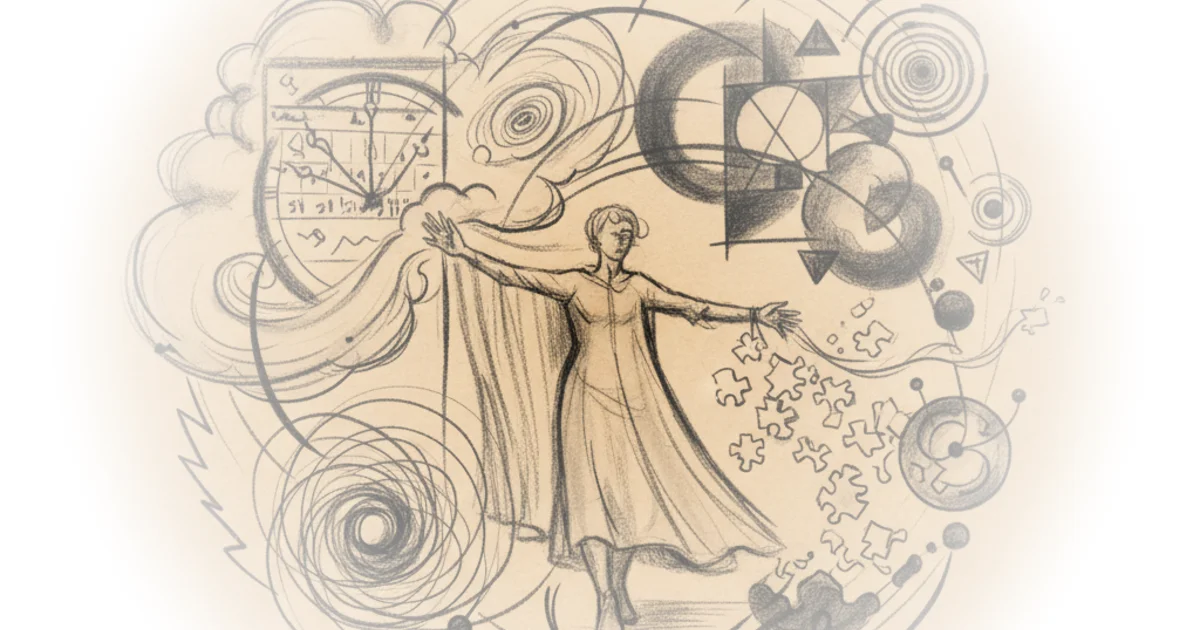
However, cracks were forming. The behavior of the electron in the atom defied these classical rules. O'Dowd notes that while Niels Bohr had created a model where electrons occupied specific orbits, it was essentially a patchwork that only worked for hydrogen. The scientific community was hungry for a deeper explanation, one that didn't rely on visual metaphors like tiny solar systems. As O'Dowd puts it, "We clung to the ambition to be aloof masters of a computable universe." This sets the stage perfectly for the protagonist's arrival: a young physicist willing to throw out the rulebook.
The Hay Fever Epiphany
The narrative pivots to Werner Heisenberg, a young physicist who decided to follow Einstein's advice to reject unfounded assumptions. But instead of questioning time or space, Heisenberg questioned the very nature of observation. "The aim of quantum theory should be to describe only quantities which are observable," O'Dowd quotes Heisenberg. This was a radical departure. Heisenberg realized that no one could actually see an electron's orbit; they could only measure the light emitted when an electron jumped between states. Therefore, the theory should not describe the invisible path, but the visible jump.
This shift led Heisenberg to invent a new kind of mathematics: matrices. O'Dowd highlights the frustration and brilliance of this moment, noting that Heisenberg discovered that in this new algebra, "x y is not always the same as y x." This non-commutativity was the mathematical fingerprint of a universe that didn't play by classical rules. The story becomes even more compelling as O'Dowd details Heisenberg's retreat to the barren island of Helgoland, suffering from severe hay fever while wrestling with these equations. The isolation was crucial. "It was 3:00 in the morning before the final result of my computations lay before me," O'Dowd recounts, quoting Heisenberg's own words. The physical discomfort of the scientist mirrors the intellectual discomfort of the new theory.
I was deeply alarmed. I had a feeling that through the surface of atomic phenomena, I was looking at a strangely beautiful interior.
The emotional weight of this discovery is palpable. O'Dowd captures the moment Heisenberg realized the energy principle held, but at the cost of a deterministic universe. The excitement was mixed with alarm because the math implied that nature was fundamentally uncertain. Critics might note that O'Dowd simplifies the complex mathematical derivation for a general audience, but this trade-off serves the narrative well, focusing on the philosophical shock rather than the algebraic grind. The story of the hay fever cure is a brilliant metaphor: the sickness cleared, but the revelation left him with a new, more profound affliction.
The Death of Determinism
The final act of O'Dowd's coverage explores the fallout of Heisenberg's work. The new theory, known as matrix mechanics, was alien to physicists who wanted a visual story of what was happening inside the atom. O'Dowd explains that this discomfort led to the Copenhagen interpretation, which posits that the universe is truly undefined between measurements. "Matrix mechanics implied that the world is not fundamentally knowable, perhaps not even real between observations," he writes. This is the core fracture in the old worldview. The universe was no longer a clockwork machine; it was a probabilistic cloud.
O'Dowd contrasts this with Erwin Schrödinger's later wave equation, which offered a more comforting, wave-based picture of reality. While Schrödinger's approach was easier to visualize, O'Dowd points out that it was mathematically equivalent to Heisenberg's matrices. The underlying truth remained: the non-commutativity of the math meant that certain pairs of properties, like position and momentum, could not be known simultaneously with perfect precision. This led directly to the uncertainty principle. The author's coverage effectively shows that the resistance to quantum mechanics wasn't just about the math; it was a psychological struggle to accept a reality that refused to be pinned down.
Bottom Line
O'Dowd's strongest asset is his ability to humanize a dry mathematical revolution, showing that the birth of quantum mechanics was a crisis of confidence for the human mind. The piece's biggest vulnerability is the brevity with which it handles the subsequent debates between Einstein and Bohr, which deserve more time to fully appreciate the stakes. However, the verdict is clear: this is an essential listen for anyone who wants to understand why the universe is stranger than we ever imagined, and why the certainty of the past is a thing of the past.
The universe under Einstein remained measurable and knowable. But what is measured and what can be known came to depend on perspective.