A Hate Crime Charge for Holding a Camera
On a Friday in early 2026, a New York judge dismissed felony hate crime charges against Alexa Wilkinson, a Hudson Valley photojournalist whose alleged offense was photographing the New York Times building after protesters spray-painted it with the words "NYT LIES; GAZA DIES" in July of the previous year. Wilkinson did not vandalize anything. They held a camera and later posted the footage on social media. For this, Manhattan District Attorney Alvin Bragg's office subjected them to arrest, a home raid, the seizure of thousands of dollars in equipment, and the threat of years in prison.
The case is now sealed. But its implications are not.
"This case represented a troubling attempt to criminalize protected expression and to stretch hate crime laws beyond their lawful purpose."
That assessment comes from Terra Brockman, a staff attorney with the Legal Aid Society who represented Wilkinson. The characterization is difficult to argue with when examining the prosecution's own evidence.
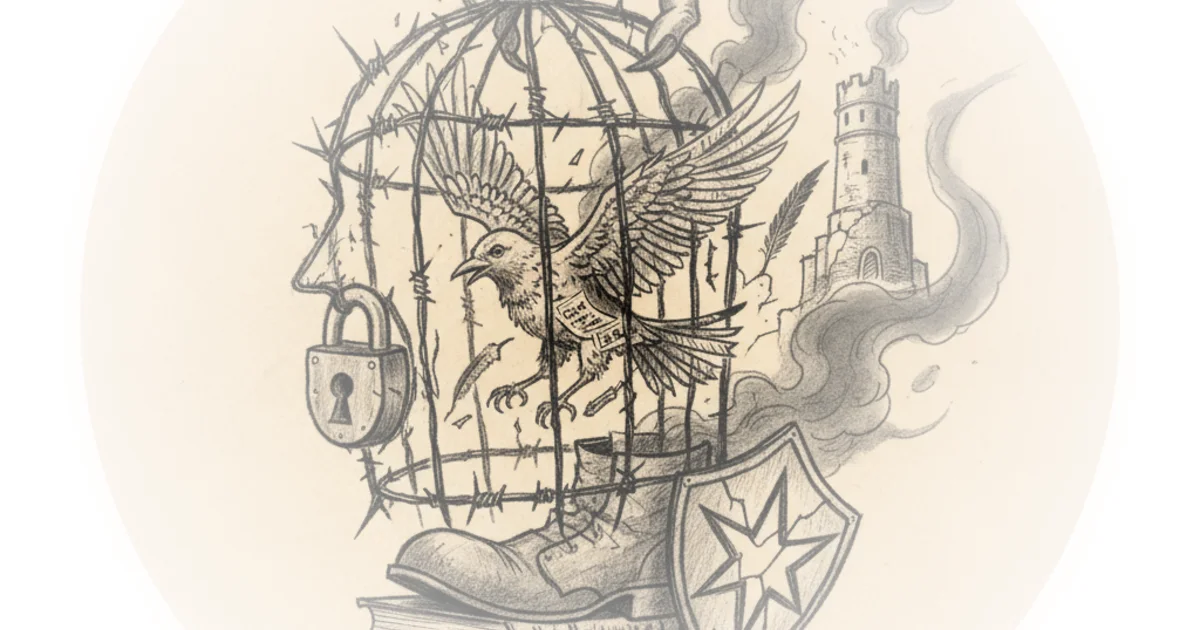
The Evidence That Wasn't
The criminal complaint against Wilkinson never alleged that they participated in the vandalism. It stated they had been "at the scene of the vandalism, holding a camera." The hate crime charge rested on two social media posts made after the incident. One was an Instagram post embedding a tweet that read, "They hanged newspaper editors at Nuremberg," with Wilkinson adding "Looking at you" while name-checking Times executive editor Joseph Kahn. The other was a TikTok video listing eleven Times employees who had been "exposed."
NYPD detective Matthew Buonaspina, who authored the complaint, noted that Kahn is Jewish, and that all but one of the eleven listed employees are Jewish. This was the totality of the prosecution's case for a hate crime.
"Photographing graffiti, criticizing news coverage, and documenting controversial matters does not by any means constitute a hate crime."
Molly Biklen, legal director of the New York Civil Liberties Union, put it plainly. Stephanie Jablonsky of the Foundation for Individual Rights and Expression went further, addressing the legal standard directly.
"If all the police have to substantiate a hate crime charge is an Instagram post screenshotting 'They hanged newspaper editors at Nuremberg' with the caption 'Looking at you [Joseph Kahn],' this is flimsy at best."
Jablonsky noted that the First Amendment's exception for "true threats" requires a speaker to communicate "a serious expression of an intent to commit an act of unlawful violence." Political rhetoric referencing historical violence does not automatically meet that standard.
To be fair, the Nuremberg reference directed at a named editor is genuinely inflammatory, and reasonable people can disagree about where provocation ends and intimidation begins. The post was not merely abstract political commentary; it named a specific person alongside an invocation of execution. That Bragg's office ultimately moved to dismiss suggests even prosecutors recognized the charge could not survive scrutiny, but the initial decision to bring it was not made in a vacuum of absurdity. There was something to investigate, even if the investigation reached the wrong conclusion about criminality.
The Raid
Two months after the vandalism incident, more than a dozen police officers in riot gear arrived at Wilkinson's home in Cold Spring, New York, on a Sunday morning. They seized virtually every piece of electronic equipment in the house: work laptops, photography gear, hard drives. They also took clothing, including socks, hats, keffiyehs, and jerseys bearing the word "Palestine." The belongings of Wilkinson's wife and a visiting friend were seized as well.
"I don't think I've ever been more terrified in my life."
That was Wilkinson's wife, who sat outside in the cold for three hours listening to officers laugh and joke while they tore the home apart. When she went back inside, she found their belongings strewn everywhere and their two cats buried under piles of possessions.
Wilkinson spent those three hours handcuffed in the back of a police cruiser, still in pajamas, in enough pain that they felt like vomiting. They were driven nearly two hours to the NYPD's Seventh Precinct and only learned they were being charged with a hate crime by overhearing officers talk. They did not see a search warrant until a cellmate who had been arrested in the same operation happened to have one in their pocket. Wilkinson was released by a judge at one in the morning.
"They ripped my entire apartment and life apart."
The material consequences were severe. With no camera and no computer, Wilkinson had to spend thousands replacing equipment essential to their livelihood. They nearly lost their job. Five months after the raid, the NYPD still had not returned their property.
The Double Standard
The charge leveled against Wilkinson, aggravated harassment in the second degree, is the same charge Bragg's office has used against defendants who hospitalized Asian New Yorkers while shouting racial slurs, who attacked a Latino man with a metal bike chain while screaming "f--- Hispanics," and who punched a gay Latino couple while yelling homophobic epithets. In antisemitism-specific cases brought on the same charge, defendants had given victims concussions and broken bones while shouting "Kill the Jews," or threatened synagogues while claiming to be the reincarnation of Adolf Hitler.
Wilkinson took photographs and posted on social media. The disproportion is staggering.
The case also has a predecessor. One year earlier, independent photojournalist Samuel Seligson, who is himself Jewish, was arrested by the NYPD and charged with a hate crime for filming vandalism at the homes of Brooklyn Museum leaders over the institution's financial ties to Israel. Like Wilkinson, Seligson was not accused of property damage. That case was also dropped.
Blue City, Red Tactics
The arrest of journalists, the intimidation of dissent, the stretching of hate crime statutes to encompass criticism of Israel: these have become familiar features of the Trump era. But this case originated with a Democratic district attorney in the bluest city in one of the country's bluest states. Bragg swept into office on promises to hold the powerful accountable, roll back mass incarceration, and pursue non-carceral approaches to justice.
"I do find it ironic that anyone in the position of running as the opposite of Trump or a fascist regime would then charge a journalist with a hate crime for a social media post."
Wilkinson's observation cuts to the core of the matter. The machinery of prosecutorial overreach is not exclusive to any party. When the tools exist, officeholders of all stripes will reach for them.
It is also worth noting that Buonaspina, the detective who authored the complaint, has his own history with the Civilian Complaint Review Board. A 2012 substantiated complaint resulted in a twelve-thousand-dollar city settlement after he detained a Black motorist and conducted an illegal search. An earlier complaint over improperly frisking a forty-two-year-old Black man was also substantiated but fell outside the statute of limitations for discipline.
"My family is Jewish. My sister is Jewish, my nephew is Jewish, my brother-in-law is Jewish, I work for Jewish orgs. I grew up with the Jewish religion around me. That's why I felt like this was so personally offensive."
Wilkinson's own background underscores the absurdity of the charge. Criticism of a newspaper's foreign policy coverage was repackaged as ethnic hatred, a move that cheapens genuine antisemitism cases and chills the journalism that a functioning democracy requires.
Bottom Line
The charges are dismissed. Wilkinson's record is sealed. But the damage, months of legal jeopardy, thousands of dollars in seized and replaced equipment, the chilling effect on their reporting, cannot be sealed away. Neither can the precedent that two separate photojournalists were arrested for documenting acts of protest rather than committing them. The Wilkinson case is a warning that press freedom is fragile, and that the threat does not always come from the direction people expect.
"I'm relieved these charges aren't hanging over me anymore. But I'm angry that it happened and that it may happen to other people around the country, and in ways that are more violent and aggressive."