Grant Sanderson has a knack for admitting when explanation falls short — and this follow-up video is a masterclass in course correction. The mathematician and creator behind the beloved 3Blue1Cor channel spent his original video introducing quantum computing, but one particular conceptual roadblock generated persistent confusion in the comments section. That roadblock: how does Grover's algorithm actually search for something without already knowing what it's looking for? Sanderson identifies the exact problem with surgical precision: viewers were essentially asking, "How could you know how to do that without already knowing which axis you're searching for?" The confusion centers on a "key step" in the algorithm where one specific vector gets multiplied by negative one — and readers couldn't fathom how you'd apply that operation without first knowing which direction to flip. This is precisely the kind of conceptual block that makes a complicated topic impenetrable, and Sanderson tackles it head-on.
The Concrete Example Problem
Sanderson makes a deliberate choice to anchor abstract ideas in something tangible: Sudoku. He writes, "On your normal classical computer, it's not hard to write a function that checks whether a proposed solution follows all of the Sudoku rules and solves the puzzle." This is the foundation — you can verify an answer without knowing what it is. The analogy works because Sudoku has that peculiar property where the rules don't reveal the solution; they only validate one. It's a perfect microcosm for what quantum computing actually does. He contrasts this with something even more opaque: "The function SHA 256, for example, is what's called a cryptographic hash function... if someone could reverse engineer it, they would be mining all of the Bitcoin in the world and breaking numerous other cryptographic schemes." The point is sharp: these functions have an emergent property that neither human nor machine can easily extract.
The Black Box Confusion
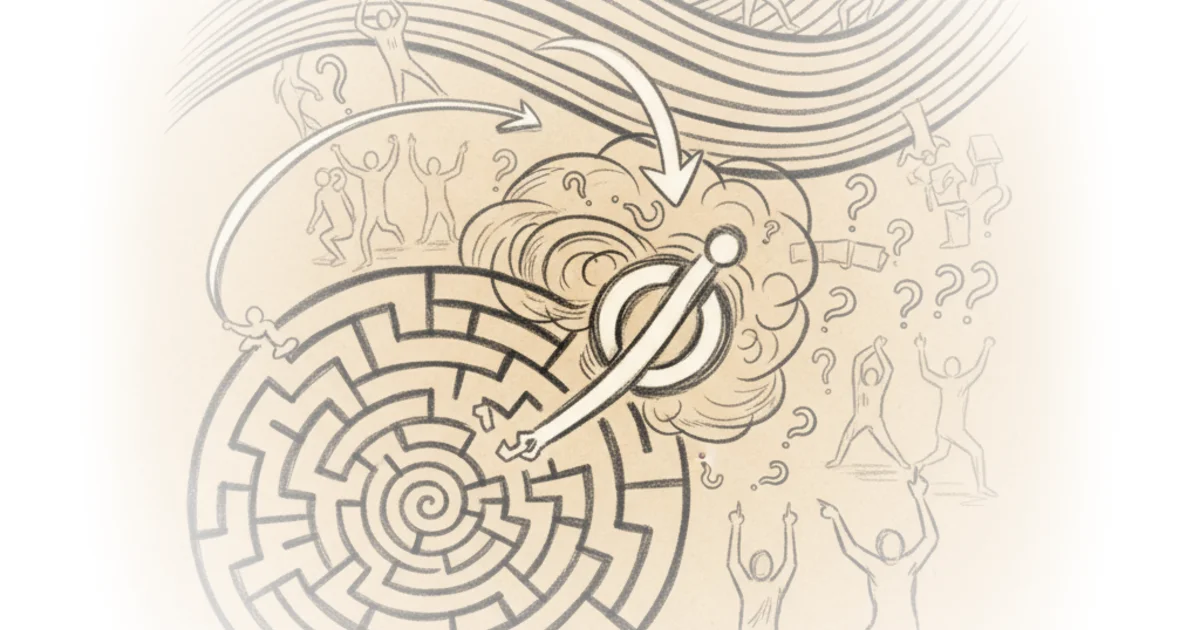
What emerges from this discussion is a crucial (clarification): "But to be clear, in order to translate the classical verifier into the quantum version, you absolutely need to get into the guts of the function." Sanderson is directly addressing a framing problem he acknowledges was misleading. He writes that opening his original video by saying there was "some mystery number that we're searching for" made it "seem like the computer kind of knows the answer ahead of time. It's just hiding it from us." This is the heart of what confused viewers: the algorithm doesn't know the answer, and neither does the computer. The key value isn't hidden in the source code — it's an emergent property of how the logic gates behave when you test them against different inputs.
Sanderson makes this concrete with a clean analogy: "The logic gates distill the rules of the game, but but not the strategy." That's a useful distinction for anyone trying to understand quantum computing without getting lost in the weeds. The verification function captures what valid solutions look like, not where they are.
Superposition and Linearity
The most substantive technical explanation comes from how Sanderson describes superposition itself. He writes: "One way that you can represent this is with a column vector where we think of each component as being associated with one of the possible bit strings." Then he introduces the more common convention among physicists, writing it "with an explicit weighted sum of all the basis directions, each one represented with a cat" — a playful reference to Schrödinger's famous feline. When the state vector looks like this, "you say that it's in superposition, meaning it has some nonzero component associated with multiple distinct bitstrings." The analogy he uses is elegant: "It's a lot like saying if someone is walking northeast, their velocity is a superposition of north and east. They're traveling both directions at the same time."
This matters because it addresses what quantum computers actually do — not outputting true or false, but taking vectors and producing new vectors through transformations that operate linearly on all possible states simultaneously. "When I say that operations in quantum computers are linear, what I mean is that if you pass in one of these weighted sums... then the output looks like the same weighted sum but of the transformed versions of each vector." The linearity point is where Sanderson earns the real explanation: it's not magic parallel processing, but a mathematical property of how transformations work on high-dimensional spaces. He invites reflection: "I invite you to reflect on whether that's necessarily a fair way to summarize it" — acknowledging that the parallelism framing, while intuitive, can be misleading.
The function doesn't know the answer. It's just that certain inputs trigger sign flips — and finding which ones do is what quantum search makes efficient.
Bottom Line
Sanderson's strongest move here is distinguishing between knowing an answer and recognizing when it's been found. His vulnerability lies in the gap between intuitive analogies and actual quantum mechanics — the superposition explanation works until it doesn't, and linearity remains harder to visualize than the "parallel" framing suggests. The piece succeeds because it models exactly what good technical communication should: admitting confusion, then systematically dismantling it. Readers watching this follow-up will understand Grover's algorithm better not because it's simpler, but because the conceptual barrier — knowing which axis to flip — has been properly reframed as an emergent property of the function itself rather than something baked into the code.