The most chilling evidence in Tim Mak's reporting isn't a military simulation or a geopolitical map; it is a raw, profanity-laced radio exchange between coast guards that reveals the Taiwan Strait has already become a hostile, shouting zone. Mak moves beyond the abstract threat of invasion to document a "Grey Zone" reality where routine harassment is the prelude to a potential blockade, arguing that the world's most critical semiconductor supply chain hangs by a thread of natural gas reserves that would last only ten days.
The Sound of Escalation
Mak anchors his analysis in a specific, exclusive recording: a September 2022 exchange where Chinese coast guard personnel explicitly insulted their Taiwanese counterparts, yelling, "Motherf*cker. You are an idiot." This is not merely an anecdote; Mak uses it to illustrate a deliberate shift in tone following Nancy Pelosi's visit, suggesting that the "middle line" of the strait is no longer a buffer but a contested border. He writes, "These kinds of tensions between the two coast guards have become routine since 2022... The provocative actions continued, not only to intimidate the Taiwanese but also to set up a possible future operation: a blockade of Taiwan."
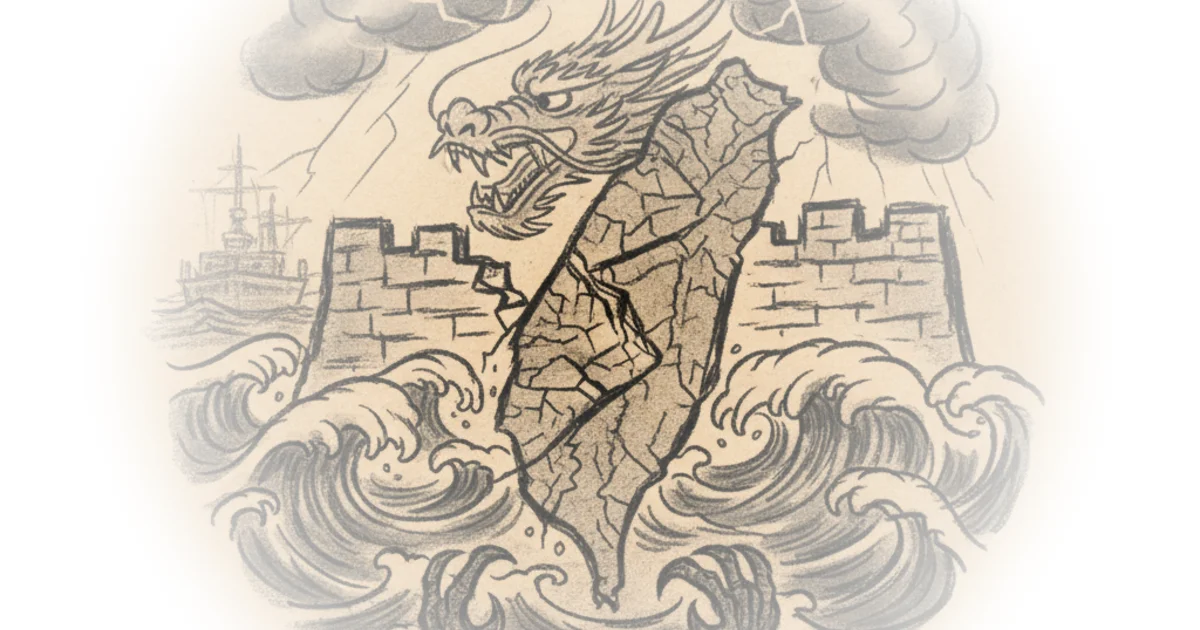
The framing here is effective because it strips away the diplomatic veneer. By focusing on the daily reality of Chinese aircraft crossing the middle line, Mak forces the reader to confront the normalization of aggression. He notes that while these incursions are "silent to the Taiwanese public," the data tells a different story. This approach grounds high-stakes geopolitics in the visceral experience of those on the water.
"If Taiwan faced a blockade and lost the critical resources, Taiwan wouldn't survive for too long, but surrender."
Mak weaves this stark assessment through the personal narrative of Jack Yu, a former sailor who now understands the strait as a lifeline. Yu's observation that "Taiwan is an island. Our country relies on trade to run functionally" serves as the human counterweight to the military jargon. Mak's choice to profile a sailor rather than a general is a strategic move; it highlights that the primary vulnerability is not just military defense, but the interruption of commerce.
Critics might argue that focusing on a single sailor's perspective risks oversimplifying the complex, multi-layered defense strategies Taiwan has developed, yet Mak balances this by citing the Center for Strategic and International Studies (CSIS). The wargaming data supports Yu's fear: in simulations without direct U.S. intervention, 40 percent of inbound ships were destroyed. The author effectively uses this data to show that "almost all scenarios entailed casualties," making the blockade not just a logistical challenge, but a humanitarian catastrophe waiting to happen.
The Fragility of the Grid
The piece's most urgent argument concerns energy. Mak details how Taiwan's natural gas reserves would be exhausted in a mere ten days, leading to "blackouts and public panic." He connects this technical vulnerability to a broader political shift, noting that the ruling Democratic Progressive Party has "toned down its long-standing anti-nuclear stance" in response to these threats.
Mak writes, "After that, Taiwan may be plunged into darkness, panicking the public and creating chaos." This is a powerful reframing of the energy debate. It moves the conversation from environmental ideology to existential survival. The author suggests that the blockade is designed to exploit this specific weakness, noting that while coal and oil have longer reserves, the immediate loss of liquified natural gas (LNG) would cripple the island's ability to function or fight.
"China only wants to damage Taiwan's economy... All they need to do is stop the ships coming into Taiwan."
This insight from Jack Yu is crucial. Mak uses it to explain why China might avoid a full-scale naval battle that jeopardizes its own shipping lanes. The strategy is one of strangulation, not necessarily a direct assault on every vessel. This aligns with historical precedents of coercion, echoing the pressures seen during the First Taiwan Strait Crisis, where the threat of force was used to alter the status quo without immediate total war.
However, the article could have explored more deeply the potential for international intervention. While Mak mentions U.S. wargaming results involving the loss of hundreds of aircraft, the political will to sustain such a conflict remains an open question. The narrative focuses heavily on the inevitability of the blockade's success if unchallenged, which is a valid point but leaves the reader wondering about the specific triggers that would compel the U.S. to act before the ten-day energy window closes.
The Global Stakes
Mak broadens the scope to the global economy, reminding readers that Taiwan Semiconductor Manufacturing Company (TSMC) produces over 67 percent of the world's high-end chips. "Do other countries want these chips to fall into China's hands?" Mak asks, channeling Yu's anxiety. The implication is clear: a blockade is not a regional dispute but a global crisis that would disrupt the AI revolution and the digital infrastructure of the entire world.
The author draws a parallel between the Taiwan Strait and the Gulf of Aden, where Jack Yu once faced Somali pirates. But Mak is careful to distinguish the two: "The Taiwan Strait is not just a piracy risk." The threat is state-sponsored and systematic. He notes that Chinese "ocean militia" vessels, disguised as fishermen, have been expelled nearly 3,700 times between 2022 and 2025. This "Grey Zone Warfare" blurs the line between peace and war, making it difficult for the international community to respond with traditional military alliances.
"Days feel like years. Loneliness is a bigger enemy."
This final reflection from Yu, describing the psychological toll of the strait, serves as a haunting coda to the strategic analysis. Mak uses it to remind the reader that behind the geopolitical chess game are individuals living in a state of perpetual anxiety. The isolation of the strait mirrors the isolation of the island itself.
Bottom Line
Tim Mak's reporting succeeds by grounding the abstract threat of a Chinese blockade in the concrete reality of a ten-day energy window and the daily harassment of coast guards. The piece's greatest strength is its refusal to treat the Taiwan Strait as a distant geopolitical abstraction, instead revealing it as a pressure cooker where the world's most vital technology supply chain is vulnerable to a single, calculated move. The biggest vulnerability in the argument is the assumption that the international community will remain passive until the crisis is imminent, a risk that the author hints at but does not fully dissect.