The assassination of Alexander the Great's father wasn't just a family tragedy — it may have shaped the most consequential leader in ancient history.
In 336 BCE, King Philip II of Macedon was murdered in public, stabbed to death before witnesses. The victim wasn't some minor ruler but arguably the most important political figure in the region during that era. His death created an immediate power vacuum unlike anything most observers had witnessed. When Adolf Hitler died in 1940 or when Franklin Roosevelt collapsed, historians can at least speculate about how history diverged — but with Philip's assassination, the entire trajectory of Macedon itself hung on a knife's edge.
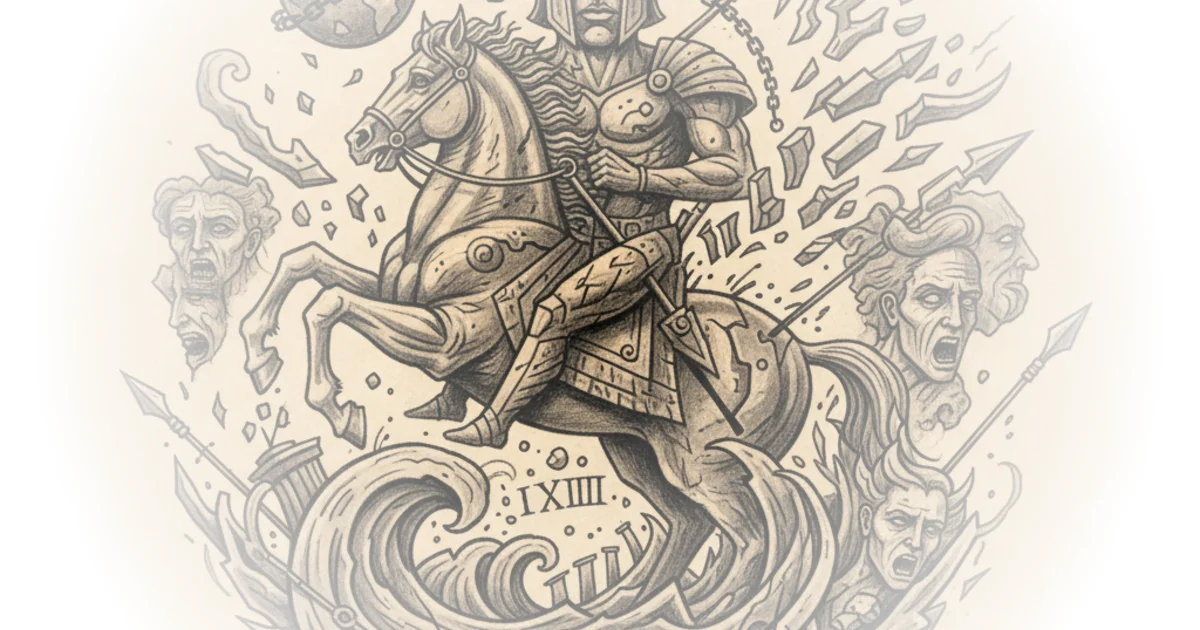
The system around the throne wasn't built for resilience. Power remained concentrated in one person, and removing that person left no clear mechanism for what came next. This is precisely what makes the moment comparable to September 11th or Pearl Harbor: everyone understood instantly that everything had changed, yet nobody could predict how it would unfold.
Young Alexander was only twenty years old when he witnessed his father's murder. He wasn't merely losing a parent — he was losing the anchor of his entire world. Some historians believe this trauma manifested later in Alexander's legendary aggression during warfare. Others argue his psychological wounds came from battles themselves, not from witnessing the assassination. The speculation is unavoidable because ancient sources offer fragmentary accounts at best.
The succession itself remained entirely uncertain after Philip fell. Macedonian royal succession wasn't automatic — anyone with bloodline connections could plausibly claim the throne, and outside powers frequently exploited these openings to keep Macedonia divided. Alexander faced rivals backed by foreign interests. He needed allies quickly, and one crucial supporter was General Antipater, who publicly endorsed him.
Yet historians freely admit most details from those critical early days have vanished entirely. What survives are scattered fragments and imaginative reconstructions. The sources allow very little concrete certainty about what happened during the first few days of his reign — a period that likely ranked among the most consequential of his career.
This explains why so many vastly different versions of Alexander exist across history. Some portray him as a philosopher-king, others as a drunken genocidal butcher. Part of that divergence comes from how each historian fills in the blanks where evidence fails. The first blank belongs to whether Alexander witnessed his father's murder directly or orchestrated it — a question that fundamentally changes how we understand his psychology.
Alexander eventually fled with his mother to her homeland, which critics cite as evidence of serious family fractures at precisely the moment he most needed stability. Yet this period also represents one of history's greatest unknowns — an inflection point where everything turned on a bolt from the blue, and one person's response reshaped the ancient world forever.
Critics might note that much of what survives about Alexander remains speculation layered upon speculation, with historians filling gaps creatively rather than honestly admitting how little we truly know. The fascination with this figure often exceeds the evidence available.
The strongest thread running through Philip's assassination is its demonstration that power concentrated in single individuals creates fragile systems — something ancient Macedonia understood better than most. That vulnerability became both Alexander's greatest liability and his greatest advantage, depending entirely on which historical account one chooses to believe.