This piece doesn't just recount the rise and fall of a comedian; it uses Russell Brand as a lens to examine a deeper fracture in our information ecosystem. Then & Now argues that the real story isn't about one man's credibility, but about how we define truth when institutions lose their monopoly on it. The most striking claim here is that labeling someone a "conspiracy theorist" has become a convenient way to dismiss legitimate questions about power, even when those questions are rooted in documented facts.
The Architecture of Doubt
Then & Now opens by reframing Brand's career not as a descent into madness, but as a shift in narrative strategy. "On the surface this is a story about Russell Brand but it's also a wider story about institutions trust truth and certainty fear coverups," they write. This distinction is crucial. The author suggests that Brand's pivot from shock-jock to political commentator was a natural evolution for someone who had already identified a disconnect between the public and the political class. The piece highlights Brand's 2013 interview with Jeremy Paxman, where Brand admitted he didn't vote because "the burden of proof is on the people with the power not people like doing a magazine." This moment, the author notes, "captured the mood an ordinary person telling the truth up against the establishment."
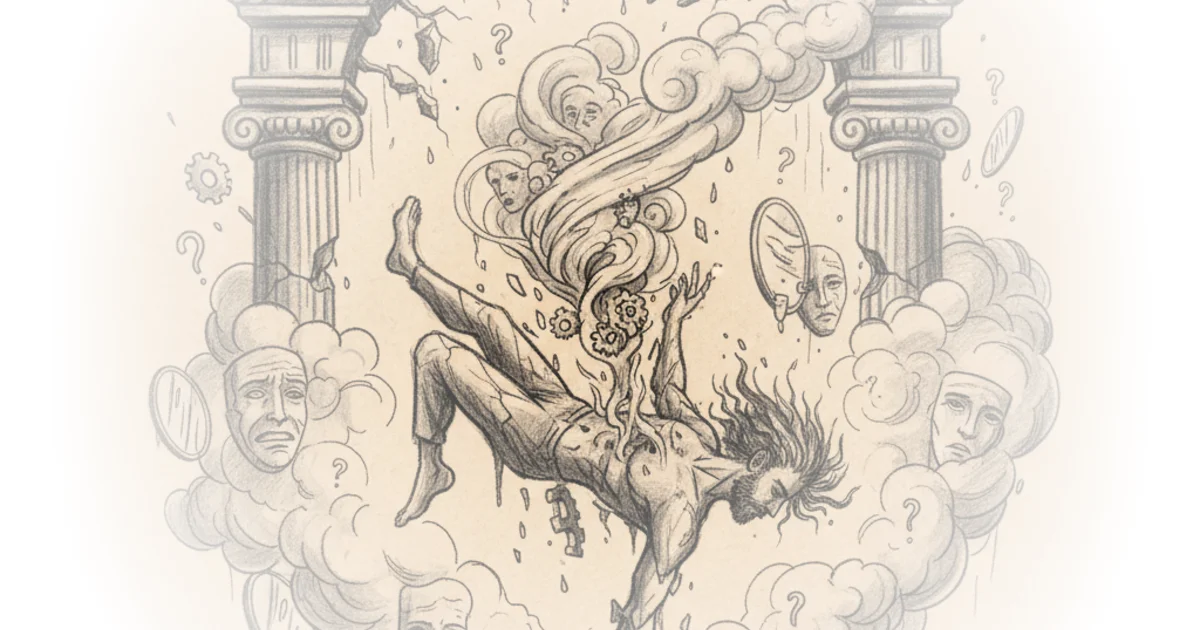
The commentary then traces how Brand's focus shifted toward the World Economic Forum's "Great Reset." Then & Now observes that while Brand's videos on this topic often garner millions of views, his core argument is surprisingly grounded in public documents rather than shadowy cabals. "I don't believe that [shady global cabals]," Brand is quoted saying. "I believe that there are plain visible economic interests that dominate the direction of international policy." This is a vital nuance that the piece captures well: the distinction between a secret conspiracy and a public agenda driven by corporate lobbying. The author points out that the Great Reset is indeed a real initiative by Klaus Schwab, but the public reaction has polarized it into either "capitalist propaganda" or a "global conspiracy to exert more control."
"It's not a conspiracy they're saying it publicly after all... I'm just using rhetoric. I'm an Entertainer."
The Psychology of Pattern Recognition
Where the piece becomes most analytical is in its examination of what actually constitutes a conspiracy. Then & Now cites psychologist Yan Willam Pran, who defines a conspiracy by five components: a connection of disconnected events, an intentional plan, a coalition, a hostile goal, and secrecy. The author applies this framework to the Great Reset, noting that while it meets several criteria, it fails the "secrecy" test because it is openly discussed. "The more interesting component is the first one," Then & Now writes, "it makes connections that explains disconnected actions objects and people into patterns."
This framing is used to explain Brand's coverage of the Dutch farmers' protests. The author details the complex reality of nitrogen pollution in the Netherlands—a genuine environmental crisis requiring difficult policy choices. Yet, Brand's narrative connects these local protests to the "Great Reset," Bill Gates, and a global agenda to strip farmers of their livelihoods. Then & Now acknowledges that Brand raises valid points about the disproportionate burden placed on ordinary people versus industrial polluters, but argues that he "ignores some of the complexity." The piece notes that the Dutch government has also targeted major industrial polluters like the Tata Steel plant, a detail often omitted in the broader narrative of "ordinary people vs. the elite."
Critics might note that dismissing the "conspiracy" label entirely ignores the real power dynamics at play. Even if the plans are public, the lack of democratic accountability for bodies like the World Economic Forum is a legitimate grievance. However, Then & Now maintains that the danger lies in the "pattern recognition" that turns complex policy debates into a binary struggle between freedom and authoritarianism.
The Pandemic and the Narrative Trap
The final section tackles the most volatile topic: the pandemic. Then & Now observes that Brand's content shifted from "reasonable" critiques of lockdowns to broader theories about the "lab leak" hypothesis and vaccine data integrity. The author highlights how Brand transforms the World Health Organization from a health body into a symbol of an "elitist surveillance society." "The lab leak hypothesis isn't about laboratory safety precautions," the piece clarifies, "but about a cover up involving World governments the WH and and big Tech censorship."
The commentary is particularly sharp when discussing the whistleblower claims regarding vaccine trials. Then & Now notes that while Brand cites a British medical journal article raising concerns, he often spins these isolated issues into a narrative of total systemic fraud. "Brand has a tendency to take a story and spin it into a wider pattern," the author concludes. This tendency, they argue, is what ultimately eroded Brand's credibility with mainstream audiences, even when he started with a kernel of truth.
"The word freedom is racist. I want to look at several stories as they unfolded... to ask a question which I think is fundamental to our Information Age: what does it mean to be called a conspiracy theorist?"
Bottom Line
Then & Now's strongest contribution is its refusal to simply dismiss Brand as a crackpot, instead dissecting the psychological and structural reasons why his narrative resonates so deeply with a disillusioned public. The piece's biggest vulnerability is that it sometimes underestimates how much "public" agendas can still feel like secret conspiracies to those excluded from the decision-making rooms. The reader should watch for how this tension between public policy and public trust continues to reshape political discourse, regardless of the specific figures involved.