This piece from Sinification offers a chillingly clear window into how Beijing's strategic elite is recalibrating its worldview as the global maritime order fractures. Rather than focusing on the immediate humanitarian toll of the conflict or the tactical movements of navies, the editors synthesize a consensus among Chinese establishment analysts: the United States is no longer capable of guaranteeing the freedom of navigation it once promised. The most striking insight is not that China is preparing to fill the vacuum, but that it is actively preparing for a world where sea lanes are no longer public goods, but contested, fragmented zones of leverage.
The End of the Cheap Hegemony
The article argues that a significant shift has occurred in how Chinese intellectuals interpret the crisis. They have moved beyond calculating the economic cost of oil disruptions to analyzing the structural decay of American power. Sinification reports that analysts at the China Institutes of Contemporary International Relations (CICIR) view the current conflict as the exposure of a US strategy of "low-cost hegemonic maintenance." This is a crucial reframing. It suggests Washington is no longer trying to sustain a full global order but is instead attempting to preserve primacy by concentrating power over selected trade corridors and financial nodes.
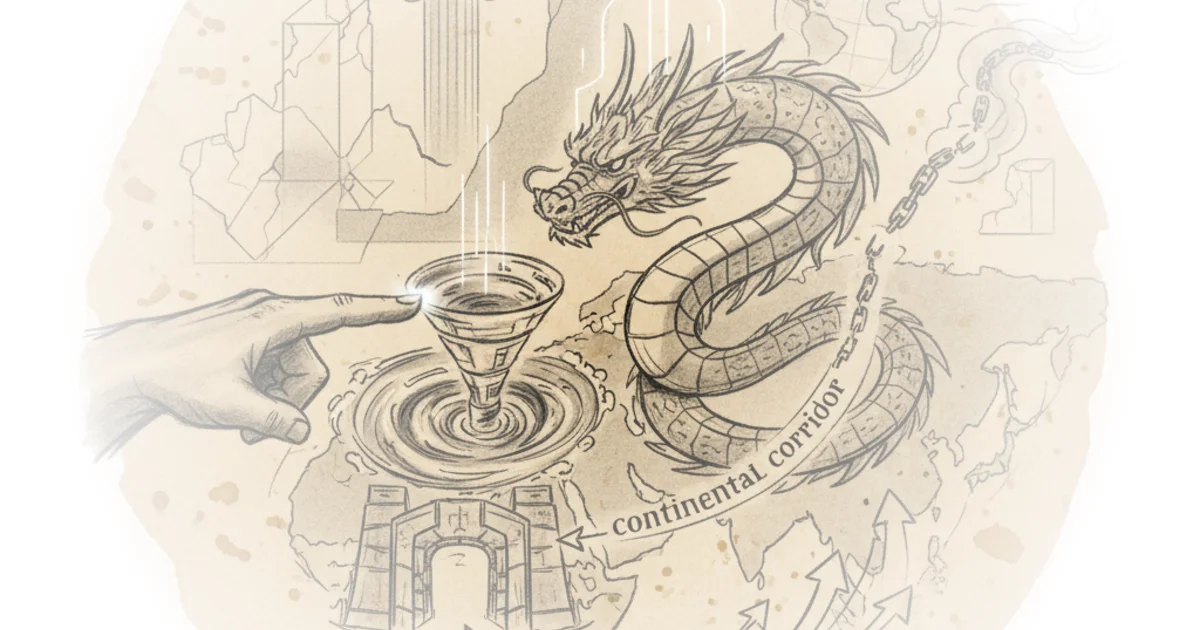
The piece notes that this strategy is failing. The inability to secure quick results in the Strait of Hormuz reveals a "brittle form of US power." Chen Wenxin, a director at CICIR, is quoted describing the administration's drive to "control key strategic resources and strategic corridors, and reshape the global strategic landscape." The commentary suggests this is less about restoring order and more about a desperate attempt to prolong the "petrodollar order."
"The war with Iran thus becomes the moment of this strategy's exposure: an attempt to maintain hegemony on the cheap that instead accelerates its decline."
This analysis holds weight because it aligns with observable trends in US foreign policy, yet it strips away the rhetorical flourishes to reveal a cold calculation of resource control. However, one might argue that this view underestimates the resilience of the US alliance network, which the article itself admits remains the strongest external force in the region, even if it now relies on "unpredictability" rather than stable leadership.
Sovereignty vs. Navigation
A more nuanced debate emerges from the Shanghai foreign-policy circuit, represented by institutions like Fudan University and the Shanghai Institutes for International Studies (SIIS). Here, the focus shifts from US decline to the legal and institutional openings created by the chaos. The editors highlight a fundamental clash in international relations theory: the tension between maritime hegemony and coastal sovereignty.
Liu Zhongmin, director of the Middle East Institute at SIIS, articulates this conflict clearly. He argues that "on maritime issues involving seas, straits and canals, there has always been a struggle over power and rights between maritime hegemonic states and coastal states." The piece paraphrases his view that while hegemonic states advocate for freedom of navigation backed by force, coastal states argue that sovereignty and jurisdiction should be exercised by them. This framing is particularly potent because it mirrors Beijing's own long-standing arguments regarding the South China Sea, suggesting a strategic alignment with Iran's legal position without necessarily endorsing its military actions.
Yet, the article also captures a deep anxiety within this camp. While some scholars propose a multilateral framework where regional powers and Asian energy importers co-manage the strait, others warn of the dangers of legitimizing blockades. Qin Tian, deputy director of the CICIR Middle East Institute, warns that if the US withdraws its commitment to Gulf security, the region could face an "order vacuum." This is a critical counterpoint to the optimism of institutionalists. It suggests that replacing a flawed hegemon with a fragmented, localized management system might not bring stability, but rather a dangerous power vacuum where no rules apply.
"If the US is no longer fully committed to ensuring the security of the Persian Gulf, then the Gulf's security order becomes a huge question mark... it is entirely possible that the Persian Gulf could face an order vacuum in the future."
The editors also note the historical precedent of the Suez Canal, where a Western-dominated chokepoint was eventually subjected to a new access regime. However, they wisely caution that the stakes in Hormuz are far higher, given its centrality to global energy flows. The comparison to the Bab-el-Mandeb strait and the China-Pakistan Economic Corridor underscores a broader trend: as maritime routes become unreliable, the strategic value of continental corridors and land-based connectivity increases. This is not just about oil; it is about the physical architecture of the global economy shifting away from the sea.
The Strategic Trap
Perhaps the most sobering argument in the piece is the warning against China embracing a world where blockades are legitimized. Legal scholar Ye Yan is cited arguing that accommodating an Iranian-controlled access regime could be a "strategic trap." The fear is that by accepting the disruption of Hormuz, Beijing would inadvertently hand the US the legal legitimacy to impose sweeping secondary sanctions and set a precedent for future disruptions, such as India blocking the Strait of Malacca.
This perspective highlights a critical vulnerability in the Chinese strategic calculus. While the administration's "low-cost hegemony" may be failing, the alternative—a world of fragmented, contested chokepoints—poses an existential risk to China's export-driven economy. The piece notes that while there is a preference for "adaptation to fragmentation," there is no consensus on how to navigate a world where the rules of the road are no longer guaranteed by a single power.
"The dominant recommendation is adaptation to fragmentation, not restoration of a pre-existing order: diversify energy suppliers, expand land-based corridors and strengthen Eurasian connectivity."
The human cost of this strategic maneuvering is largely absent from the analysts' discourse, a common blind spot in establishment commentary. The focus remains on energy flows, legal precedents, and institutional power, with little mention of the civilians caught in the crossfire of a conflict that is reshaping the global order. This detachment is a reminder that these are high-level strategic calculations, not humanitarian assessments.
Bottom Line
Sinification's analysis is a masterclass in reading the strategic subtext of a crisis, revealing that Beijing sees the Hormuz conflict not as a temporary disruption, but as the death knell of the US-led maritime order. The strongest part of the argument is its identification of the shift from "freedom of navigation" to "contested access," a change that fundamentally alters the risk profile for global trade. However, the piece's biggest vulnerability is its reliance on the assumption that China can successfully navigate this fragmentation without suffering the same economic shocks it seeks to avoid. The reader should watch for how quickly Beijing moves from theoretical adaptation to concrete investment in land-based corridors, as the window for a maritime solution narrows.