Dan Perry delivers a stark warning: the world stands on a razor's edge where a potential diplomatic off-ramp could simultaneously de-escalate a regional war and validate a regime that has massacred its own people. This piece is notable not for predicting peace, but for dissecting the terrifying cost of the alternative, weaving together the mechanics of nuclear proliferation with the brutal reality of proxy warfare. Perry argues that the current crisis is a direct consequence of past strategic failures, forcing a choice between two flawed paths: a deal that buys time at the price of legitimacy, or a continuation of conflict that risks a nuclear threshold state.
The Anatomy of a Dangerous Compromise
Perry frames the emerging negotiations as a high-stakes gamble where the United States and Iran are attempting to reverse the momentum of a conflict that has already destabilized global energy markets. He points to reports of a one-page memorandum where Tehran would temporarily suspend uranium enrichment in exchange for phased sanctions relief. "Obviously, if finalized this could quickly lower the immediate risk of a wider regional war and calm global energy markets," Perry writes, acknowledging the immediate humanitarian and economic benefits of such a move.
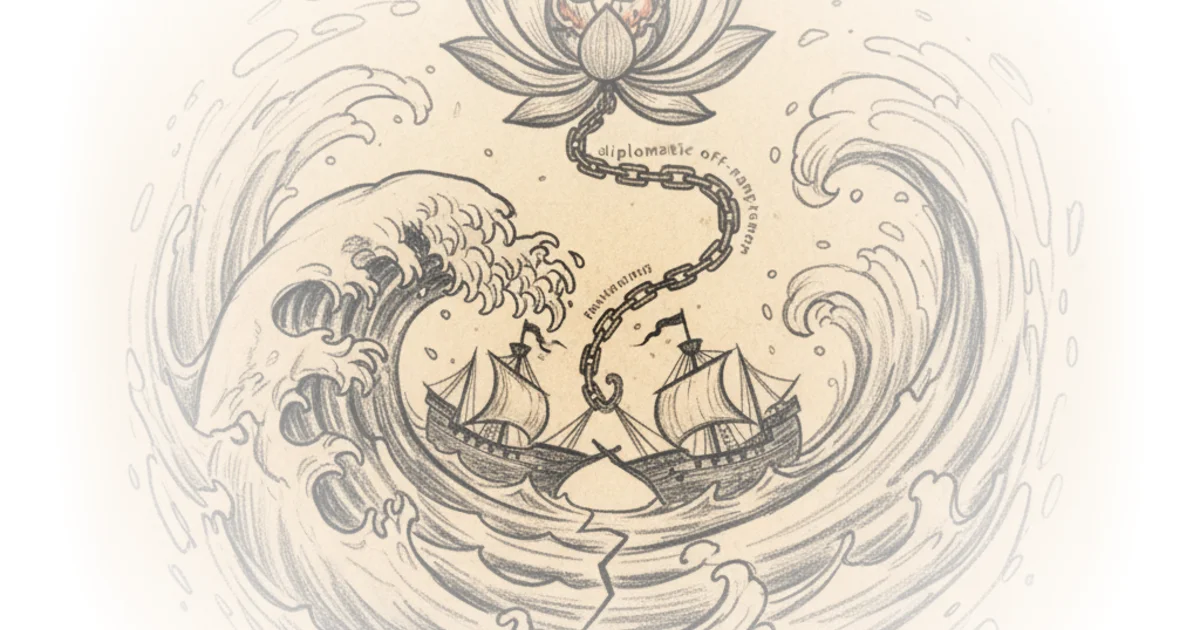
However, he immediately pivots to the moral and strategic hazards. The core of his argument is that this deal would fail to address the root causes of the aggression. "Rather than dismantling Tehran's regional terrorist infrastructure or weakening the Islamic Revolutionary Guard Corps, the deal would provide the regime with economic breathing room and renewed legitimacy." This is a crucial distinction; the author suggests that relieving economic pressure without demanding political change merely extends the life of a government that has shown little regard for its citizens.
The author connects this potential deal to the broader history of the Strait of Hormuz, noting that Iran has successfully weaponized its geography. "Iran would be totally validated in its strategy of blocking the Strait of Hormuz to rattle world markets, and therefore would be sure to do it again whenever threatened in the future." Perry argues that the regime has learned that disruption yields leverage, a lesson that could encourage similar tactics in other global choke points. Critics might note that without sanctions relief, the regime remains economically strangled, potentially leading to internal collapse rather than renewed aggression, but Perry contends that the regime has proven resilient to pressure.
Iran would be totally validated in its strategy of blocking the Strait of Hormuz to rattle world markets, and therefore would be sure to do it again whenever threatened in the future.
The Nuclear Shadow and Strategic Blunders
The commentary takes a sharp turn to the nuclear file, arguing that the current crisis is the inevitable result of the 2018 decision to withdraw from the Joint Comprehensive Plan of Action (JCPOA). Perry cites a New York Times report to illustrate the scale of the problem: "Trump's disastrous 2018 decision to walk away from the Joint Comprehensive Plan of Action unleashed Iran's nuclear program." He contrasts the pre-deal status, where Iran had less than a single bomb's worth of enriched uranium, with the current reality of roughly 11 tons of material.
This section is particularly effective because it moves beyond partisan bickering to focus on the tangible, physical reality of the threat. "Iran has moved from a constrained program under tight inspection to what is effectively a threshold nuclear state, with material that — if further enriched, slightly — could produce scores of weapons." Perry emphasizes that the military strikes, while tactically successful, have not solved the strategic problem. "Intelligence assessments suggest that Iran's timeline to a bomb has not fundamentally changed; at best, it has been delayed modestly."
The author highlights the sheer economic cost of this thirty-year conflict, noting that "$1 trillion dollars was spent or lost because of this thirty-year conflict with the world." This figure dwarfs the GDP of the nation in question, underscoring the futility of the current trajectory. Perry argues that the regime has "mortgaged a large part of its future on nuclear capability," a move that prioritizes regime survival over the well-being of its population.
The Complexity of the Regime and the Human Cost
Perry complicates the narrative by rejecting the idea of a monolithic Iranian state. He describes the system as a "dense web of overlapping institutions, personalities, and power centers, in which authority is diffuse and often negotiated rather than dictated." This nuance is vital for understanding why diplomatic breakthroughs are so elusive. The Islamic Revolutionary Guard Corps (IRGC), he notes, spans military, economic, and political domains, and "does not reliably speak with one voice."
The human cost of this internal and external conflict is brought into sharp focus. Perry references the massacre of tens of thousands of protesters, which he argues sparked the current escalation. "It would be conservative to attach a million deaths to these groups," he writes regarding the proxy militias supported by Tehran, including Hezbollah and Hamas. This statistic serves as a grim reminder that the geopolitical maneuvering has real, devastating consequences for civilians across the Middle East.
The piece also touches on the Palestinian elections in the West Bank, where turnout hovered around 56 percent. Perry interprets this not as enthusiasm, but as "persistence," noting that "Civic life, battered but intact, continued." This stands in stark contrast to the chaos in Gaza, where he describes a "mess" of no reconstruction, no aid surge, and no political horizon. "As long as it refuses to disarm, the basic conditions for rebuilding remain absent, and civilians continue to bear the cost of that stalemate."
The regime that just killed many thousands of protestors starts to test the limits of that sovereignty-based idea.
Perry also addresses the Israeli government's handling of the situation, particularly the interception of a Gaza-bound flotilla. He notes that while the Israeli public views this as a "PR stunt," the government's approach has been "especially ham-fisted," causing reputational damage without changing the underlying dynamics. This critique adds a layer of accountability, suggesting that military and diplomatic tactics must be weighed against their long-term strategic and moral costs.
Bottom Line
Dan Perry's strongest argument lies in his unflinching analysis of the nuclear threshold, demonstrating that military strikes alone cannot reverse the proliferation of enriched uranium. However, his reliance on the assumption that the regime will inevitably exploit any diplomatic breathing room to further its regional agenda may underestimate the internal fractures within the Iranian leadership. The reader should watch for whether the proposed sanctions relief is truly phased and conditional on verifiable behavioral changes, or if it merely serves as a temporary pause in a much longer, more dangerous conflict.