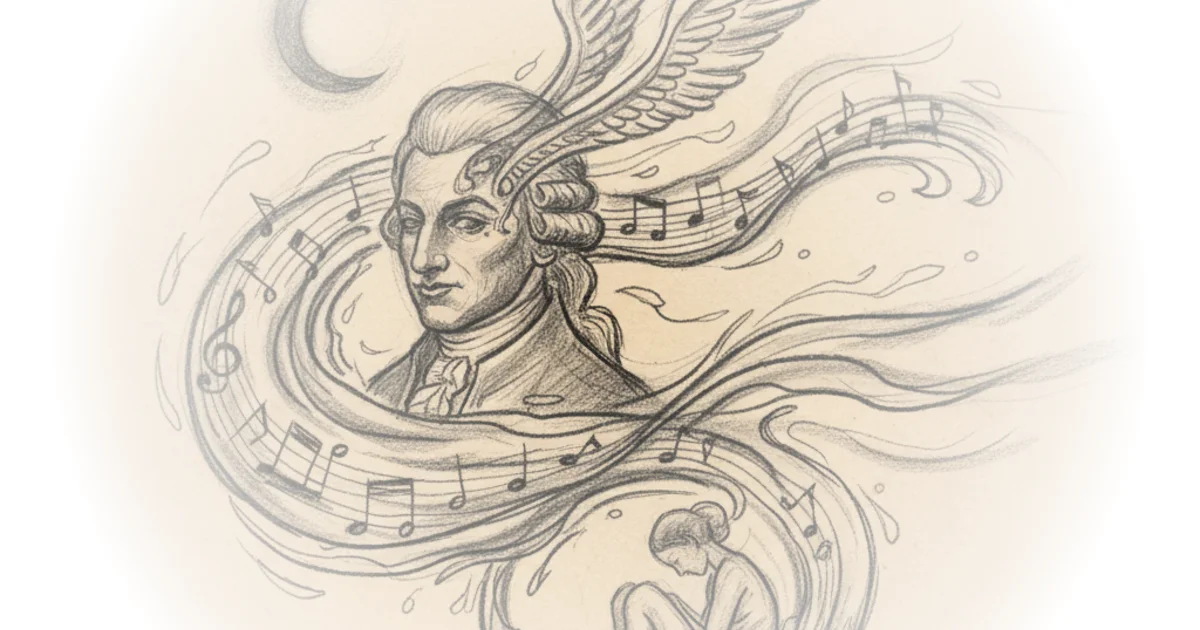
Dan Carlin opens with a meditation on creativity that feels immediately relatable: "when I am completely myself entirely alone or during the night when I cannot sleep it is on such occasions that my ideas flow best and most abundantly." This is the Mozart quote about inspiration at 3 a.m., and it's the anchor for everythingCarlin will explore. He's not just talking to artists here—he's talking to anyone who's ever felt like their best thinking happens in moments they can't control. The scope he introduces is ambitious: "one could easily make a case that all human civilization is the result of creativity over Millennia." That's a bold claim, and it sets up the conversation as something larger than just how musicians make records.
Carlin frames Rick Rubin as someone who can help readers amplify creativity—not a narrow music producer but what he calls a "creativity amplifier." This distinction matters because it's Carlin's way of saying: whatRubin does isn't just for musicians. It's for anyone trying to understand where ideas come from and how to get more of them.
The Metaphysical Problem
Carlin acknowledges that discussing creativity without it sounding metaphysical is nearly impossible. "The concept in the Middle Ages and the Renaissance I mean it was religious I mean that's what creativity was it was just simply God speaking through you." This historical framing is smart—he's not dismissing the spiritual angle, he's showing how deeply rooted the mystery of inspiration is in human culture. He notes that Rubin's book received reviews calling it "woo-woo" andsort of out there, and he uses this to make a larger point: "it's a hard subject to talk about without it being sort of metaphysical sounding." The irony is intentional. Carlin seems to be saying that the subject itself resists clean categorization.
When you read about creativity long enough, you realize we place too much emphasis on creativity for obvious artists—meaning painters and musicians—but no one thinks about how much creativity it takes just to get through life.
This is a crucial reframing. Most discussions of creativity focus on artistic fields where the output is visible—painting, music, film. But Carlin argues that any novel solution to a problem represents human creativity at work. This widens the conversation dramatically. The counterargument here is worth considering: critics might note that broadening creativity to include every problem-solving moment risks diluting what makes artistic inspiration distinct. Not all novelty is equally valuable.
Recordings as Time Capsules
Carlin's historical angle through Rick Rubin's book becomes concrete when he describes recordings as "frozen in Amber"—moments captured forever. He uses Mick Jagger and the Rolling Stones' album "Exile on Main Street" as an example: "that is a representation of where that band was in the late 60s." When listeners today engage with it, they may get a different impression than someone listening right after release. The recording itself becomes a time capsule—Carlin's metaphor is precise and evocative. He asksRubin about this directly: "how much does this act as a time capsule for you when you re-listen to things?" This is the interview's most intellectually rich moment because it reveals how recordings carry emotional weight beyond just audio.
Rubin's response shows somethingCarlin finds compelling: he rarely revisits his own work. He's either working on new material or listening to new discoveries, which means old recordings don't naturally surface in his life. When he does listen back, he's "usually put back in more often than not put back in the place of recording"—the feeling of being back in the room where it happened. Sometimes he'll hear a song he produced in a public space and experience that surprise: "I'll still be surprised by things I'll hear things that we may have poured over a long time deciding." The paradox is powerful: familiarity coexists with hearing it fresh, like for the first time.
The Diary Entry Problem
Carlin's most penetrating observation comes when he discusses why artists delay releasing work. "One of the things that's helpful about knowing that is so many artists are precious about the things they're making to a point where it's nearly impossible to put anything out." This isn't just about perfectionism—it goes deeper: "it's not historically the best work they believe they can ever do in their life and if they don't believe it's the best work they could ever historically do in their life then why share it." The logic is circular and crushing. Artists wait because they believe better work exists ahead, but waiting changes who they are as people—the "person who started the project and the person who's finishing the project are two different people." This insight connects individual psychology to creative output in ways that feel genuinely insightful.
Carlin then turns this lens on himself: "the problem is with the following work is that the best work you've ever done becomes the expectation for the next work." He's describing a phenomenon every creator knows—the previous success becomes a baseline you're forced to chase. He uses his own podcast as an example: quality standards have risen so much over time that old episodes sound "cringy" compared to current standards, even though they were considered good when released. This is the universal dynamic of creative work.
Bottom Line
Carlin's strongest contribution here is reframing creativity from something exclusive to artists and making it genuinely human—present in every novel solution, every problem solved, every unexpected idea. His vulnerability lies in how broadly he stretches this definition; not all novelty carries equal weight. The conversation withRubin works best when it's concrete—when he's describing recordings as time capsules or exploring why artists hold back their work. These are insights that feel both universal and specific, and they give listeners permission to see creativity as something they're already doing.
Carlin's framing of Rick Rubin as a "creativity amplifier" rather than just a music producer opens space for this conversation to be about more than music—it's about how anyone can think differently about where ideas come from and why the process matters.