While the world's eyes remain fixed on the erratic energy policies of the United States, Dave Borlace argues that the true vanguard of the global energy transition is quietly emerging from South America. He presents a startling statistic that upends the usual narrative of developing nations as laggards: for the first time in history, not a single new coal-fired power plant is being planned anywhere on the continent. This shift is not merely a statistical anomaly but a structural realignment that could redefine global climate outcomes.
The Structural Shift Away from Coal
Borlace opens by contrasting the information overload and policy paralysis in the US with the tangible progress occurring just below the equator. He notes that while many feel like "Alex Delarge in that horrible scene from A Clockwork Orange, having our eyes metaphorically forced open by a constant barrage of TV and social media information overload," the reality on the ground in Latin America is one of decisive action. The author points to the collapse of coal infrastructure as the most significant indicator of this change. "This recent article on the Clean Technica website by industry analyst Michael Barnard points out the really quite remarkable fact that for the first time in history, there are no new coal fired power plants being planned anywhere on the continent." Ten years ago, the pipeline was full; today, it is empty, a transformation accelerated by China's 2021 decision to stop funding overseas coal projects.
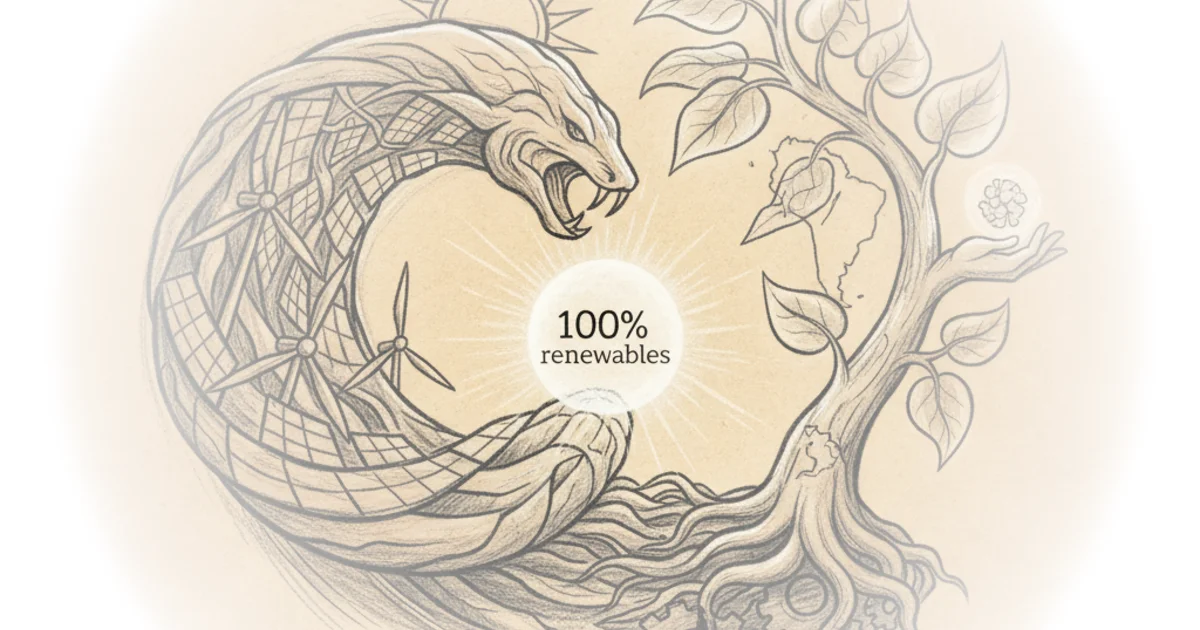
This evidence is compelling because it highlights a geopolitical pivot that often goes unreported in Western media. The region is no longer waiting for permission to decarbonize; they are simply doing it. Borlace emphasizes that this is not just about replacing one fuel source with another, but about addressing energy poverty and economic development simultaneously. "Most governments have recognized that a properly managed energy transition has the potential to reduce deforestation pressures in those regions." The argument here is that economic growth and environmental preservation are not mutually exclusive in this context, provided the right technologies are deployed.
The Double-Edged Sword of Hydro
However, Borlace does not offer a utopian vision. He critically examines the region's reliance on hydroelectric power, describing it as "a bit of a double-edged sword." While hydro provides essential base load power, the environmental and social costs are mounting. He details how massive reservoirs can become sources of greenhouse gases, noting that emissions from decomposing organic matter "can in some cases be comparable to the emissions of local fossil fuel fired power plants." Furthermore, the physical and social impacts are severe, from blocking fish migration to displacing communities and destroying cultural sites.
The most urgent critique concerns the climate itself. As the planet warms, the very resource that powers these dams becomes unreliable. Borlace cites the International Energy Agency, warning that "Latin American hydro powers overall capacity factor is projected to decline about 8% on average by midcentury simply as a result of the changing climate." This is a crucial insight: the region's historical advantage is becoming a vulnerability. Critics might note that abandoning hydro entirely is not currently feasible for grid stability, but Borlace's point is that relying on it as a long-term silver bullet is a dangerous gamble. The shift toward wind and solar is not just an option; it is a necessity for resilience.
Rivers and watersheds are already experiencing reduced or more erratic rain patterns and more frequent droughts, turning a historic advantage into a future liability.
The Challenge of Excess and Integration
As countries like Chile and Brazil accelerate their renewable adoption, they face a new, modern problem: too much success. Borlace highlights the "caillment problem" in Chile, where renewable output exceeds grid capacity, forcing turbines to shut down. "The folks at Ember tell us that almost 20% of Chile's wind and solar was cailed in 2024 costing the country millions in lost revenues and potential savings across industry transport and agriculture." This is a paradox of progress—generating clean energy that goes to waste because the infrastructure cannot absorb it.
The solution lies in storage and grid modernization, areas where the region is still playing catch-up. Borlace acknowledges that while Chile is investing in battery storage, "long duration storage is currently expensive and yet to scale." He also points out that many grid systems "aren't yet designed for high shares of variable renewables and need urgent upgrades to futureproof them." This adds a layer of complexity to the narrative; the transition is not just about building solar panels, but about a massive, capital-intensive overhaul of the entire electrical architecture. A counterargument worth considering is whether the pace of grid modernization can keep up with the speed of renewable deployment, or if this bottleneck will stall progress.
Political Volatility and the Path Forward
The final piece of the puzzle is political stability. While Brazil under President Lula is hailed as a "poster child for renewable transformation," other nations face significant headwinds. Borlace points to Argentina, where the political leadership is described as having a "drill baby drill attitude," threatening to exploit vast shale gas reserves despite renewable targets. He warns that "national policies that can lurch from one extreme to another as leaders come and go" create a risky environment for the long-term capital needed for energy projects.
Despite these risks, the momentum seems undeniable. International investors and domestic pension funds are increasingly comfortable financing these projects. Borlace concludes that the stakes are incredibly high, not just for the continent, but for the world. "South America matters a lot. Not just because of its rainforest and carbon sinks, although yes, definitely them, but also because the lessons learned there about how best to manage the energy transition will most likely be translated to Africa and Asia and other developing parts of the world." The region is effectively running the pilot program for the rest of the Global South.
Bottom Line
Dave Borlace's strongest argument is the demonstration that South America has achieved a structural break from fossil fuels, moving past the planning stage entirely for coal. However, the piece's greatest vulnerability lies in the tension between rapid renewable deployment and the lagging grid infrastructure, alongside the persistent threat of political volatility in key nations. The world should watch not just the megawatts being generated, but how these nations solve the storage and transmission bottlenecks that threaten to turn their green success into a stranded asset crisis.