In a venture capital landscape drowning in consensus, Mario Gabriele's latest correspondence with Floodgate founder Mike Maples, Jr. offers a rare, unsettling diagnosis: the era of true heresy may be over. While the industry celebrates a unified belief in artificial intelligence, Gabriele and Maples argue that this very unanimity has created a dangerous orthodoxy where 'seeming contrarian' has become the new conformity. For the busy investor or operator, this piece is not a cheerleading session for the next big thing, but a warning that the most valuable insights are currently being drowned out by a flood of 'glossy uniformity.'
The Illusion of Dissent
Gabriele opens by framing the current moment as one of 'intense, ferocious orthodoxy.' He observes that while everyone agrees AI is transformative, the debate has narrowed to mere degrees of impact rather than fundamental questions. 'Does it count as heresy to simply pay more for the same company everyone agrees is compelling?' Gabriele asks, highlighting the paradox where paying a premium for consensus is treated as a strategy. This framing is crucial because it exposes the hollowness of the current market's 'contrarian' signals. As Gabriele notes, 'With the exception of contrarians like Founders Fund, VCs of the 2010s balked at backing defense and industrial companies. Now, they are in fashion.' The shift isn't necessarily heretical; it's just the latest trend in a cycle of imitation.
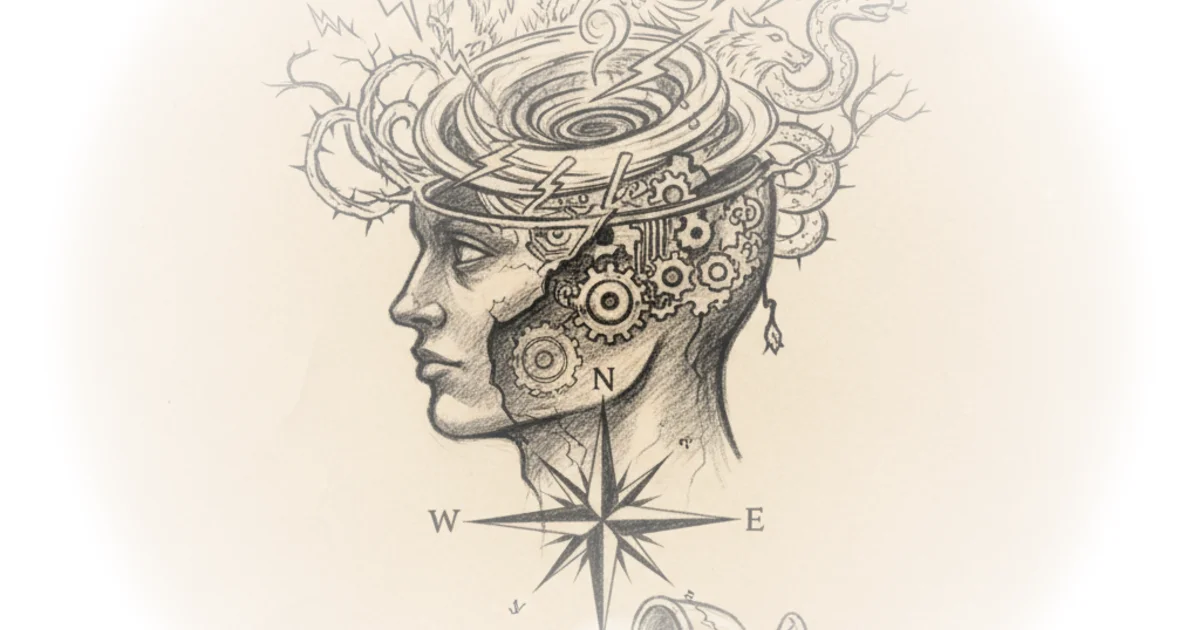
The piece draws a sharp distinction between simple contrarianism and genuine heresy. Maples, responding to Gabriele, clarifies that 'Contrarians say everyone thinks A, so I'll say B. That's still playing the same game, and just taking the opposite position.' True heresy, he argues, requires dismantling the A/B framework entirely. This distinction is the intellectual core of the article. It suggests that the current wave of 'AI for X' startups, which Gabriele describes as 'prompt-to-code product or browser agent released' every few days, are merely playing inside the same game. They are variations on a theme, not a new paradigm. The reference to Peter Thiel shouting 'mimesis!' from the wings serves as a perfect, biting critique of this replication. Critics might argue that iteration is necessary for progress, but Maples and Gabriele contend that without a foundational anomaly, iteration is just noise.
'A well-told story can sound exactly like an insight. It has the same structure and words. But real insight comes from noticing something specific about reality.'
The Anatomy of a Heretic
Gabriele structures the conversation around the specific ingredients required for a heretical idea, moving beyond vague platitudes about 'thinking differently.' Maples outlines a rigorous three-part test: a founder must have a 'different life experience,' the ability to 'see something others don't,' and the 'courage to act on it.' This triad is a powerful analytical tool. It moves the discussion from abstract philosophy to the gritty reality of founder psychology. Maples illustrates this with the Airbnb story, noting that the founders 'didn't start by thinking about hospitality. They were broke friends trying to pay next month's rent.' Their insight—that people would choose to stay with strangers if it felt 'meaningfully human'—was an anomaly that didn't fit existing patterns. This historical parallel to the Galileo affair, where a new observation shattered an established model, adds necessary depth. Just as Galileo's telescope revealed a universe that contradicted the church's dogma, the Airbnb founders' lived experience revealed a market reality that the hospitality industry ignored.
The commentary here is particularly effective because it challenges the reader to look for 'new scarcities.' Maples explains that 'when computation became cheap, software became scarce.' Now, as AI commoditizes certain forms of cognition, the scarcity shifts elsewhere. 'AI has commoditized some forms of cognition while others remain unsolved,' he writes. This reframes the investment thesis from 'how do we build another chatbot?' to 'what human capability is now the bottleneck?' It forces a pivot away from the hype cycle toward the 'capability cycle.' Maples advises investors to 'find the entrepreneurs who have waited their whole careers to build something that new capability unlocks.' This is a call to patience and deep domain expertise, a stark contrast to the 'roiled' but ultimately shallow debates between 'accelerationists' and 'doomers' that dominate the current zeitgeist.
The Crisis of Recognition
Perhaps the most haunting part of the exchange is Maples' admission of uncertainty. He confesses, 'If heresy is freedom of thought, then do I actually have any heresies left in me?' This vulnerability is rare in financial commentary. Maples worries that the 'VC industrial complex' has become so adept at mimicking contrarianism that 'seeming contrarian has become the new orthodoxy.' Gabriele reinforces this by noting that 'founders raising money aren't necessarily the ones who've noticed something true about the world. They're the ones who can tell a good story about platform shifts and timing.' The danger, as Maples puts it, is that 'a well-told story can sound exactly like an insight.' This is a critical warning for any investor or operator navigating the current AI boom. The ability to articulate a vision is no longer a proxy for the ability to discover a truth.
The article's tone shifts from analytical to almost melancholic as it confronts the possibility that the space for genuine disruption has shrunk. 'There's far less room for heretical insight in AI than most people admit,' Maples writes. The market is 'roiled by disagreements' on the surface, but 'Seemingly without exception, venture investors are keen to invest in the current wave.' This creates a culture where 'creative homogeneity seems to have taken so firm a hold.' The piece suggests that the next big breakthrough won't come from the center of the AI debate, but from 'somewhere surprising, from a place or anomaly everyone has dismissed.' This echoes the historical pattern where paradigm shifts often come from the periphery, ignored by the mainstream until they are undeniable.
Bottom Line
Gabriele and Maples deliver a necessary corrective to the AI hype cycle, arguing that the most valuable opportunities lie not in betting on the consensus, but in finding the anomalies that the consensus cannot explain. The piece's greatest strength is its rigorous definition of heresy as a combination of unique experience, distinct perception, and the courage to act, rather than mere contrarian posturing. Its biggest vulnerability is the risk of becoming a self-fulfilling prophecy: if everyone is looking for 'heresy' in the same way, the search itself may become the new orthodoxy. The reader should watch not for the next 'AI for X' pitch, but for founders who are solving problems in material sciences or drug discovery using AI as a tool, not a product. In a world of glossy uniformity, the only true edge is the ability to see what others have been trained to ignore.