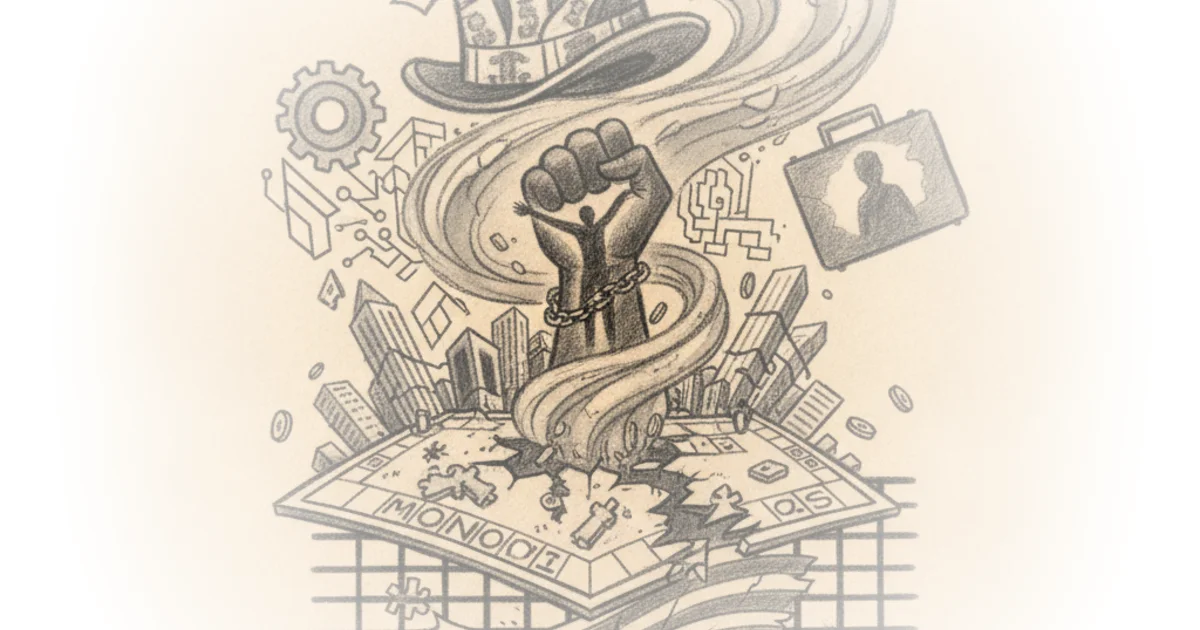
Matt Stoller delivers a jarring historical correction: the modern civil rights movement didn't just evolve; it was hijacked by corporate human resources departments to replace genuine economic redistribution with identity compliance. While most observers celebrate the opening of the Obama Presidential Center as a triumph, Stoller argues it actually symbolizes the final victory of Wall Street over the promise of equality, funded by the very oligarchs who dismantled the middle class.
The Wealth Trap of History
Stoller begins by anchoring his argument in the Juneteenth holiday, noting that while it commemorates emancipation, the modern celebration often obscures the economic reality of post-Civil War America. He writes, "Legally, the freeing of the slaves was one of the greatest redistributions of wealth in world history, and there were land grants to the whites in the form of the Homestead and Southern Homestead Acts." This reference to the Southern Homestead Act of 1866 is crucial; it reminds us that Reconstruction initially promised land and economic power, not just legal freedom. However, Stoller contends this vision was crushed not by cultural resistance alone, but by financial engineering.
The author traces a direct line from the Panic of 1873 to the collapse of racial solidarity. When Ulysses S. Grant's administration returned the nation to the gold standard, it triggered a depression that devastated both white workers and freed slaves. Stoller observes, "A bitter protest of Southern property reenforced Northern reaction; and while after long years the American world recovered in most matters, it has never yet quite understood why it could ever have thought that black men were altogether human." This framing is powerful because it shifts the blame from abstract racism to concrete monetary policy. The financial crisis destroyed the multi-racial coalition needed to sustain equality.
A bitter protest of Southern property reenforced Northern reaction; and while after long years the American world recovered in most matters, it has never yet quite understood why it could ever have thought that black men were altogether human.
Critics might argue that reducing the failure of Reconstruction solely to financial markets ignores the deep-seated ideological commitment to white supremacy. However, Stoller's point is that economic desperation made that ideology easier to weaponize against a multi-racial working class.
The Corporate Takeover of Equality
The piece then pivots to the 20th century, arguing that while the Civil Rights Act of 1964 was a moral victory, its enforcement mechanism was flawed from the start. Unlike environmental or labor laws, civil rights had no dedicated federal regulator like an EPA or NLRB. Instead, as sociologist Frank Dobbin found, corporations filled the void. Stoller explains that "it was human resources departments who ended up as the interpreters of the laws." This is a devastating critique of modern liberalism: we outsourced justice to the very entities we were trying to regulate.
Stoller notes that this shift coincided with the rise of deregulation and de-unionization. As general economic rights eroded, identity became the only remaining lever for protection. He writes, "Soon it was fine for an airline to price discriminate against customers for any reason, or to fire someone for any reason except identity." This creates a paradox where society is more tolerant culturally, yet less protected economically. The focus on HR compliance allowed companies to claim moral virtue while concentrating wealth.
The Obama Paradox and the Liberal Crack-Up
The commentary reaches its most contentious point when analyzing the Obama administration. Stoller argues that despite being elected on a platform of hope, the administration presided over policies that exacerbated inequality. "Obama represented 'hope and change,' the idea that we could transcend old conflicts," Stoller writes, but notes that his tenure resulted in "the biggest loss of black wealth in our lifetimes." The author suggests that the Obama Presidential Center, funded by tech billionaires like Jeff Bezos and Steve Ballmer, serves as a monument to this disconnect.
The article posits that the failure to address corporate power led to a political backlash. Stoller describes how "older Democrats decided to double down on the moral virtues of centering identity grievance" rather than confronting the rise of monopolies. This strategy, he argues, left the party vulnerable when young black men began voting for Trump in 2024 due to economic disenfranchisement. The author concludes that "the activism and legal fights in the Selma era turned into HR compliance regimes blessed by judges in the 80s and onward," effectively replacing law with corporate management.
The activism and legal fights in the Selma era turned into HR compliance regimes blessed by judges in the 80s and onward.
A counterargument worth considering is that identity politics remains a necessary tool for protecting marginalized groups against overt discrimination, regardless of economic conditions. Stoller acknowledges this but insists that without economic power, these protections are hollow.
Bottom Line
Stoller's most compelling contribution is his historical linkage between the financial collapse of 1873 and the modern erosion of civil rights through corporate HR structures. The argument's vulnerability lies in its tendency to view identity politics as a mere distraction from class struggle, potentially underestimating the independent moral value of anti-discrimination efforts. Readers should watch for how this analysis influences upcoming debates on antitrust enforcement and the future of labor regulation.