The machine that saved Moore's Law is unlike anything humanity has ever built. It costs $400 million, contains mirrors so precise that if one were scaled to the size of Earth, the largest imperfection would be no thicker than a playing card, and it fires 50,000 tin droplets every second—each heated to over 220,000 Kelvin, roughly 40 times hotter than the surface of our sun. This machine is not science fiction. It exists. And without it, the chips that power your phone, laptop, and every digital product you own would not be possible.
The Heart of Modern Computing
A microchip is essentially a nanoscopic computing city. When you zoom in, you find skyscrapers hundreds of layers tall with hundreds of kilometers of wires connecting everything. At the very bottom are transistors—billions of them forming the ones and zeros that make your computer work. The chip functions by whisking electrons from transistor to transistor. The smaller these transistors can be made, the shorter the distance signals must travel, and the faster they can compute. More transistors fit into the same area, resulting in a much more powerful chip.
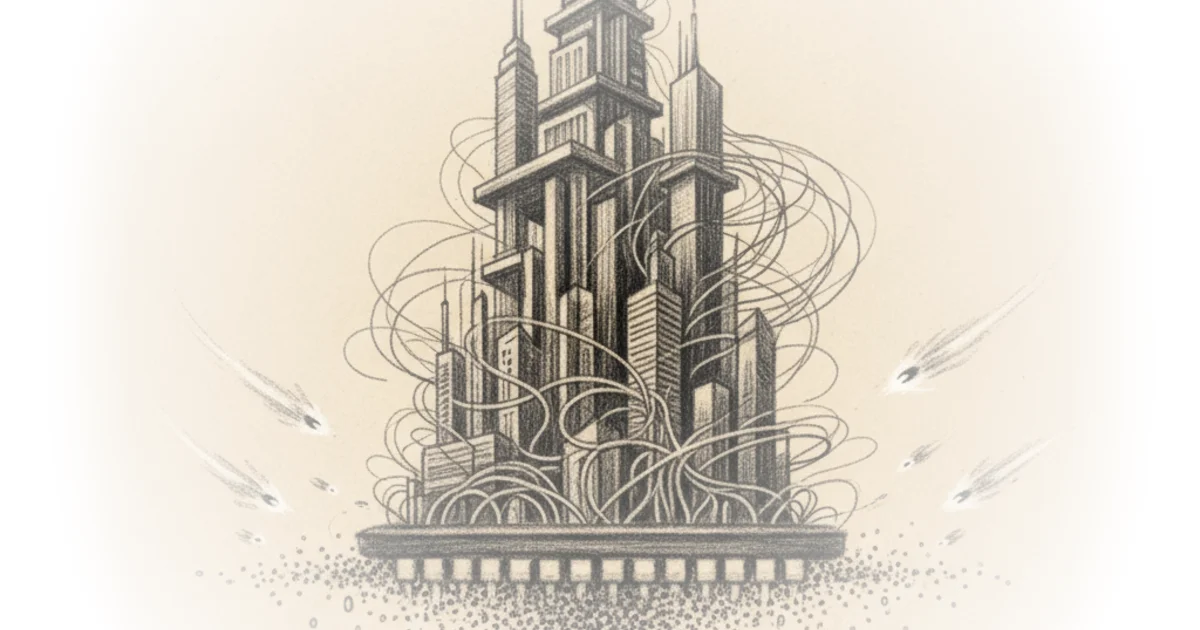
For over 50 years, transistors got smaller and smaller, and the number you could fit on a chip doubled approximately every two years. This pattern became known as Moore's Law, named for Intel co-founder Gordon Moore after he noticed it in 1965. It has been one of the main drivers of the technology industry.
But around 2015, progress came to a screeching halt. The physical limits of light itself seemed to block any further miniaturization. And we might have never gotten past this wall if it weren't for a single company that builds these machines—the only company in the world that can make them.
The Most Complicated Product Humanity Has Built
This machine is so complex and bizarre that describing it requires a thought experiment. Imagine you are shrunk to the size of an atom. You're given a laser strong enough to melt through metal like butter. A tiny droplet of molten tin, roughly the size of a white blood cell, is shot out in front of you at 250 kilometers per hour. Your task is to hit this droplet not once, not twice, but three times in a row in just 20 microseconds with your little laser.
That is exactly what this machine does. It hits one tiny tin droplet three times in a row, heating each one up to over 220,000 Kelvin. And it doesn't just hit one droplet—it hits 50,000 droplets every single second.
The same machine also contains mirrors that might be the smoothest objects in the universe. If you scale one up to the size of Earth, the largest bump would be no thicker than a playing card. On top of that, it is able to overlay one layer of a chip perfectly on top of another and never be off by more than five atoms. And this all happens while parts of the machine whip around at accelerations of over 20 Gs.
For 30 years, almost everyone thought that actually building this machine was impossible. And yet, it exists. There is only one company in the world that can make it: ASML.
How a Microchip Is Made
To make a microchip, you start by taking silicon dioxide, usually from sand, and purifying it into ultra-pure silicon chunks. These are melted down in a special furnace. A small seed crystal is lowered into the vat. Silicon atoms attach to the crystal, extending its structure. Then you slowly raise the seed crystal while rotating it. This results in a large single-crystal silicon ingot.
The ingot is then cut into wafers with diamond wire saws—up to 5,000 of them—after which each wafer is carefully polished. Next, it's coated with a light-sensitive material called photoresist. There are different kinds, but in a positive photoresist, the areas exposed to light become weaker and more soluble. So if you shine light through a patterned mask, you can selectively weaken parts of that coating.
Then you rinse the wafer with a basic solution to wash away the exposed photoresist, leaving the design imprinted. Now you can actually turn this pattern into physical structures. This is often done by etching into the uncovered silicon using either chemicals or plasma. And then you deposit a metal like copper to fill in those etched lines. As a last step, you wash away the remaining photoresist. And now you've made a single layer of the chip.
We've simplified this cycle down to the main steps: coat, expose, etch, and deposit. It repeats for every single chip layer. Depending on the chip, there could be anywhere from 10 to 100 layers. The bottom layer is the transistors—the most complicated layer, requiring hundreds of steps that all need to be perfect. The higher layers are a little easier; these are the metal wires that carry signals and power.
By the end, the completed wafer can have hundreds of chips, which are then cut into separate pieces, packaged, and put into products.
Where Light Becomes a Problem
But by far the hardest and most crucial step in the process is where you shine light through the mask and onto the wafer. This is photolithography. And that's because this step determines how small you can make the features.
At first, it seems simple. Light passes through the openings and gets blocked by all the rest. But as you try to print smaller and smaller features, the gaps in the mask start to approach the wavelength of the light. And that causes problems.
When light hits the reticle, its wave fronts bend as they pass through each gap. Each gap sends out waves that spread out and overlap. Let's just look at the light from these two gaps. When the peaks of one wave line up with the troughs of the other, we say that the two waves are out of phase and they cancel each other out. So you get dark spots. And when the peaks line up with the peaks, the two waves are in phase. They add up and you get bright spots.
You get interference, right? And you get a diffraction pattern.
Now diffraction is inevitable. So instead of fighting it, designers actually use it to get the patterns they want. They kind of work backwards from the eventual pattern they want on the wafer and they design the slits so that diffraction will occur in such a way that it creates the pattern that they want.
You see three dots. The middle dot that's the original one—that's the zero order. And then on the left and the right you can see the first and the minus first orders. In order for us to have this image resolved on the wafer, you need to capture the zero and the first and the minus first order.
The smaller you make the features, the larger this angle between the zero and first orders becomes. So the larger your lens needs to be to capture the light. The size of the lens is described by the numerical aperture, or NA for short, which is just the size of this angle. So the larger that is, the smaller the features you can print.
But there is a hard limit to how large your lens system can be. When this angle is 90 degrees and your numerical aperture is one, well, your lens would have to be infinite. Fortunately, there is one other thing we can change.
If I take a red laser with a wavelength of around 650 nanometers, and if I take a green laser with a wavelength of about 532 nanometers, then you can see that the green dots are closer spaced than the red dots. That's because the light from the two different gaps doesn't have to travel as far to match up in phase again. So the orders end up closer together. With a smaller wavelength, you can print smaller patterns using the same lens.
All of this is captured by the equation which determines the smallest feature size or critical dimension. But since there's a limit to how much you can increase the numerical aperture over time, the only way to keep making smaller and smaller features is by using shorter and shorter wavelengths.
So this is exactly what happened up until the late 1990s when the industry settled on 193 nanometer deep UV light. This was the light that was used to make all of the most advanced chips right until around 2015. But by that point, scientists had reached the limit to how small they could make the features. And Moore's Law was about to run into a brick wall.
The Radical Change
So a radical change was needed—a change that had been brewing for around 30 years. All the way back in the 1980s, Japanese scientist Hirokazu Kinoshita came up with a crazy idea. Why not use much shorter wavelengths like X-rays of around 10 nanometers? In theory, that should allow you to print much smaller features.
But you quickly run into a problem. X-rays at these wavelengths have enough energy to eject electrons from their atoms. So most materials absorb them. But unlike medical X-rays, which have wavelengths shorter than 1 nanometer, these are still long enough to interact with air. So air absorbs them, too. That meant that Kinoshita's setup had to be in a vacuum. But even worse, he couldn't use lenses to focus the light because the lenses would absorb it too. So it seemed like this idea would never work.
But around 1983, Kinoshita stumbled on a paper by Jim Underwood and Troy Barise. Their work focused on special mirrors that could reflect X-rays with a wavelength of 4.48 nanometers. So Kinoshita was intrigued. Curved mirrors can focus light just like lenses do. If he could figure out how to make these special mirrors for the wavelength he was using, then this could be another way to do photolithography.
The mirrors work something like this. When light crosses from one medium to another, say from air to glass, it bends or refracts. Some of it goes through and part reflects back. How much gets reflected depends on things like the angle, the light's polarization, and most importantly for us, the difference between the refractive indices of the two media. The larger that difference, the more light is reflected.
And Underwood and Barise used that principle. They made a super thin layer of tungsten less than 1 nanometer thick—thin enough that X-rays could pass through without immediately being absorbed. When X-rays hit the layer at a specific angle, the tungsten reflected less than 1%. Then they carefully tuned the layer thickness so the path length of the transmitted X-rays was only one quarter of its wavelength.
Then they added another layer, this time out of carbon. It has a higher refractive index than tungsten for wavelengths of 4.48 nanometers. The X-rays hit the boundary and a little bit more reflects. But this time, the phase is inverted or it's changed by half a wavelength. This happens when any light moves from a lower refractive index to a higher one.
Now, by the time this new reflected wave reaches the tungsten boundary, it has traveled another quarter of its wavelength for a half wavelength in total. So the two phases line up and the waves interfere constructively.
Underwood and Barise kept doing this trick for a total of 76 alternating layers so that in total they could reflect back much more of the X-rays. Now they only managed to reflect around 6% of the light, but it was a proof of principle that you could reflect X-rays.
So Kinoshita saw the possibilities. He got to work and after around two years his team designed and built three tungsten-carbon curved multi-layer mirrors to reflect 11 nanometer light. And with it he managed to print lines four microns or 4,000 nanometers thick—proving that at least in theory X-ray lithography was possible.
A year later in 1986 he went to present his findings to the Japanese Society of Applied Physics. Proud and excited, he explained his setup and showed his image. But to his horror, the audience refused to believe it. People seemed unwilling to believe that they had actually made an image by bending X-rays, and they tended to regard the whole thing as a big fish story.
Kinoshita was devastated. Nobody believed that this was a viable way forward.
Why Skepticism Was Justified
And unfortunately, the reaction was at least somewhat justified. First, this light isn't naturally produced by anything on Earth. The closest natural source is the sun. We had to basically build an artificial sun here on Earth.
Most scientists, including Kinoshita, produced X-ray light using a particle accelerator or a synchrotron. It gives an enormous amount of power. It's as big as a soccer field. You can fuel a whole fab. The problem is if the light goes out, the whole fab goes out. So each machine needed its own power source.
But even if you could produce the light, you'd need to make incredibly smooth mirrors to actually focus and print those tiny features. You would need the smoothest objects in the universe.
If one mirror would be the size of Earth, then the average bump on it is about 2-3 nanometers high. For a normal household mirror, the average height is about 4,000 silicon atoms. But for Kinoshita's mirrors—which not only needed to reflect X-ray light, which has 100 times shorter wavelength, but also needed to minimize scattering so that all the photons make it onto the wafer—it needed to be way more smooth. It needed to be atomically smooth.
In fact, the average bump could only be about 2.3 silicon atoms thick.
Critics might note that building such a machine seems impossible given these enormous challenges—the need for an artificial light source, the impossibly smooth mirrors, the vacuum chamber requirements. The difficulty seemed insurmountable.
But Kinoshita's work proved it was at least theoretically possible. And eventually, after decades of refinement, ASML built the machine that made it real.
Bottom Line
The story of ASML and extreme ultraviolet lithography is one of the most remarkable engineering achievements in human history. It saved Moore's Law when physical limits seemed to have blocked any further progress. The machine costs $400 million, weighs roughly a ton, and contains mirrors so precise that if scaled to Earth's size, their imperfections would be thinner than a playing card. It fires 50,000 tin droplets per second at temperatures 40 times hotter than the sun's surface. This is not science fiction—it is how your chips are made.
The strongest part of this argument is the sheer engineering marvel of it: taking an idea that seemed impossible in 1986 and turning it into reality over decades of refinement. The biggest vulnerability is that without ASML, we simply could not make smaller chips—and without smaller chips, the entire digital world would grind to a halt. This piece makes the case that this machine is quite possibly the most important industrial tool humanity has ever built.