While the West obsesses over the sheer volume of Chinese AI output, a harrowing new analysis reveals that this statistical dominance is built on a foundation of systemic human waste. Jordan Schneider, writing for ChinaTalk, dismantles the romanticized narrative of China's "AI talent pipeline," arguing that the country's success is not a triumph of efficiency but a brutal exercise in natural selection where the majority are discarded to fuel the few. For busy leaders assessing global tech competition, this piece offers a critical reality check: the metric of success is not just who produces the most papers, but at what human cost that production is sustained.
The Illusion of Efficiency
Schneider begins by challenging the prevailing assumption that China's STEM education system is a model to be emulated. The author notes that while US institutions rely heavily on Chinese-born researchers—accounting for 38% of the AI workforce compared to 37% for US-born peers—China's domestic progress is powered almost entirely by its own citizens. "China's AI research publication output matched the combined output of the US, UK, and European Union, and now commands more than 40% of global citation attention," Schneider writes. Yet, the author argues this volume masks a deeply inefficient engine. The system does not nurture talent broadly; it filters it ruthlessly. "The top STEM genius everyone sees at the summit is built upon the bodies of massive numbers of talented students who failed to reach the top," Schneider observes. This framing is crucial because it shifts the focus from a "race" to a structural critique of resource allocation. Critics might argue that high-stakes competition drives innovation globally, but Schneider's evidence suggests that in China, the cost of this competition is the systematic atrophy of potential in the non-elite majority.
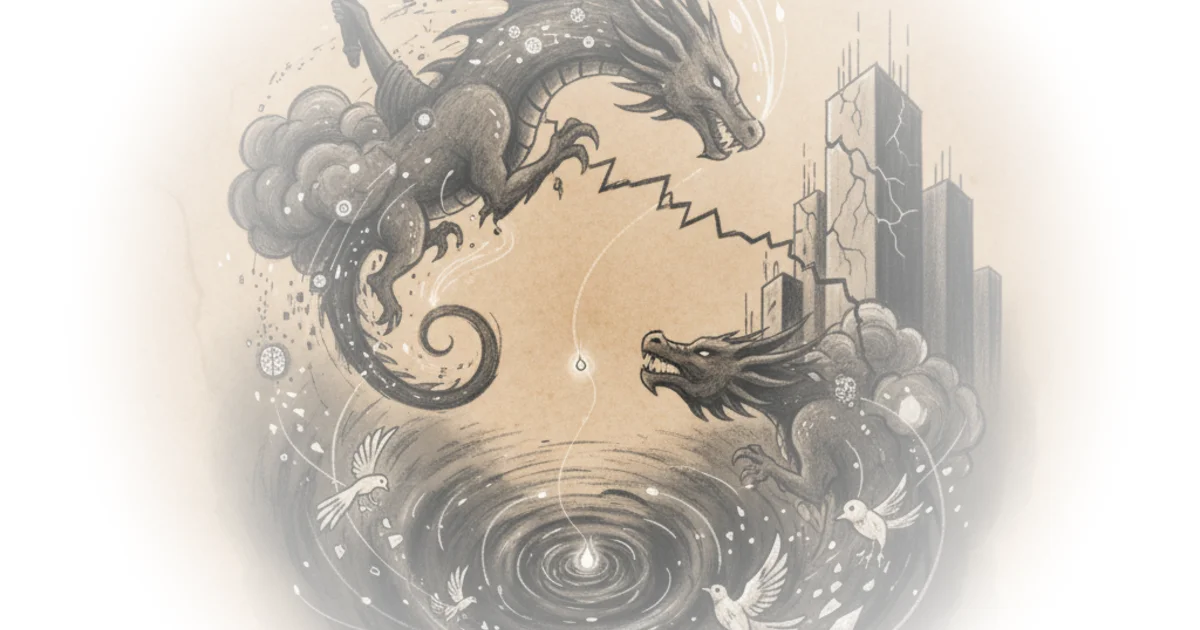
The author draws on personal experience in Hangzhou, a hub of AI innovation, to illustrate how the pipeline functions as a series of traps rather than a ladder. From elementary school, children are funneled into coding and math Olympiads, a path that mirrors the intensity of the Gaokao but adds layers of specialization that leave little room for error. Schneider describes a high school where "at least 400 students entered these training streams, but fewer than 30 students in total might reach the national stage." The stakes are absolute: "The later you were eliminated from the Olympiad track, the more closing the gap and getting into a good university via the Gaokao became a hopeless endeavor." This creates a scenario where a student's entire future hinges on a single, narrow metric. The author notes that in their city, the top high school recruited fewer than 300 students through exams out of 95,000 test-takers, creating a bottleneck so severe that failure in one track effectively closes all others. This is not merely competitive; it is a zero-sum game where the "reward" for the winner is the guarantee of elite status, while the "punishment" for the loser is the loss of all academic opportunity.
This piece is not about the life stories of successful Chinese AI or STEM talents. It is not about how the talent system works — but about how it does not.
The Human Toll of the Grind
The commentary takes a darker turn as Schneider explores the mental health crisis embedded within this educational architecture. The author moves beyond statistics to recount the silence of a psychiatry clinic waiting room, where a former Olympiad teammate, once destined for Peking University, sat alongside them. "We saw each other in the waiting room but did not speak. The silence was an agreement to pretend we did not know each other," Schneider writes. This anecdote powerfully illustrates the stigma surrounding failure and mental health in a system that prizes resilience above all else. The pressure is not limited to students; it permeates the entire academic ecosystem. A 2025 study cited by the author compiled 130 verified suicide cases in China's academic circles, finding that work and academic pressure were the leading factors in 53 percent of cases. "More than half of those who died worked in science and engineering fields," Schneider notes, highlighting that the most "valuable" assets of the nation are also the most vulnerable.
The institutional demands are described as inhuman. Schneider details a PhD advisor's requirements, which include "11 hours of work daily, from 8:30 to 22:30, with six fingerprint check-ins and security camera monitoring." Students are expected to produce high-impact papers during vacations, with no allowance for failure. "There is no cushion for failure," the author emphasizes. This rigid structure mirrors the infamous "996" working hour system often discussed in tech circles, but here it is applied to the formative years of a child's life. The author points out that even the physical environment is designed for exhaustion; a university in Beijing changed its trash bins to have flat tops simply so students could use them as desks to code while standing. This detail underscores a culture where rest is viewed as a liability. A counterargument worth considering is that such intensity is necessary to compete on a global scale, but Schneider's data suggests that the system is actually losing talent to burnout and suicide, potentially undermining the very goal it seeks to achieve.
The Myth of the Pipeline
Ultimately, Schneider argues that the "pipeline" is a misnomer. It is not a conduit that transports talent from childhood to adulthood; it is a filter that discards the vast majority. The author cites a 2021 Nature study showing that while elite Chinese students show significant growth in critical thinking, "the average STEM student at a non-elite university saw virtually no skill gains and often experienced a decline." This stagnation is particularly tragic because these students begin with skills surpassing their peers in India or Russia. "Their considerable initial talent is thus arguably wasted because the Chinese system reserves the resources necessary for continued skill development exclusively for the small cohort admitted to the most selective, 'elite' institutions," Schneider concludes. The system is described as "ruthless natural selection: only the brightest continue, and the rest are quietly discarded." This framing challenges the narrative of China's inevitable rise, suggesting that the current model is unsustainable and ethically fraught.
The author also highlights the demographic impact, noting that suicide rates among children and adolescents have risen significantly, with deaths among 15-24 year-olds surpassing three per 100,000. "During the 2020 Gaokao year... there were at least three high school students rumored to have committed suicide in the city. None were publicly acknowledged," Schneider writes. The lack of transparency further obscures the true cost of the system. The author suggests that the "myth" of the pipeline serves to justify the suffering, framing it as a necessary sacrifice for national greatness. However, the evidence presented paints a picture of a system that is not only cruel but potentially inefficient in the long run, as it burns out the very human capital it claims to cultivate.
This system of ruthless natural selection: only the brightest continue, and the rest are quietly discarded.
Bottom Line
Jordan Schneider's analysis is a vital corrective to the Western obsession with China's AI output, exposing the human wreckage hidden behind the impressive citation metrics. The argument's greatest strength lies in its unflinching documentation of the psychological and physical toll on students and academics, transforming abstract policy debates into a matter of human rights. However, the piece's vulnerability is its reliance on anecdotal evidence and unverified social media reports for some of its most shocking claims, which critics may use to downplay the systemic nature of the crisis. Readers should watch for how the Chinese government responds to these mounting pressures, as the sustainability of a system built on such extreme attrition remains an open and dangerous question.