This 2012 account of Hebron, republished by Matthew Clayfield, offers a visceral, ground-level view of an occupation that has calcified into a surreal, daily reality for Palestinians. While much modern coverage focuses on high-level diplomacy or explosive violence, Clayfield's narrative forces the reader to confront the mundane, grinding mechanics of control that define life in the West Bank. In an era where the status quo is often treated as a static backdrop, this piece argues that the true horror lies not in the battles, but in the absurdity of a city split in two, where a broken car and a missing brake pad become metaphors for a fractured existence.
The Geography of Exclusion
Clayfield begins not with a political manifesto, but with a mechanical failure, using the breakdown of a car to illustrate the impossible logistics of Palestinian movement. He describes a journey that should take thirty minutes stretching into hours because of the need to bypass Jerusalem. "It should by rights be a half-hour drive," Clayfield writes, "but with Jerusalem, and therefore Israel proper, lying smack-bang between the two, the only way to get from one to the other without crossing over and back again... is to take a wide berth around the city to the east." This framing is effective because it grounds the abstract concept of borders in the physical exhaustion of the traveler. The detour isn't just a nuisance; it is a structural feature of the occupation that consumes time, fuel, and patience.
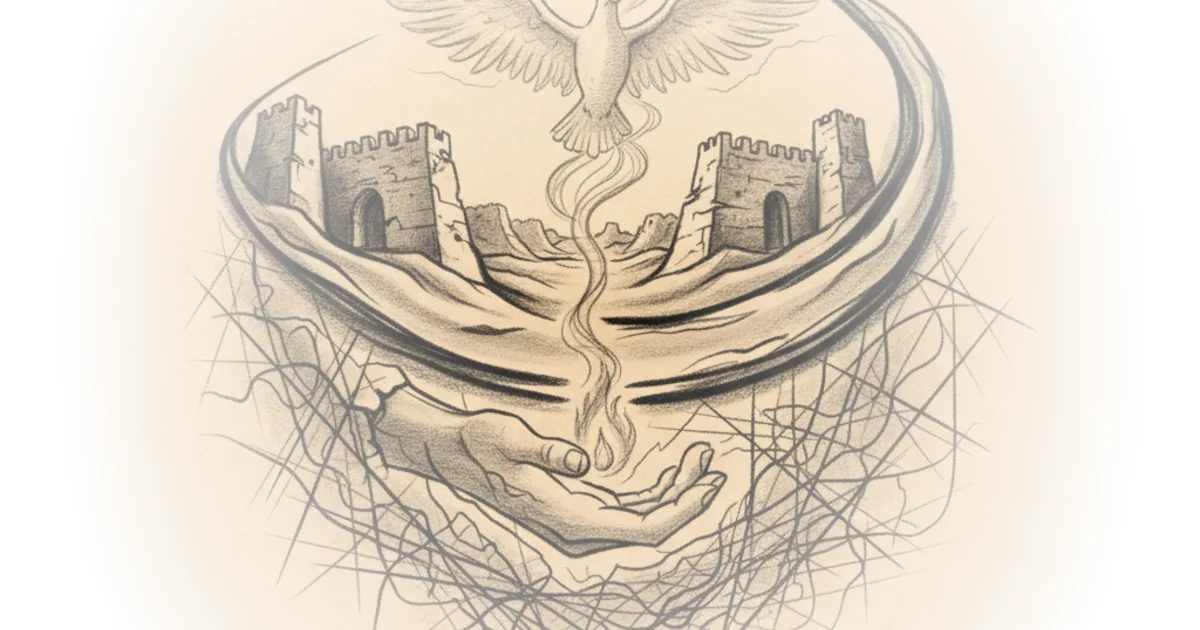
The author's description of the vehicle's disintegration—radiator smoking, bull bar falling off, driving without brakes for forty-five minutes—serves as a potent allegory for the fragility of life in this zone. "The halting journey is ultimately worth it," Clayfield notes, leading the reader into the stark reality of Hebron. Here, the narrative shifts from mechanical struggle to human confinement. The city is described as "cleaved in two," where a walk through a normal-looking market suddenly opens into a sun-drenched square dominated by an Israeli military pillbox. Clayfield captures the dissonance of the scene: a young soldier "cradling his assault rifle in his lap, his conscripted legs dangling against the wall in the Palestinian-controlled section of the city known as H1." This juxtaposition of a teenager's casual posture with the weight of an assault rifle underscores the normalization of militarization in civilian spaces.
"This is a city cleaved in two: one wanders through the Old City's souk, thinking everything normal if a little subdued, until one emerges into a bright, sun-drenched square, whereupon one is confronted with an Israeli pillbox."
The Architecture of Oppression
Clayfield's most striking observation concerns the physical infrastructure of the occupation, specifically the wire canopies erected over the streets. These are not just barriers; they are a visual manifestation of the separation between the ground floor and the lives above. "The Palestinians have jerry-rigged a chain-link wire canopy a few feet above head height all along the sections of the walkway that open to the sky," he writes. The author details how residents try to hide these cages with carpets, yet the silhouette of the wire remains visible against the light. This imagery is powerful because it illustrates the inescapable nature of the surveillance and control.
The narrative then exposes the source of this tension: the settlers living in the apartments above the market stalls. Clayfield explains that garbage thrown from these windows—"Coke cans, butcher's paper, used teabags caught hanging and dripping dry"—serves as a constant reminder that the Palestinians own only the stalls, while the buildings above are occupied by settlers. This detail humanizes the conflict by focusing on the daily indignities of living under someone else's trash. The author notes that these settlers are the beneficiaries of a 1968 decision by Rabbi Moshe Levinger, framing the current occupation not as a spontaneous event but as a deliberate, decades-long project of settlement. "There are between five and eight hundred of these in the city," Clayfield states, grounding the political in the specific number of families.
A counterargument worth considering is that the security measures, including the wire canopies and checkpoints, are framed by the Israeli government as necessary protections for settlers living in a hostile environment. However, Clayfield's account suggests that these measures have created a self-fulfilling prophecy of hostility by destroying the local economy and turning a vibrant city into a "ghostly, near-abandoned strip of prime real estate."
The Privilege of Movement
One of the most uncomfortable sections of the piece involves the author's own experience crossing from the Palestinian-controlled H1 to the Israeli-controlled H2. Clayfield highlights the stark disparity in freedom of movement based on race and nationality. When a local suggests he visit the Jewish side of the Cave of the Patriarchs, the author is stunned by the ease of access. "Just let yourself through?" he asks himself, noting the lack of restrictions for him compared to his Palestinian companions. He describes the experience as "more than a little like racial profiling, even if I'm the happy beneficiary of it."
This section is crucial because it forces the reader to confront the reality that the occupation operates on a dual system of law and movement. Clayfield admits to feeling like a trespasser in the Jewish sector, worried about his motives, yet he is allowed to pass without question. "I don't bother speaking to the guys at the checkpoint and they don't bother stopping me when I let myself back through into H1," he writes. The ease of his movement contrasts sharply with the suspicion his Palestinian friends face. This dynamic is reinforced when an American-Palestinian visitor remarks, "Israel puts so much time and energy into protecting the thugs on the other side of that wall. They have to know. They just don't do anything about it."
The Checkpoint and the Water
The narrative culminates in a tense encounter at a checkpoint on the way back to Ramallah. The author's sense of safety evaporates when an Israeli soldier questions whether he is being kidnapped by his Palestinian hosts. The soldier's suspicion is rooted in the assumption that a foreigner would not voluntarily travel with Palestinians in this context. "Are you supposed to be in this car?" the soldier asks, followed by, "Do you know these men?" Clayfield describes his reaction not as fear for himself, but as deep offense on behalf of his friends, who are reduced to potential kidnappers in the eyes of the state.
"For him and his friends, tonight is water. And it's never very far from boiling."
Clayfield closes by invoking David Foster Wallace's parable of the fish to explain the invisibility of the occupation's reality to those outside it. He suggests that for the people of Hebron, the constant humiliation and restriction are so pervasive they become the water they swim in. The final line, "They cannot have Jerusalem. We will take it back from them," spoken by his friend Shehada, is not presented as a political slogan but as a statement of existential necessity. The author's choice to end on this note, rather than a summary of the political situation, leaves the reader with the emotional weight of the conflict rather than just the facts.
Critics might argue that the piece focuses too heavily on the psychological impact on the author and his Palestinian friends, potentially overlooking the complex security dilemmas faced by the Israeli military. Yet, the piece's strength lies in its refusal to abstract the conflict into policy debates, keeping the focus squarely on the human cost of the status quo.
Bottom Line
Matthew Clayfield's piece is a masterclass in using personal narrative to expose the structural violence of the occupation, arguing that the true tragedy of Hebron is the normalization of absurdity and humiliation. While it lacks the perspective of the security forces, its unflinching look at the daily degradation of Palestinian life offers a necessary counter-narrative to official justifications. The reader is left with the chilling realization that for the people of Hebron, the water they swim in is boiling, and the world outside remains largely unaware.