Perun cuts through the fog of diplomatic ambiguity to reveal a stark reality: the Strait of Hormuz is no longer just an oil choke point, but a fragile artery feeding the global food supply and a gas network that the world cannot afford to break. While political leaders in Tehran engage in a confusing game of contradictory signals, the author argues that the economic consequences of this conflict are already being felt in the price of a bag of coffee or a child's toy, regardless of whether a single drop of oil has stopped flowing.
The Illusion of Control
Perun begins by dismantling the notion that Iran possesses a symmetrical military capability to strike the United States directly. Instead, the author posits that Tehran's strategy relies on applying "international or global cost" by targeting the Strait of Hormuz. "The straight of Hmuz is a vital economic artery," Perun writes, noting that "even a slight disruption here could have an impact that echoed across the global economy." This framing is crucial because it shifts the focus from a purely military contest to a battle of economic endurance. The author highlights the dissonance in Iranian messaging, where the UN ambassador claims no intention to close the strait while domestic media acts as if it is already sealed. "It's an absolute ship show of a situation," Perun observes, capturing the chaos facing sailors and traders caught in the middle.
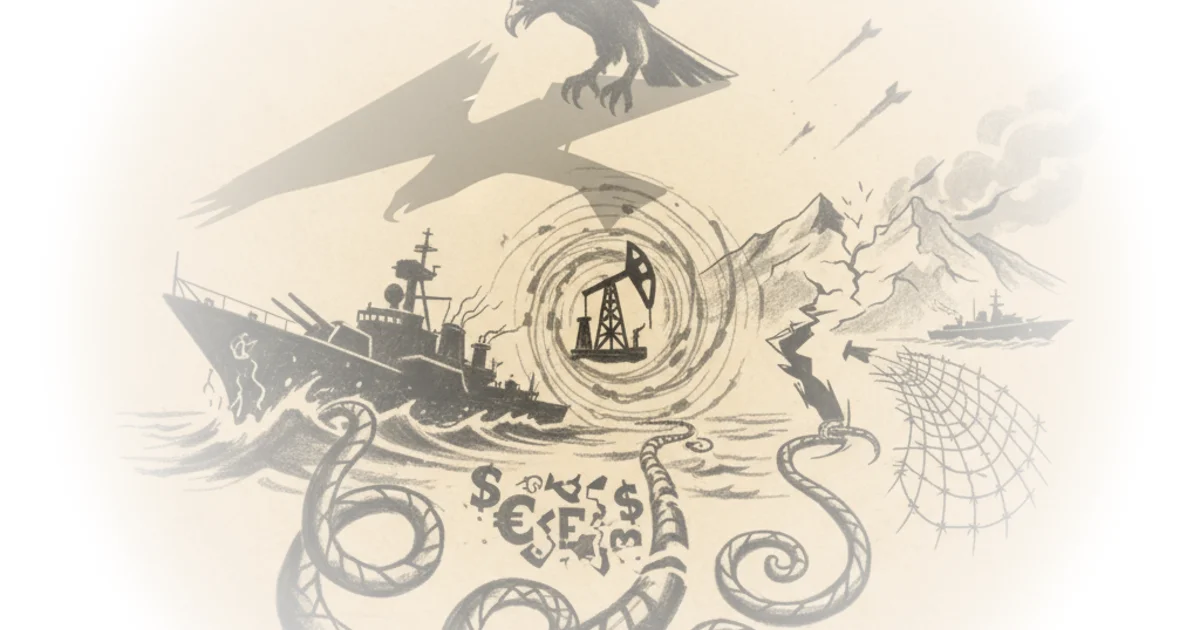
This historical parallel is not merely academic; it serves as a warning that asymmetric threats often outpace conventional responses. The author draws on the 1980s "Tanker War" to illustrate how a smaller force can paralyze a superpower's logistics. During Operation Earnest Will, the US Navy found itself "cautiously fell[ing] in behind" a damaged tanker, a moment that exposed a critical vulnerability. As Perun notes, the US Secretary of Defense at the time admitted, "We weren't looking for mines there because we'd never seen a mine in that area." This admission underscores a recurring theme: the high cost of protecting global trade against low-cost, asymmetric threats. Critics might argue that the US Navy has evolved significantly since the 1980s, yet the fundamental challenge of clearing mines and securing a narrow waterway against a determined adversary remains a massive resource drain.
Squeezing energy exports out of the Middle East has always been a powerful strategic play, but not a silver bullet.
The New Geography of Scarcity
The most distinctive contribution of this piece is its reframing of the Strait of Hormuz not as America's umbilical cord, but as Asia's. Perun points out that the global energy map has shifted dramatically since the Cold War. "Basically, this isn't America's primary energy umbilical anymore," the author states, citing data showing that over 12 million barrels a day flow to Asia, compared to a fraction for Europe and the Americas. This geographic pivot changes the strategic calculus entirely. While the US has become a net exporter, nations like China and India remain deeply dependent on this single gateway. The author further expands the scope beyond oil, noting that the Gulf is now a critical node for liquefied natural gas (LNG) and fertilizer production. "Qatar's production offline for example blows a roughly 20% hole in the global supply," Perun writes, emphasizing that gas tankers are "very expensive and very vulnerable."
The implications for global agriculture are particularly alarming and often overlooked in military analyses. With a third of global seaborne fertilizer trade passing through the strait, a disruption here threatens food security far beyond the energy sector. Perun explains that the correlation between gas prices and nitrogenous fertilizer costs means that "it's arguably not a great time to be a farmer dependent on these supply chains." The author suggests that while wealthy nations might absorb higher costs through inflation, the true victims will be those with the "least capacity or willingness to pay." This economic realism provides a sobering counterpoint to the often-sensationalized narratives of total global collapse. A counterargument worth considering is that global markets are remarkably adaptable, with slack capacity and alternative routes often mitigating shocks faster than historical precedents suggest. However, Perun's data on the lack of spare capacity in the LNG market lends weight to the argument that the margin for error has vanished.
The Strategic Dead End
Ultimately, Perun argues that history suggests these economic shocks rarely deliver the strategic victories the aggressor seeks. The author reflects on the 1973 oil embargo and the 1980s tanker wars, concluding that "none of these oil shocks in the 70s and 80s really seem to have delivered the strategic outcomes the initiating party wanted." The core of the argument is that while disrupting the strait inflicts pain, it is not a "silver bullet" for geopolitical dominance. The US Navy, despite its initial clumsiness in the 1980s, eventually demonstrated that holding the passage open was possible, albeit at a high cost. "It took a lot less resource commitment on the part of the Iranians to problematize and slow down traffic... than it did for the US and its partners to try and hold that passage open," Perun writes, highlighting the asymmetry of effort required. This dynamic suggests that while Iran can raise the price of conflict, it cannot easily dictate the outcome.
The world was on track for LG over supply in 2026. But they've also reportedly suggested that it would only take about a month of Qatar's production being shut down to cause a deficit on the international market.
Bottom Line
Perun's analysis succeeds in moving the conversation beyond military posturing to the tangible, cascading effects on global supply chains, particularly regarding food and gas. The strongest part of the argument is the detailed breakdown of how a disruption in Hormuz translates to inflation for everyday goods, making the abstract threat of war immediately personal. However, the piece slightly underestimates the speed at which global markets can reroute flows and the political will of major powers to secure these lanes, potentially overstating the inevitability of a prolonged global crisis. Readers should watch for whether the US and its allies can replicate the logistical feats of the 1980s in a more complex, multipolar world where the primary stakeholders are Asian nations, not just the United States.