Matthew Clayfield does not write about the San Fermín festival as a travel guide or a spectacle of danger; he frames it as a profound, almost spiritual collision of strangers that demands total personal surrender. The piece's most striking claim is that the event is not a gift given to the tourist, but a gift the tourist must give to the community through vulnerability and the abandonment of control.
The Architecture of Chaos
Clayfield opens by contrasting the sterile, detached experience of watching the festival from afar with the visceral reality of being on the ground. He writes, "I watched it live on YouTube... and felt nothing but sick to my stomach. I should have been there." This immediate admission of physical and emotional disconnection sets the stage for his argument: the essence of San Fermín cannot be consumed passively. He notes that while his parents hate the bullfighting, the author misses the sense of belonging, stating, "I miss my people, and my second home, and I miss the knowledge that, somewhere in the world, for at least ten days a year, I belong somewhere."
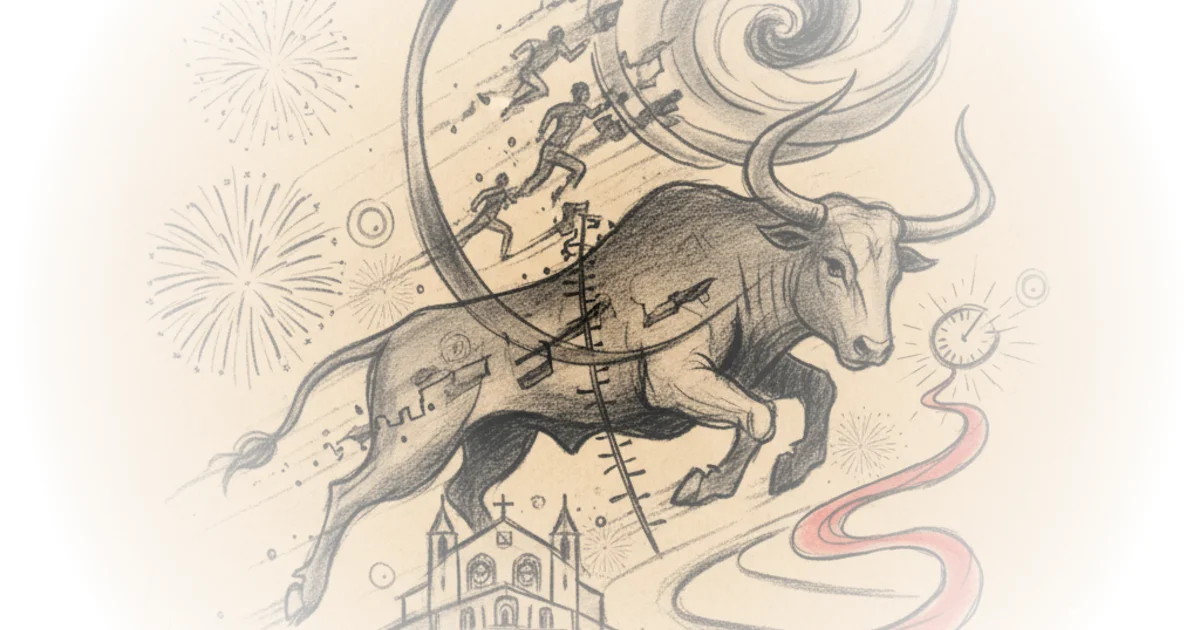
The author illustrates this through a chaotic personal anecdote about reuniting with his brother in a crowd of thousands, highlighting the absurdity of trying to impose order on the event. He admits, "This is honestly what I had thought at the time, and this is because I am an idiot," referring to the belief that he could find his brother in the throng without a phone. This self-deprecation is effective; it humanizes the experience, showing that the festival strips away the modern tools of certainty and leaves only raw, human instinct. Critics might argue that this romanticization of chaos ignores the genuine, life-threatening risks involved in the encierro, but Clayfield's focus remains on the psychological transformation rather than the physical statistics.
The Hemingway Myth and the Reality of Character
One of the most compelling sections involves a chance encounter in an Irish pub where a stranger passionately denounces Ernest Hemingway as a "fecking cunt" for his treatment of women and friends. The tension snaps when the narrator's friend reveals, "Ernest Hemingway was my grandfather." Clayfield uses this story to dismantle the romanticized literary myth that draws many to Pamplona. He writes, "Of all the bars in all in the towns in all the world, of all the towns in all the world, this one more than any other is one in which one should consider the unlikely coincidence likely."
This anecdote serves a dual purpose: it grounds the festival in the messy reality of human interaction rather than the polished pages of fiction, and it suggests that the true value of the event lies in the unexpected connections formed between people, not the historical figures they emulate. The author suggests that the festival is a place where identities are stripped down, allowing for a raw honesty that is rare elsewhere. As Clayfield puts it, "In Pamplona, as in Spain more generally, a spirit of generosity means nothing unless the person who possesses it is also generous with his or her spirit."
San Fermín is not a gift being given to you, but one that you give, that requires you to give of yourself.
The Guardian Angel in Ray Bans
The emotional core of the piece centers on "The Bomber," a legendary runner who became a personal superstition for the author. Clayfield describes him as a "guardian angel in Ray Bans," noting that the runner's presence provided a sense of safety that transcended logic. He writes, "I could only have it confirmed for me after the dust had settled... I walked away convinced that he was somehow responsible for the fact that I wasn't dead."
The author reflects on the Bomber's philosophy, describing the festival as a "gift" that requires the participant to be fully present. He recounts the Bomber's advice to younger runners and his belief that traditions like the corrida have a vital role in a homogenized world. However, the narrative takes a somber turn with the Bomber's death, forcing the author to confront the fragility of these rituals. "I don't know how I'm going to go this year in the knowledge that Bomber isn't out there anymore," Clayfield admits, adding, "Frankly, I'd rather believe in the Bomber."
This section effectively argues that the festival's power comes from its community of believers, who create their own meaning in the face of mortality. The author acknowledges his own atheism but chooses to embrace the superstition because it offers necessary reassurance: "As you walk out onto those cobblestones each morning, you'll take whatever reassurance you can get." A counterargument worth considering is that this reliance on superstition might distract from the ethical questions surrounding the treatment of animals in the festival, yet Clayfield's focus remains strictly on the human experience of fear, courage, and connection.
Bottom Line
Matthew Clayfield's piece succeeds by shifting the focus from the spectacle of the bulls to the internal transformation of the runner, arguing that the true danger and reward of San Fermín lie in the loss of control and the discovery of community. The strongest element is his reframing of the festival as an active exchange of spirit rather than a passive observation, though the piece occasionally skirts the darker ethical implications of the bullfighting itself. Readers should watch for how the author navigates the tension between the romanticized myth of the festival and the gritty, often painful reality of human connection it fosters.