A Former Attorney Takes On the Appalachian Mountain Club
Erik Phillips-Nania completed a twelve-day traverse of all forty-eight 4,000-foot peaks in New Hampshire's White Mountains before applying for an overnight front desk job at the Appalachian Mountain Club in the summer of 2022. He was hired to work alone through the night at the Highland Center, cleaning and monitoring the building while guests slept. What happened next became a federal court case that remains active today.
Phillips-Nania's account centers on a collision between institutional COVID-19 policy and individual religious conviction. He practiced breath-based spiritual disciplines, specifically pranayama, and held commitments to ahimsa (non-harm) and satya (truthfulness). On these grounds, he requested a religious exemption from AMC's vaccination requirement.
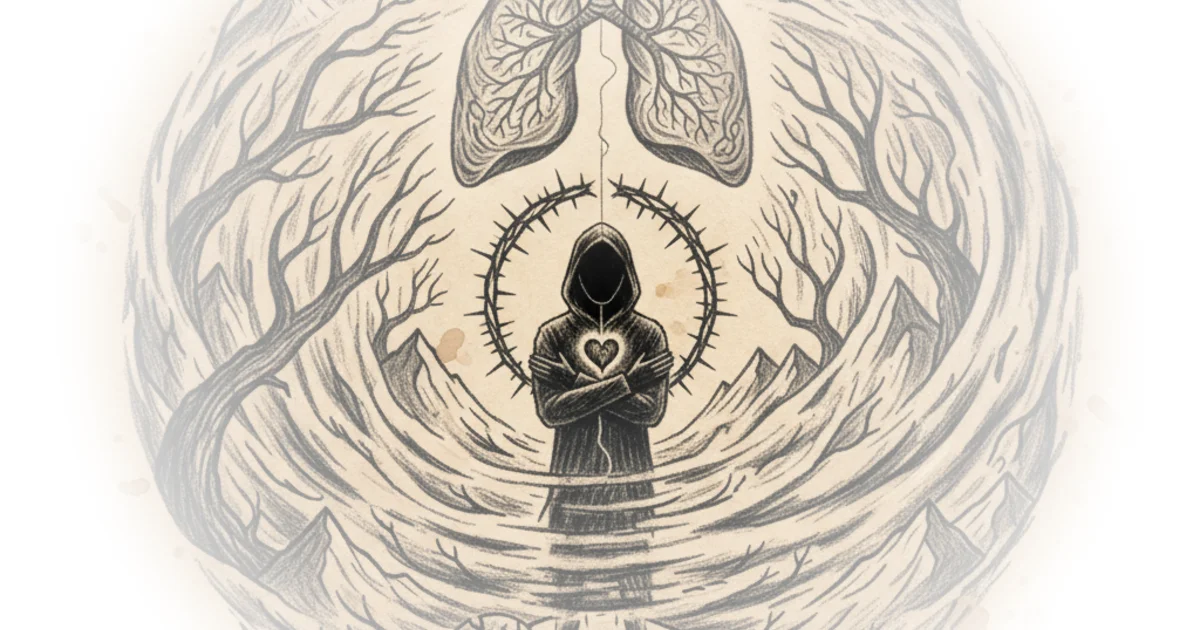
Breath, in my tradition, is not metaphor. It is communion.
The request was not casual. Phillips-Nania, who did not disclose to his employer that he was a former attorney, submitted detailed documentation. He cited his prior COVID-19 infection, studies on natural immunity, waning vaccine effectiveness against transmission, and what he characterized as emerging evidence of adverse events. He framed his refusal as a moral obligation.
I did not lose my job during the Covid era because I was careless, indifferent to others, or hostile to science. I lost it because I would not perform their ritual of fear or be punished with a mask for a religious exemption from vaccination.
The Accommodation That Wasn't
AMC granted a partial exemption. Phillips-Nania was required to test weekly, a condition imposed on no other employee. Masking was nominally required but, he writes, never enforced during his overnight shifts. Management gave verbal permission for him to remain unmasked, which he did for months.
Every test came back negative. No one alleged he posed a risk.
But the dynamic shifted when he began asking questions about inconsistencies in enforcement. Vaccinated employees who had not received updated boosters faced no additional requirements, even though they no longer met AMC's own definition of "fully vaccinated." Phillips-Nania, the sole religiously exempt employee, bore all the extra burden.
These were not hostile questions. They were precise ones. They were not welcomed.
His manager's response to the questioning was blunt. Phillips-Nania recounts being told, with visible emotional intensity, to stop asking questions about AMC's COVID policy altogether.
Colleagues Who Agreed but Stayed Silent
One of the more striking passages describes private conversations with coworkers. Several colleagues, mostly young backpackers, told Phillips-Nania they shared his assessment of vaccine effectiveness and risk. They had taken the shots because they needed the job, not because they believed the policy was sound.
They did not challenge the policy because they could not afford to. I could not unhear that. It confirmed that what was being enforced was not consensus, but compliance.
This section carries real weight. The gap between private belief and public behavior within institutions during the pandemic era is well-documented by now, and Phillips-Nania captures it vividly through a handful of quiet admissions from people in their twenties who felt they had no leverage.
The November Confrontation
On November 1, 2022, Phillips-Nania sent a written request for a full religious exemption from both masking and testing. That evening, during his solitary overnight shift, a supervisor arrived and demanded he mask immediately or leave.
There had been no change in conditions. No outbreak. No exposure. No guests present. Only my request — sent earlier that day to both him and upper management.
Phillips-Nania briefly put on a mask, then removed it within seconds. He describes the act as purely symbolic, a demand to perform compliance with a narrative he believed to be false. He was terminated on the spot and ordered to vacate employee housing the same day.
It was northern New Hampshire. It was November. By the next day, he was unemployed and homeless.
I did not leave because I wanted to. I left because remaining required me to violate conscience under coercion.
Where the Argument Thins
Phillips-Nania presents his case with the precision of someone trained in law, and much of it is compelling on its own terms. The selective enforcement he describes, if accurate, raises legitimate questions about religious accommodation under Title VII. But certain claims weaken the overall narrative rather than strengthen it.
His assertion that Ivermectin and Ayurvedic herbs served as effective prophylactics, and that his COVID infection amounted to "less than a cold for less than a day" as a result, moves the essay from legal argument into territory that many readers will find medically dubious. The clinical evidence for Ivermectin as a COVID prophylactic has not held up under rigorous review. Bundling this claim alongside otherwise careful legal reasoning risks undermining the discrimination case he is building, which does not actually depend on whether his personal health choices were optimal.
Similarly, characterizing all masking as inherently harmful to healthy individuals overstates the scientific consensus, even among critics of broad mask mandates. The stronger version of his argument, that masking a solitary overnight worker serves no rational safety purpose, does not require the broader claim.
The Legal Aftermath
AMC's formal termination letter reframed the events. What had been an on-the-spot firing over masking became "abandonment." Phillips-Nania's notation of disagreement on his employment contract was relabeled "falsification."
Their rationalizations changed. The outcome did not.
He filed a discrimination complaint with the New Hampshire Commission for Human Rights. The process took years and concluded with a finding of "no probable cause." Phillips-Nania now has an active Title VII case in federal district court and a separate state court case against the commission itself for what he alleges were procedural violations during its investigation.
The piece ends on a note that is equal parts defiance and exhaustion. Phillips-Nania frames his experience as representative of a broader failure, one in which institutions stopped distinguishing between genuine safety measures and symbolic compliance.
Policies hardened into identities. Questioning became heresy. And those who insisted — quietly and narrowly — on truth were treated as threats.
Bottom Line
Phillips-Nania's essay is a detailed, legally informed first-person account of what happens when institutional COVID policy meets sincere religious objection in a low-risk employment setting. The core facts he presents, a solitary night worker with natural immunity and consistently negative tests, fired for removing a mask while alone, make for a genuinely difficult case for the employer to defend on practical grounds.
The piece works best as a record of selective enforcement and institutional rigidity. It works less well when it ventures into broad claims about vaccine harm and alternative prophylactics that distract from the discrimination argument. Readers interested in the legal dimensions of pandemic-era religious accommodation will find this a substantive primary source. The federal court proceedings will ultimately determine whether the pattern Phillips-Nania describes amounts to unlawful discrimination or falls within an employer's discretion during a public health event.