Brad DeLong delivers a scathing takedown of the intellectual genre he terms "Speculative Nonfiction," arguing that when history is untethered from material reality, it becomes not a tool for liberation, but a cage of our own making. This piece matters because it challenges the comforting narrative that our current hierarchies are merely accidents of bad luck, suggesting instead that they are the result of deep, structural pressures that cannot be wished away by rewriting the past.
The Grand Narrative Trap
DeLong opens by questioning the utility of David Graeber and David Wengrow's The Dawn of Everything, a book that promises to "rediscover the freedoms that make us human" by rewriting history. The author is skeptical of this project, noting that the book's "scaffolding of fact is too thin to support the Grand Narrative." Instead of rigorous analysis, DeLong argues, the authors resort to "fake facts" and "strenuous mental gymnastics" to force history into a mold that suits their ideological desires.
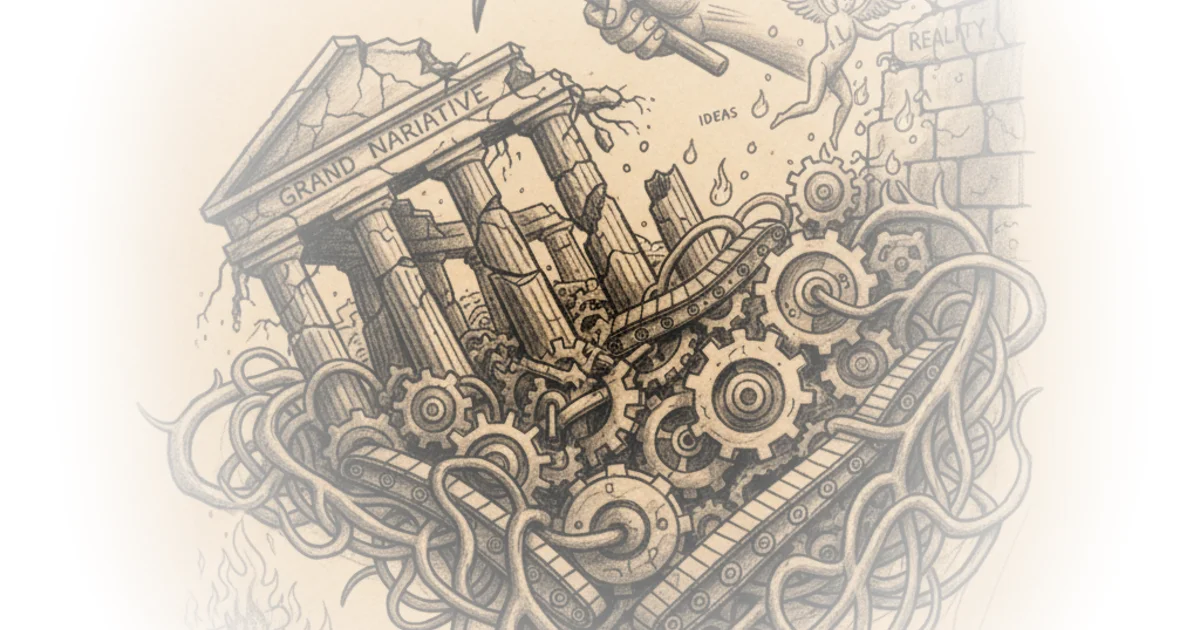
The core of DeLong's critique is that Graeber and Wengrow confuse the boundaries of the playing field with the game itself. He writes, "It is not ideas that control social reality, but rather underlying modes of production, distribution, coërcion, and communication that set the boundaries of the playing field on which ideas contend for honors." This is a crucial distinction. It suggests that while we can imagine different worlds, our ability to build them is constrained by how we feed, house, and move our populations. A counterargument might be that highlighting alternatives expands the "Overton window" of political possibility, but DeLong insists that expanding the window on a foundation of sand is a dangerous game.
"Speculative Nonfiction is not, I think, a useful intellectual genre... relying entirely on rhetorical misdirection tricks with smoke and mirrors."
DeLong leans heavily on the review by Walter Scheidel to dismantle the book's central claims. He points out that while Graeber and Wengrow condemn "conventional narratives of world history," they ignore the overwhelming evidence that farming unlocked a massive increase in human carrying capacity, allowing our species to grow by "three orders of magnitude." The authors' attempt to highlight "hybrid forager-farmers" and "developmental lags" is worthy, DeLong admits, but they ultimately fall into a trap: "a trap that was slow in closing was, in the end, a trap." The historical record shows that once agriculture took hold, the concentration of power was not an anomaly but a near-inevitable consequence of managing surplus and population density.
The Myth of the Stateless City
The commentary turns sharply when addressing specific historical examples. DeLong highlights how Graeber and Wengrow take speculative interpretations of archaeological sites and present them as settled fact. He notes their claim that structures on the late fourth millennium BCE acropolis of Uruk were assembly halls, which then "swiftly morph[s] into fact, turning into 'at least seven centuries of collective self-rule' at Uruk." This leap from hypothesis to history is, for DeLong, a fatal flaw.
He applies the same scrutiny to Teotihuacan, a city of 100,000 residents that lacked clear iconographic evidence of royalty. While Graeber and Wengrow see this as proof of a "surprisingly common pattern" of scaling up without elite concentration, DeLong points out the grim reality: "Pyramid construction ceased, the fanciest temple was desecrated, and high-quality stone-built multi-household apartment compounds were erected to house the urban masses... before things started falling apart." The city was an outlier, not a blueprint. As DeLong puts it, "Teotihuacan was... without precedent and successor." To build a theory of human potential on a single, failed experiment is, in his view, intellectually dishonest.
"Rely on something David Graeber wrote about how some historical episode went down and try to use it as payment as you construct an argument, and you are very likely to find that you have tried to buy something with faërie gold—enchanted temporarily, yes, but misled."
The author also addresses the case of Cahokia, an incipient grain state in North America that was eventually abandoned. Graeber and Wengrow frame the collapse of Cahokia and the subsequent rise of indigenous political structures as a "backlash" against overlords, a conscious choice to avoid the "evolutionary trap" of the state. DeLong dismantles this, noting that the "absence of horses" and sparse populations were the real reasons for the lack of centralized power, not a moral or political rejection of hierarchy. "If the anti-Cahokia backlash scenario is the best Graeber and Wengrow can come up with to demonstrate alternative trajectories of social evolution, determinists can rest easy," he writes. The argument that we could have chosen a different path ignores the material constraints that made the state the dominant form of organization for the majority of humanity.
The Cost of Idealism
DeLong's most stinging critique is reserved for the book's conclusion, where Graeber and Wengrow claim that "the possibilities for human intervention are far greater than we're inclined to think." DeLong argues that this hope is built on a misunderstanding of history. He writes, "Their idealist purism traps Graeber and Wengrow in a cage of their own making." By ignoring the materialist perspective—that our social structures are tied to how we produce and distribute resources—the authors offer a vision of freedom that is disconnected from the realities of the modern world.
He challenges the notion that the rise of the state was merely a "malign contingency." Instead, he suggests that the concentration of power was the result of "very strong pressures and trends" that cannot be easily reversed. "How much do these faded traditions have to offer to us today, how can they teach us to make different choices in the present?" DeLong asks. The answer, he implies, is not to look for lost utopias in the archaeological record, but to understand the material forces that shape our current reality.
"Materialism is not the enemy of historical understanding: it is essential to it. Nor is it the enemy of social activism. It might even be its best friend."
Critics might argue that DeLong is too dismissive of the value of counterfactual thinking, which can inspire new political movements. However, DeLong's point is that inspiration without factual grounding is dangerous. If we build our hopes on "faërie gold," we will be left with nothing when the sun comes up. The book's failure to account for the "concurrent growth in prosperity, health, longevity and knowledge" alongside the rise of states further undermines its claim that "something has gone terribly wrong with the world."
Bottom Line
DeLong's argument is a necessary corrective to the trend of using history as a prop for contemporary political wish-fulfillment. His strongest point is the insistence that material conditions, not just ideas, dictate the boundaries of social possibility. However, his dismissal of speculative history risks closing off the very imagination needed to challenge the status quo. The reader must watch for the tension between the comfort of a grand narrative and the hard work of understanding the messy, often brutal, realities of the past.