In a year where the global order feels less like a steady ship and more like a vehicle careening toward a ditch, Damien of Geopolitical Dispatch offers a rare and necessary diagnosis: the era of prediction is dead, and the age of positioning has begun. Rather than offering another list of failed forecasts, the author reframes the chaos of 2025 and 2026 not as a failure of intelligence, but as a fundamental shift in the nature of power itself. This is a crucial pivot for busy leaders who are tired of betting on single outcomes in a world that refuses to follow a script.
The End of the Predictable Era
The piece opens by dismantling the comforting illusions of the past few years. Damien notes that even to a "modern-day Nostradamus, 2025 was a year full of surprises." The author highlights a stark reversal in global conflict dynamics: the war in Ukraine ground on despite promises of resolution, while the conflict in Gaza halted against all odds. More critically, the executive branch abandoned the language of a "rules-based international order," replacing it with older, harsher concepts of "spheres of influence" and "might makes right."
This shift is not merely rhetorical; it reflects a tangible change in how the United States and other powers are acting. The author observes that threats once dismissed as bluster were executed, while expected interventions never materialized. The result is a geopolitical landscape that feels "vaudevillian, almost burlesque," where the line between serious statecraft and performance art has blurred. This framing is effective because it captures the disorientation felt by institutions that rely on consistent signals from Washington.
The article then turns to the military missteps of the administration, specifically the intervention in Venezuela and the subsequent campaign against Iran. The author writes, "Seemingly emboldened by this military success, President Trump then took on Iran — 'decapitating' its leadership only to find, like the mythological Hydra, two heads regrow for every one chopped off." This reference to the Lernaean Hydra serves as a potent historical anchor, reminding readers that violence often begets complexity rather than resolution. The failure to predict the closure of the Strait of Hormuz following an aerial attack on Iran underscores a deeper institutional blindness.
"When it comes to predicting the nature and location of our next military engagements, since Vietnam, our record has been perfect. We have never once gotten it right."
By quoting former Secretary of Defense Robert Gates, Damien connects current failures to a long, unbroken streak of American strategic miscalculation. The argument here is that the Department of War's planners ignored historical precedents, assuming a level of control that simply does not exist in the modern theater. Critics might note that the article attributes these failures to a specific administration's hubris, but the broader point—that institutional arrogance often blinds planners to second-order effects—remains valid regardless of who is in the Oval Office.
The Staircase of Acceleration
The core of the commentary shifts from specific events to the psychological state of the world. Damien draws on the Georgian novelist and historian Boris Akunin to describe the current mood. The author paraphrases Akunin's powerful metaphor: the world is "standing on a staircase that is not only descending, but becoming steeper with every step." This captures the sensation of acceleration and loss of control that defines the current moment.
The piece argues that previous eras, from the Concert of Europe to the Cold War, possessed a sense of predictability, however illusory. The Concert of Europe, for instance, was a system of Western domination that managed conflicts for a century, creating a false sense of security before the First World War. In contrast, today's world lacks such a stabilizing mechanism. The author writes, "The nineteenth-century Concert of Europe was fundamentally a system of Western domination — when today the collective power of the West and the internal cohesion of its nations are both on the wane."
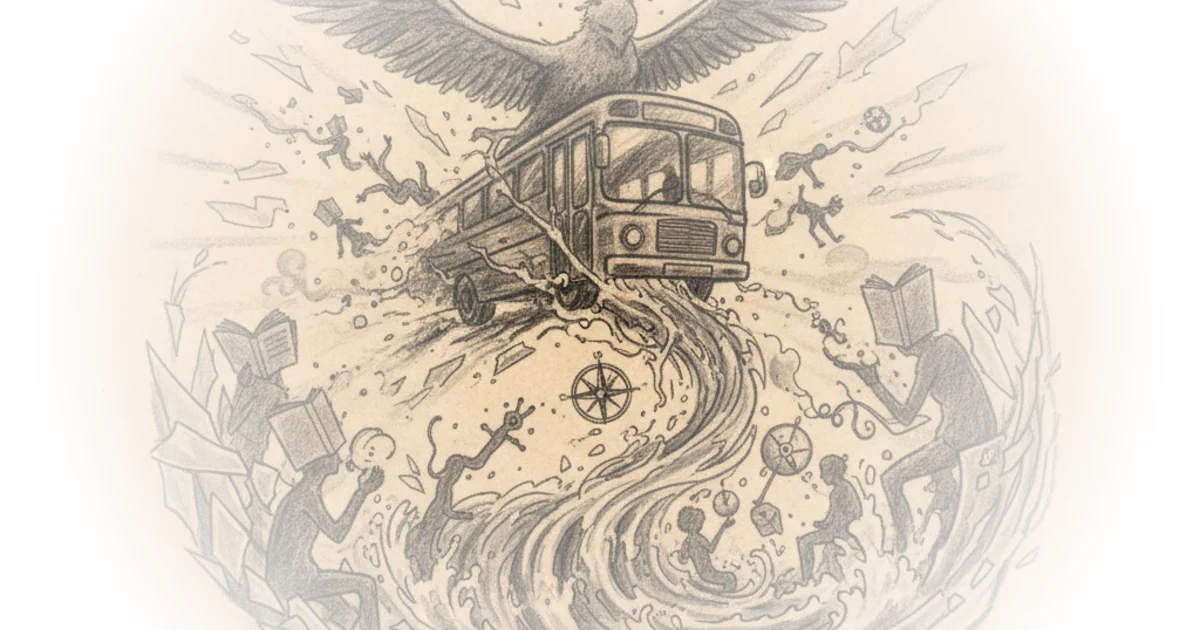
This comparison is sharp. It suggests that the old analogies no longer fit because the underlying power dynamics have shifted. The West is no longer the undisputed hegemon, and the global system is not defined by a simple bipolar rivalry. Instead, the world is fragmenting. Damien quotes Akunin again to illustrate this fragmentation: "I imagine the world as a huge bus, in which sits a very motley, quarrelsome public, and at the wheel sits an American... He jerks the wheel this way and that. He shouts some strange songs. There is a complete feeling that all of this is about to fly into a ditch."
This image of the erratic driver is the piece's most striking contribution. It moves beyond policy analysis to capture the visceral anxiety of the global public. The driver's behavior is not just a reflection of one leader's personality but a symptom of a system losing its center of gravity. The unpredictability is no longer a temporary glitch; it is the "essential condition of the world in which we live."
Positioning Over Prediction
Faced with this chaos, the natural human instinct is to seek more data and better algorithms. Damien argues that this response is futile. "The question worth sitting with instead is not 'what will happen next' but 'how do you position yourself for a range of outcomes'," the author writes. This distinction is vital. Prediction asks for a single bet; positioning asks for resilience across multiple scenarios.
The article introduces the "RANE World Humility Index of Predictions (WHIP Index)," a collaboration designed to catalog the 194 events of 2025 that no one foresaw. This initiative serves as a training exercise in humility. The author notes, "It documents 194 such moments from 2025 alone, including thirty geopolitical events that nobody called, each of which reshaped something important." By treating these failures as a curriculum rather than a scandal, the piece encourages readers to abandon the search for certainty.
The commentary suggests that the value of Geopolitical Dispatch lies not in its ability to forecast, but in its ability to orient. "In a world where the bus is jerking toward a ditch, knowing roughly where you are matters more than knowing exactly where you're going," Damien concludes. This is a pragmatic approach for leaders who cannot afford to wait for the fog to clear. Instead, they must learn to navigate the fog.
"It's tough to make predictions, especially about the future."
Quoting Yogi Berra, the author encapsulates the entire argument with a touch of wit. The piece acknowledges that while technology and AI promise foresight, they cannot account for the chaotic interplay of human fear, hope, and ambition. The "small data" of individual leaders' thoughts often outweighs the "Big Data" of algorithms.
Bottom Line
Damien's argument is a compelling call to abandon the illusion of control and embrace the reality of chaos. The strongest part of the piece is its reframing of unpredictability not as a problem to be solved, but as a condition to be managed through resilience and humility. The biggest vulnerability is the reliance on the metaphor of the "erratic driver," which, while vivid, risks oversimplifying the complex institutional forces driving US foreign policy. However, the core message remains clear: in an era where the bus is flying into a ditch, the only smart move is to stop trying to predict the crash and start bracing for impact. Leaders should watch for how this shift from prediction to positioning reshapes corporate strategy and risk management in the coming year.