In a digital landscape increasingly defined by algorithmic addiction, Scot McKnight identifies a startling counter-trend: a generation turning away from screens to find genuine connection in the wild. This piece is notable not just for its observation of a cultural shift, but for its theological reframing of how we find meaning in a chaotic world. McKnight argues that the solution to modern disorientation isn't more data, but a deeper listening to the patterns already woven into our lives and the natural world around us.
The Wild and the Wired
McKnight opens by highlighting a paradox where technology, often blamed for our isolation, is actually the gateway to a re-enchantment with nature. He notes that "Early Onset Birder Syndrome" is a self-diagnosis spreading among young people who are flocking to amateur birdwatching. The author observes that "big tech making the internet increasingly addictive" has ironically driven users toward apps like Merlin Bird ID, which he describes as "sort of like Shazam but for bird calls." This framing is effective because it avoids the usual moral panic about screen time, instead showing how digital tools can facilitate a return to the physical world.
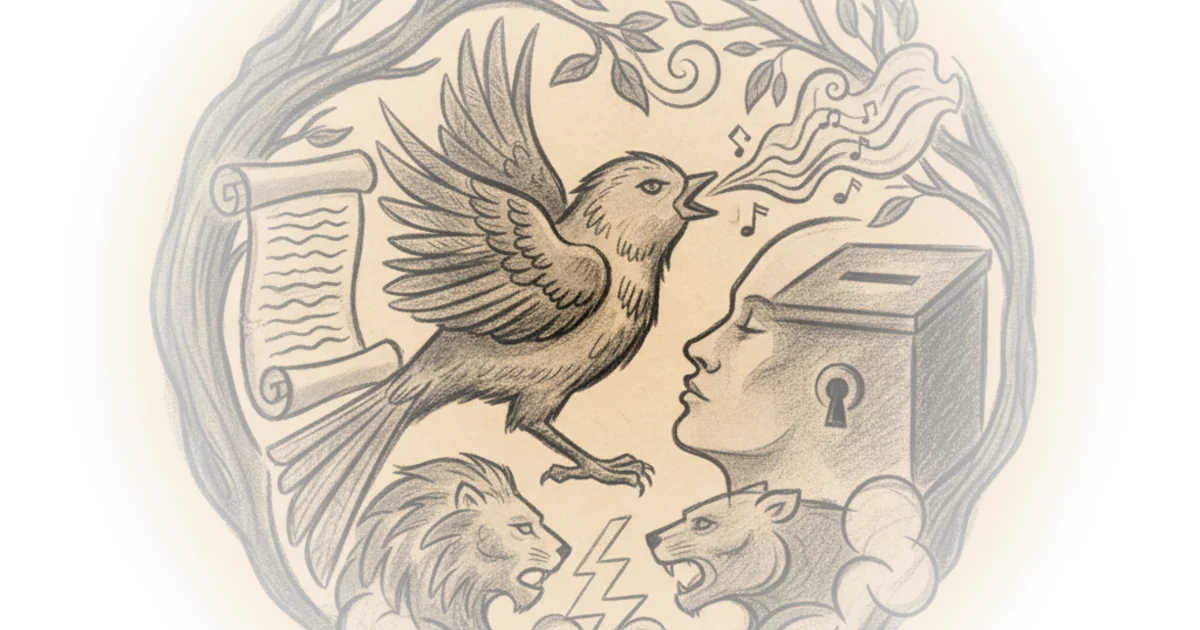
The piece draws a fascinating parallel to the historical fascination with the American woodcock, noting how Bryant Park recently went viral for crowds gathering to see the bird's mating dance. McKnight muses on the absurdity of the moment, asking readers to "imagine generating this much hype just for existing." This observation lands because it strips away the need for manufactured drama; the natural world provides its own spectacle. It echoes the genetic complexity found in the Chimera, where distinct organisms fuse into one, much like how digital and natural worlds are merging in the minds of these new birders.
"Birding really did rescue me."
The emotional core of this section comes from Bonner Black, a singer-songwriter who turned to birding during a mental health crisis. McKnight uses her testimony to argue that the activity is not merely a hobby but a lifeline. "Within a month, I was completely hooked," she admits. This personal anecdote grounds the statistical rise in birdwatching searches, proving that the trend is driven by a desperate human need for grounding, not just a fleeting fad. Critics might argue that this romanticizes a niche activity, but the sheer volume of data from Google Trends suggests a broader societal hunger for this kind of engagement.
The Golden Threads of a Life
Shifting from the natural world to the internal landscape, McKnight tackles the confusion between career and calling. He writes, "We are trained to listen to Scripture, the church, sermons, songs, and even to nature. But we are profoundly untrained in listening to our own lives." This is the piece's most provocative claim: that spiritual maturity requires a form of introspection that many religious traditions inadvertently discourage. The author suggests that when we finally listen, "it does not isolate us—it integrates us."
McKnight introduces the concept of "golden threads," those repetitive themes and desires that form a narrative beneath the surface of daily events. He argues that "life rarely moves in straight lines. It is less like a roadmap and more like a sailboat: adjusting constantly to the winds, moving forward—but rarely directly." This metaphor is powerful because it validates the non-linear nature of modern careers and spiritual journeys. It challenges the rigid, outcome-based thinking that dominates professional life.
"Career is an expression. Calling is a posture."
This distinction is the intellectual anchor of the commentary. McKnight posits that when we collapse the two, we create a "fragile identity" where losing a job means losing oneself. However, if calling is tied to those deeper golden threads, "we discover something far more stable. We can adapt without losing who we are." The argument holds up well against the backdrop of an unstable economy, offering a psychological resilience that a purely career-focused identity cannot provide. A counterargument worth considering is that for those in survival mode, the luxury of distinguishing between career and calling may feel abstract, yet the author's point is that the posture of calling is precisely what sustains one through survival.
Restoring Dignity and Tracing Shifts
The commentary then pivots to institutional reckoning and political history, maintaining its focus on patterns and restoration. McKnight details Virginia Commonwealth University's decision to spend $3.6 million on a memorial for individuals whose bodies were stolen for medical dissection. He quotes VCU President Michael Rao, who stated, "The East Marshall Street Well Project's sacred mission is to ensure every life is honored with the permanence and reverence they deserve." This section serves as a stark reminder that institutions are finally beginning to address historical violence, not through silence, but through costly, tangible acts of repair.
The design of the memorial, featuring a "unity chamber" inspired by Dogon culture with a low roof to "facilitate seated reflection," underscores the need for humility in the face of history. McKnight uses this to transition into a broader analysis of political realignment. He presents data showing that the shift of white Christians from the Democratic to the Republican party was not a slow drift but a rapid change, noting that "by 1980, the share of white Christians who were Democrats had dropped below 50%."
"It feels like they came of age when the connection between white Christianity and the GOP was already well established, and they just fell in line."
McKnight's analysis of generational data is compelling. He points out that for younger generations, there is no "crossover" moment because they were born into a political landscape where the alignment was already fixed. He further notes that "there is not a single birth cohort in this entire analysis where the nones have not become more Republican between 2008 and 2024." This challenges the narrative that secularization automatically leads to liberalism, suggesting instead that cultural and racial identities are driving political behavior more than theology alone. The evidence is presented clearly, though one might argue that the data simplifies the complex motivations behind individual voting choices.
The Adam Debate and the Postal Service
In the final sections, McKnight explores theological nuance and historical eccentricity. He discusses N.T. Wright's controversial stance on the "historical" Adam, noting that Wright is "inclined to see an original human pair" as "hominids" and "humanlike creatures." McKnight frames this not as a compromise of faith, but as an attempt to reconcile scripture with science, suggesting these figures were chosen for a "special purpose" to bring order to a chaotic world. This approach allows for a literary reading of Genesis without discarding its theological weight, a balance that often eludes polarized debates.
The piece concludes with a humorous yet insightful look at Mark Twain's lifelong feud with the United States postal service. McKnight recounts how Twain, "never one to play nice," once suggested a jail instead of a post office for a Nevada mining camp. He highlights Twain's frustration with regulations that required specific addresses, quoting the author's complaint: "Isn't it odd that we should take a spasm, every now and then, and go spinning back into the dark ages once more, after having put in a world of time and money and work toiling up into the high lights of modern progress?"
"Isn't it odd that we should take a spasm, every now and then, and go spinning back into the dark ages once more, after having put in a world of time and money and work toiling up into the high lights of modern progress?"
By juxtaposing Twain's bureaucratic grievances with the serious theological and political discussions earlier, McKnight reminds readers that the struggle for progress is often messy and personal. The inclusion of Twain's specific, almost petty battles with the Postmaster General humanizes the history of governance, showing that resistance to over-regulation is a timeless American trait.
Bottom Line
Scot McKnight's commentary succeeds by weaving together disparate threads—birding, theology, political history, and literary feuds—into a cohesive argument about the human need for pattern and purpose. The strongest element is the reframing of "calling" as a posture rather than a job, offering a durable antidote to modern instability. The piece's vulnerability lies in its reliance on the reader's willingness to engage in deep introspection, a luxury not everyone can afford. However, the call to listen to the "golden threads" of one's life remains a vital, if challenging, directive for a distracted age.