Packy McCormick proposes a counterintuitive solution to the most persistent failure of the tech industry: the inability of "good" software to survive in a market that rewards addiction and data extraction. By reframing hardware not as a barrier to entry but as a biological necessity for ethical software, McCormick argues that physical devices can act as the protective fruit that allows the seeds of resonant computing to finally take root.
The Moloch Trap of Digital Ethics
McCormick begins by identifying a structural flaw in how capitalism rewards digital products. He points out that "the market doesn't account well for externalities, negative or positive, and so trying to do the 'right thing' is disadvantageous." This is a sharp observation of the "Moloch" dynamic, a concept from internet lore describing multipolar traps where rational actors are forced to compete to the bottom even when they collectively prefer a better outcome. As McCormick notes, "Multipolar traps, situations in which everyone is competing against everyone else, lead to races to the bottom where no one can unilaterally stop even when everyone agrees the outcome is bad."
The author illustrates this with the stark reality that "there are no healthy snacks in the top 10." Software that prioritizes user wellbeing, privacy, or focus often loses to competitors that optimize for engagement at the cost of mental health. McCormick writes, "If a social media product gets the most people to spend the most time in it, it wins. It is not penalized for brainrot and depression." This framing effectively strips away the moralizing tone often found in tech criticism and replaces it with a cold, economic diagnosis: good defaults fail because the people who benefit from them (society) are not the same people making the purchase decision (the individual user).
"Good for you" stuff, stuff with positive externalities usually gets its ass handed to in the market.
Critics might argue that this view is overly deterministic, ignoring moments where consumer sentiment has shifted to demand ethical alternatives. However, McCormick's data on venture capital—where half of VC-backed companies have less than a year of cash remaining—suggests that the pressure to extract immediate value remains overwhelming. The system is rigged against patience, and without a structural intervention, the "resonant" vision remains a manifesto rather than a market reality.
Hardware as the Biological Vector
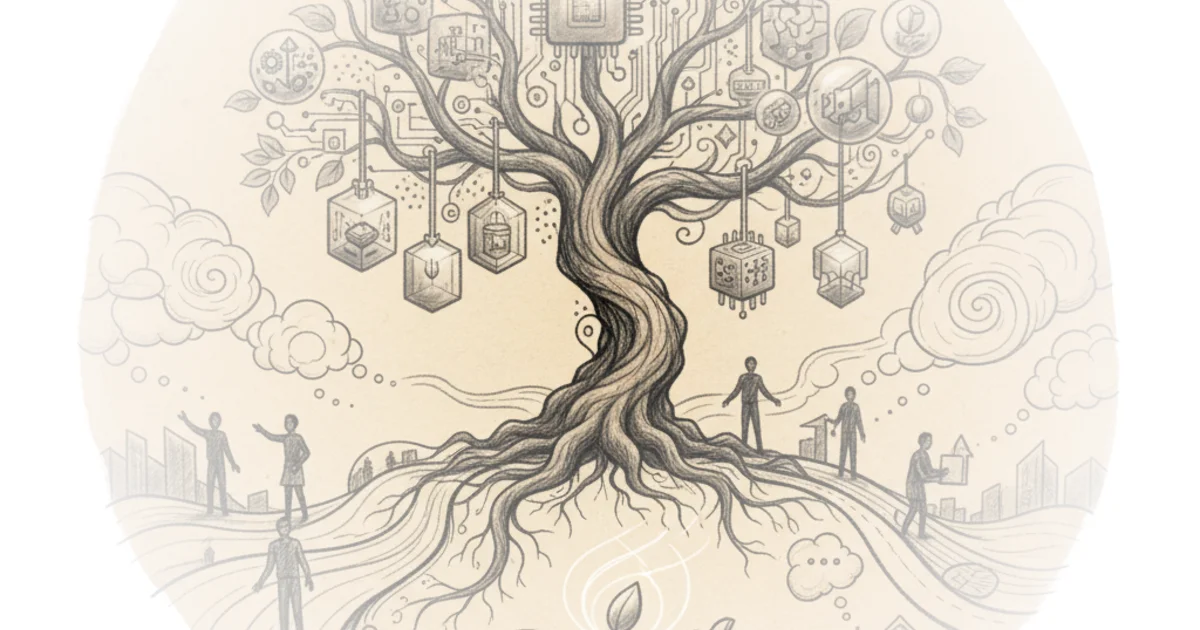
The essay's most distinctive contribution is the biological analogy that gives the piece its title. McCormick, co-writing with Anjan Katta of Daylight Computer, suggests that "one point of hardware is to be a fruit." He explains that "an apple tree wraps its reproductive code (the seed) in an animal-tempting package (the fruit)." In this model, the hardware is the delicious, tangible product that users are willing to buy, while the ethical software is the seed that gets distributed for free inside it.
This reframing solves the "activation energy" problem. McCormick argues that "hardware provides activation energy and overpowers friction." Users are often unwilling to pay a premium for privacy or focus in the abstract, but they will pay for a device with a screen that doesn't emit blue light. As McCormick puts it, "Come for the hardware, stay for the software." The device acts as a subsidy for the ecosystem, generating the cash flow necessary to sustain the development of software that might otherwise be unprofitable.
The financial logic here is compelling. McCormick notes that the predecessor to Daylight, the reMarkable tablet, generates "around $400+ million in revenue at ~50% margins" despite lacking the expensive components of modern smartphones. This cash flow allows the company to "survive the valley of death that is the three to five to seven, 10 years before this actually serves to accrue value for your ecosystem." By bundling the cost of ethical defaults into the hardware purchase, the user never has to make the difficult choice between convenience and wellbeing in the moment.
"Your negative externalities are my opportunity."
This approach mirrors the long-term strategy of companies like Amazon, where Jeff Bezos famously said, "your margin is my opportunity." McCormick flips this to suggest that the negative externalities of the current tech landscape—addiction, privacy erosion, attention fragmentation—are the very market opportunity for a hardware-first, software-second company.
Seeding a New Ecosystem
The final layer of the argument addresses the distribution problem. In a saturated app store environment, even high-quality software struggles to be found. McCormick writes, "Apple's App Store and Google's Play Store are so unbelievably saturated that it's practically impossible to stand out, even if you're building something genuinely better than what already exists." Daylight, by contrast, offers a curated environment where developers can "finally have a chance to compete on product quality on the new platform."
This creates a virtuous cycle. Because the hardware users are already paying a premium for a specific experience, they are more receptive to software that aligns with those values. McCormick explains that developers can be asked to "implement this protocol" as part of the base SDK, creating a baseline of "good-for-you" defaults without degrading the user experience. The hardware acts as a filter, ensuring that the "seeds" of resonant computing are planted in fertile ground.
However, this strategy is not without risk. The counterargument is that hardware is notoriously difficult to scale and maintain, with thin margins and complex supply chains. If the hardware fails to gain traction, the entire ecosystem collapses before the software can mature. Yet, McCormick remains optimistic, noting that "even if the software bet is wrong, you still have the differentiated hardware." The physical device provides a fallback that pure software startups lack.
Bottom Line
McCormick's argument is a sophisticated synthesis of biological evolution and market economics, offering a plausible path out of the "Moloch" trap that currently plagues digital product design. The strongest part of the piece is the realization that hardware can serve as a financial and psychological bridge, allowing ethical software to bypass the immediate friction of user adoption. The biggest vulnerability remains the execution risk of building hardware at scale, but if successful, this model could fundamentally alter how we think about the relationship between our devices and our wellbeing.