John Pistelli delivers a rare literary autopsy that refuses to bow to hype, dissecting the recent Nobel Prize in Literature with a skepticism that cuts through the usual reverence. While the cultural establishment celebrates László Krasznahorkai as a master of the apocalypse, Pistelli argues that the author's signature long-sentence technique often masks a lack of genuine challenge, offering "mere visual impediment" rather than intellectual rigor. This is not a review for the passive reader; it is a confrontation with the mechanics of modernism and the danger of confusing stylistic difficulty with depth.
The Apocalyptic Trap
The piece centers on Pistelli's struggle with The Melancholy of Resistance, the text many Anglophones use as their entry point into Krasznahorkai's work. He acknowledges the buzz but immediately questions the substance. "Unlike Sam Kriss, I will probably go on; unlike Sam Kriss, I'm afraid it's supposed to be funny," Pistelli writes, highlighting the dissonance between the author's intended satire and the reader's experience of "mean-spirited sophomoric satire." He finds the humor not in the absurdity of the world, but in the cruelty of the author toward his characters, specifically two women who are subjected to social chaos and revealed as dupes of their own will-to-power.
Pistelli's critique of the prose style is particularly incisive. He suggests that the relentless, comma-spliced sentences are less a revolutionary form and more a trick. "If half the commas might just as well be periods... then we have the superficial mimicry of an experimental technique barely concealing a conventional, in this case satirical, grammatical and fictional design," he observes. This is a bold claim: that the "frenzied stasis" Krasznahorkai aims for is actually just a fog of mood that obscures a very traditional, and perhaps lazy, narrative structure. Critics might argue that the difficulty of the syntax is the point—that it forces the reader to experience the breakdown of language in a collapsing world—but Pistelli insists that true apocalyptic literature should describe the events clearly rather than summoning a "vaguely summoned fog."
Such prose is hard to quote for reviewing purposes, which might forestall a certain kind of critical objection; if they can't find where your sentences begin or end, then Compact magazine can't say you have bad grammar!
The Illusion of Solidity
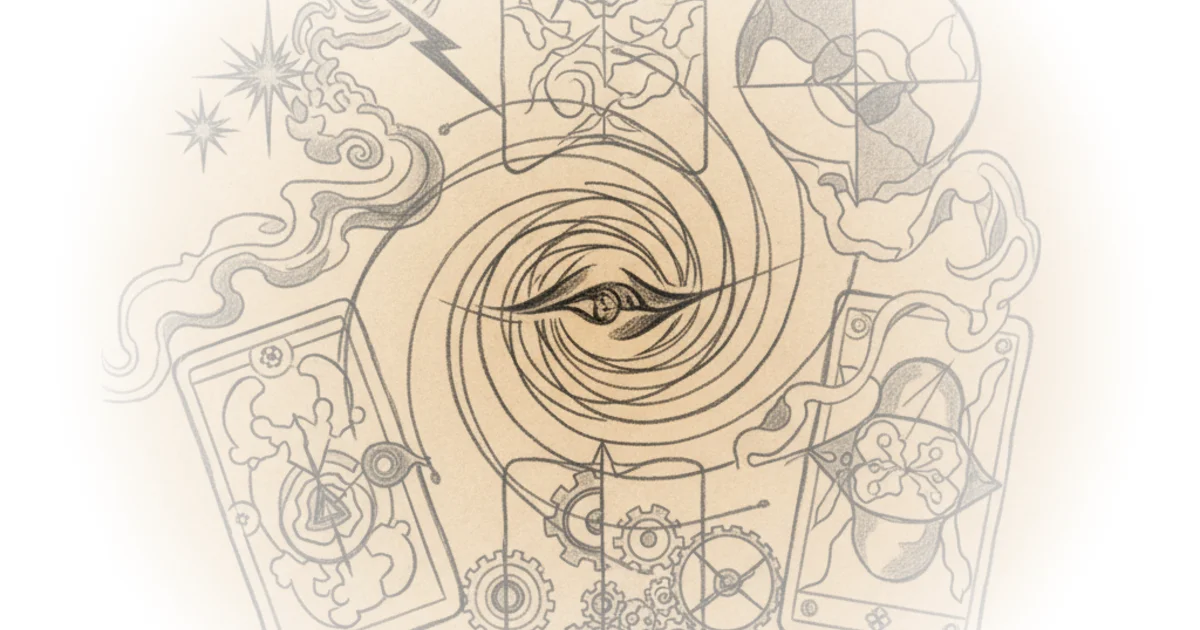
Beyond the specific critique of Krasznahorkai, Pistelli weaves in a broader meditation on why we are drawn to the obscure and the arcane. He touches on the work of filmmaker Maya Deren and the philosopher Nick Land, suggesting that our fascination with the "half-remote" is a form of self-sabotage or a desperate grasp for control. He notes that "numbers don't mean anything any more than words do, of course, but they have an illusion of solidity that words don't, so they drive people crazy with the dream of control or of perfect understanding." This connects his literary criticism to a wider cultural anxiety: the desire to find hidden patterns in a chaotic world, whether in tarot cards, Kabbalah, or the endless clauses of a Hungarian novel.
He applies this same rigorous lens to Willa Cather's Death Comes for the Archbishop, contrasting Cather's "mythic method" with the irony of her modernist peers. Pistelli praises her for creating a "new kind of prose epic" that elevates storytelling over dramatization, noting her goal to write in a style "absolutely the reverse of dramatic treatment." Yet, he also points out the fragility of the order she depicts, an "alternate founding for the United States" based on values that were "more honorable, if not more durable, than those of Enlightenment and economic power." This juxtaposition of the beautiful and the deadening serves as a counterpoint to the chaotic energy he finds lacking in Krasznahorkai.
The Bottom Line
Pistelli's strongest move is his refusal to accept stylistic complexity as a proxy for literary merit, challenging the reader to demand clarity over confusion. The piece's biggest vulnerability is its own potential for elitism; by dismissing the "fog of mood" as insufficient, he risks overlooking the valid literary tradition of using ambiguity to reflect the unknowable nature of trauma and history. However, his insistence on honesty—admitting when a celebrated work fails to move him—provides a necessary corrective to the uncritical adoration that often surrounds Nobel laureates.
The whole opening chapter from the perspective of Valuska's snooty mother is funny—the way she perceives and thinks about the world is funny. When the guy is oggling her and she's uncomfortable and her bra snaps for no reason and her boobs start bouncing it's funny. Well, there is taste in humor as in everything else.