In an era where artificial intelligence promises to generate photorealistic humans in seconds, a retrospective on Pixar's early struggles reveals a counterintuitive truth: perfection is often the enemy of believability. This piece from Animation Obsessive dismantles the long-held industry obsession with "synthespians," arguing that the path to emotional resonance wasn't paved by better technology, but by the courage to embrace stylization over replication. For busy readers tracking the trajectory of digital media, this historical pivot offers a crucial lesson on why audiences reject the uncanny valley even when the pixels are perfect.
The Trap of Realism
The article begins by exposing a fundamental misconception that haunted computer graphics in the 1980s and 90s: the belief that the ultimate goal was to replace living actors with digital replicas. Animation Obsessive reports on early experiments like Rendez-vous in Montreal (1987), where creators boasted, "You can put actors out of jobs," only to produce results that were deeply unsettling rather than impressive. The piece effectively reframes these failures not as technical glitches, but as philosophical missteps.
The narrative highlights how Pixar initially sidestepped this issue entirely. Their early shorts featured inanimate objects and natural phenomena because, as the editors note, "Modeling and animating a human character on a computer is a difficult proposition." Craig Good, a key figure at the studio, articulated the core difficulty when he wrote that "The eye is very unforgiving when it comes to human faces." This observation remains startlingly relevant today; despite exponential growth in computing power, the human brain's ability to detect subtle inconsistencies in facial movement has not changed.
The closer you get to reality, that's when the brain starts to kick in with its auto-recognizers, and thinks something is a little weird.
The article details Pixar's first serious attempt at a human character: Billy, the baby in Tin Toy (1988). While technically groundbreaking enough to win an Oscar, the character ultimately failed to land emotionally. The editors paraphrase technical director Bill Reeves, who admitted that despite hours of research into infant movement, "the skin wasn't flabby like a real baby's would be." The result was a figure described by some as "demonic" and "from hell," trapped in an awkward middle ground between realism and caricature. This section serves as a powerful case study for the limits of pure simulation; the team achieved 90% of their motion goals, yet that remaining 10% of imperfection was enough to break the audience's suspension of disbelief.
Critics might argue that the technology simply wasn't ready at the time and that modern rendering engines have solved these issues. However, the piece suggests a deeper issue: the very pursuit of photorealism creates an expectation that no digital medium can fully satisfy without triggering revulsion.
The Artistic Pivot to Stylization
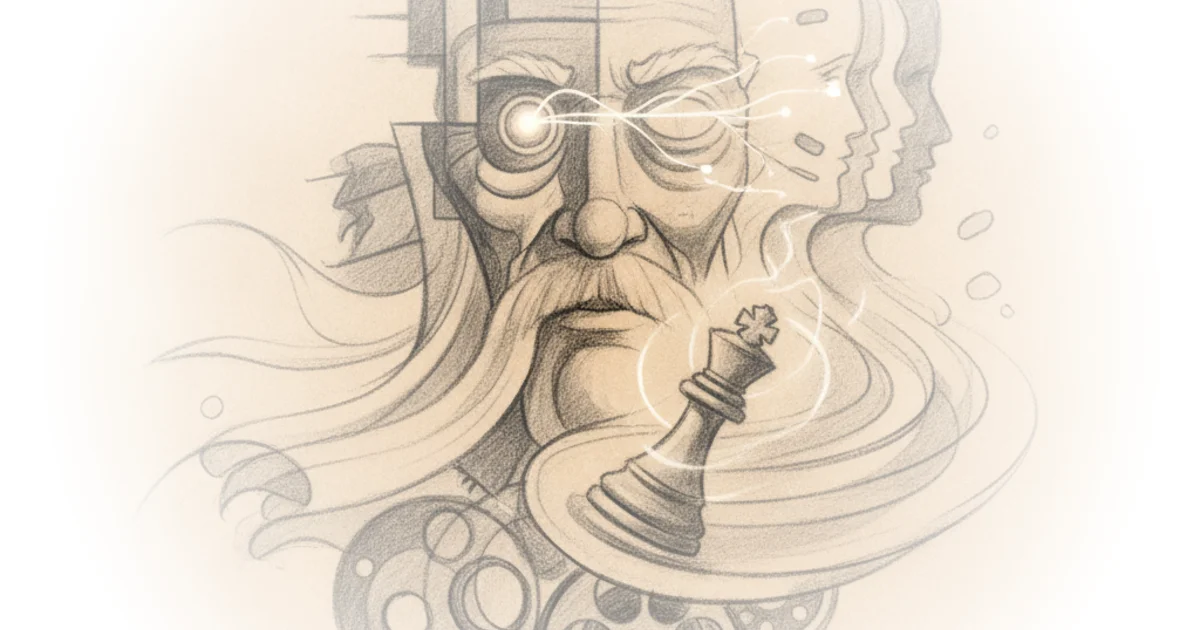
The turning point arrives with the 1997 short film Geri's Game, which Animation Obsessive identifies as the moment Pixar finally "cracked" the human character code. Unlike previous attempts, this success wasn't driven by a race toward realism, but by a deliberate retreat into stylization. The editors trace director Jan Pinkava's inspiration to Czech stop-motion master Jiří Trnka, noting that Pinkava "completely ripped off" Trnka's designs to create Geri, an old man who plays chess against himself.
The coverage argues that the solution lay in treating the character as a digital puppet rather than a biological entity. Pinkava is quoted dismissing the industry's obsession with fake people: "It's not... the creation of fake people to compete with living actors." Instead, he embraced the idea that characters should be "more archetypical than a human actor can be, and portray and serve the idea of a person, not their surface." This distinction is vital. By abandoning the goal of replicating skin texture or bone structure exactly as they appear in nature, the animators freed themselves to focus on expressiveness and movement.
The article draws a fascinating parallel to Trnka's own philosophy from 1955, where he argued that "A perfect imitation of a human... gives the impression of life neither as a statue nor as a puppet." The editors use this historical context to show that the solution to the uncanny valley was not new technology, but an old artistic principle: abstraction creates connection. While Toy Story had struggled with humans who looked like "the world's most complicated plastic," Geri's Game succeeded because the character was designed from the ground up as a stylized figure.
We don't think about it in terms of computer graphics very much, but it's an incredibly rich tradition.
This section effectively challenges the modern narrative that AI-generated content will inevitably lead to perfect human replication. The piece suggests that the most compelling digital humans are those that acknowledge their artificiality through design choices, rather than trying to hide them behind a veil of hyper-realism.
Bottom Line
The strongest argument in this coverage is its reframing of technical limitations as artistic opportunities; Pixar's greatest breakthrough came not from rendering better skin, but from admitting they couldn't and choosing to be stylized instead. The piece's biggest vulnerability is its focus on a single studio's trajectory, potentially overlooking how other industries (like video games or VFX) are still chasing the photorealistic dream despite the risks. For readers navigating the current wave of generative AI, the takeaway is clear: believability comes from character and style, not just resolution.