Alex O'Connor delivers a crucial correction to the modern self-help industrial complex: Stoicism is not merely a toolkit for emotional resilience, but a comprehensive metaphysical system where ethics are the fruit, not the root. By tracing the philosophy's lineage from a shipwrecked merchant in Athens to the Roman emperors, O'Connor reveals that the popular image of the "unfeeling stoic" is a historical accident caused by the loss of early texts, not a faithful representation of the philosophy itself.
The Shipwreck That Built a Philosophy
O'Connor begins by dismantling the assumption that Socrates founded Stoicism, a common misconception even among enthusiasts. He clarifies that while Socrates was the "grandfather figure," the actual founder was Zeno of Citium, a man whose entire philosophical journey began with a catastrophic business failure. "The story we have is that his first encounter with philosophy was reading about Socrates," O'Connor notes, recounting how Zeno, after losing his cargo in a shipwreck, stumbled into a bookstore and found his calling. This anecdote is more than a charming origin story; it illustrates the core Stoic tenet that external fortune is irrelevant to internal character. The author effectively uses this narrative to show that Stoicism was born from a radical reorientation of values, not a gradual academic evolution.
However, O'Connor goes further by situating Zeno within the Cynic tradition, a connection often overlooked in pop-philosophy. He explains that the Cynics, exemplified by Diogenes, took Socratic ideas to an extreme, rejecting all social convention. "Plato had described Diogenes the Cynic as Socrates gone mad," O'Connor writes, highlighting how Diogenes pushed the idea that only virtue matters to the point of living in a barrel and ignoring the laws of the city. This historical context is vital because it shows that Stoicism was originally a reaction against the Cynics' radicalism, seeking a middle ground between total social rejection and conventional life. Critics might argue that this distinction is too academic for the average reader seeking practical advice, but O'Connor's point is that without understanding the tension between Cynic radicalism and Stoic moderation, one cannot truly grasp why Stoics value social duty so highly.
"It's like saying if you asked somebody what is Christianity and they said oh it's it's where you don't have sex before marriage... the whole sort of Jesus's resurrection and God's existence is like really important and that sort of ethical consequence is just one part of a much broader story."
The Lost System: Logic, Physics, and Ethics
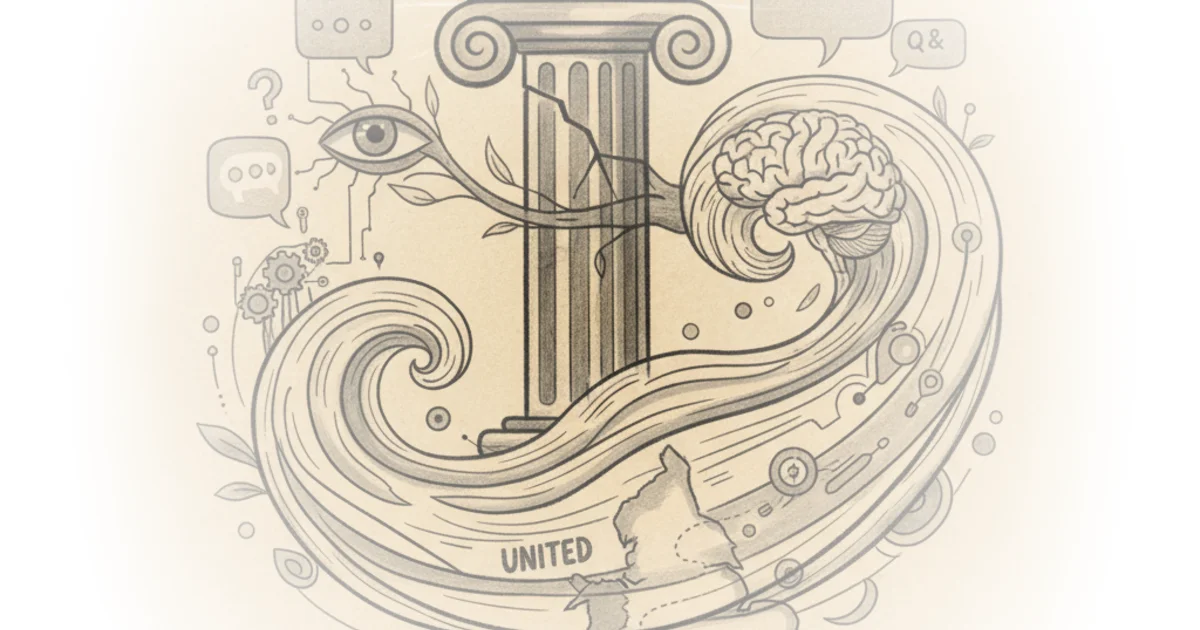
The most significant contribution of O'Connor's commentary is his insistence that Stoicism is a tripartite system comprising logic, physics, and ethics. He argues that the modern obsession with Stoic ethics alone is a distortion caused by the survival of Roman texts over Greek ones. "The early Stoics... are developing a rich complex philosophical system. There's metaphysics, physics, epistemology, logic, theories of grammar as well as the ethics," he states. This is a powerful corrective to the notion that Stoicism is just about "gritting your teeth" during hard times. O'Connor explains that for the original Stoics, understanding the nature of the universe (physics) and the rules of reasoning (logic) were prerequisites for living virtuously. You could not be a good person if you did not understand the rational structure of the cosmos.
He traces the transmission of these ideas to the Roman world, noting that the siege of Athens by Sulla marked a turning point where the living tradition in Greece faded, and the ideas were translated into Latin by Cicero. "Cicero's accounts are kind of the earliest and fullest and most complete accounts we have of early stoic thought," O'Connor points out, emphasizing that our knowledge of the early system relies heavily on these later summaries. The author then contrasts the Greek theoreticians with the Roman practitioners like Seneca and Marcus Aurelius, who are often viewed as merely applying the theory. "I think we can see ways in which they are in fact... engaging with those ideas," he argues, challenging the stereotype that the Romans were uninterested in the deeper metaphysical questions. This nuance is essential for anyone trying to understand the full scope of the philosophy, as it prevents the reduction of a complex worldview into a simple self-help slogan.
The Danger of Surface-Level Understanding
O'Connor's final and most provocative claim is that treating Stoicism as purely an ethical philosophy is a category error. He compares it to defining Christianity solely by its sexual ethics while ignoring the resurrection or the existence of God. "To say that that is what stoicism is... seems a bit like saying... it's where you don't have sex before marriage," he writes, illustrating how incomplete the modern definition is. This framing is effective because it forces the reader to confront the limitations of their current understanding. If one accepts O'Connor's premise, then reading only Meditations or Letters provides an incomplete picture, as these texts often assume a background of logic and physics that is no longer fully preserved.
The author acknowledges that most people interact with philosophy on a surface level, which is fine for casual interest. "Most people interact with most philosophies in a relatively sort of surface level way," he concedes. However, for those who claim to study Stoicism, the implication is clear: they must dig into the fragments of the early Athenians to understand the foundation upon which the Roman ethics rest. This is not an elitist demand but a call for intellectual honesty. A counterargument worth considering is that the Roman texts are the philosophy for most people because they are the only ones that survived intact and offer the most practical guidance. Yet, O'Connor's insistence on the broader system remains a compelling reminder that the "how" of living is inextricably linked to the "why" of the universe.
Bottom Line
Alex O'Connor's commentary succeeds in restoring the intellectual depth of Stoicism, exposing the modern reduction of the philosophy to mere emotional regulation. The strongest part of his argument is the historical reconstruction showing how logic and physics were once the bedrock of Stoic ethics, a context lost when the Greek texts vanished. The biggest vulnerability lies in the practical application: for the busy modern reader, reconstructing the lost metaphysical system may feel like an insurmountable hurdle, leaving the question of how to access this "fuller" Stoicism unanswered. Readers should watch for future discussions on how to integrate these ancient logical frameworks into contemporary life without getting bogged down in the missing texts.