Rohin Francis transforms a stand-up routine into a profound exploration of why our bodies are asymmetrical, arguing that the placement of our hearts is not a biological accident but a cascade of cosmic and molecular forces. This piece stands out by connecting the dots between quantum physics, ancient meteorites, and the very reason a dragon's heart is on the left, offering a rare glimpse into the deep history of life's architecture.
The Cosmic Origin of Asymmetry
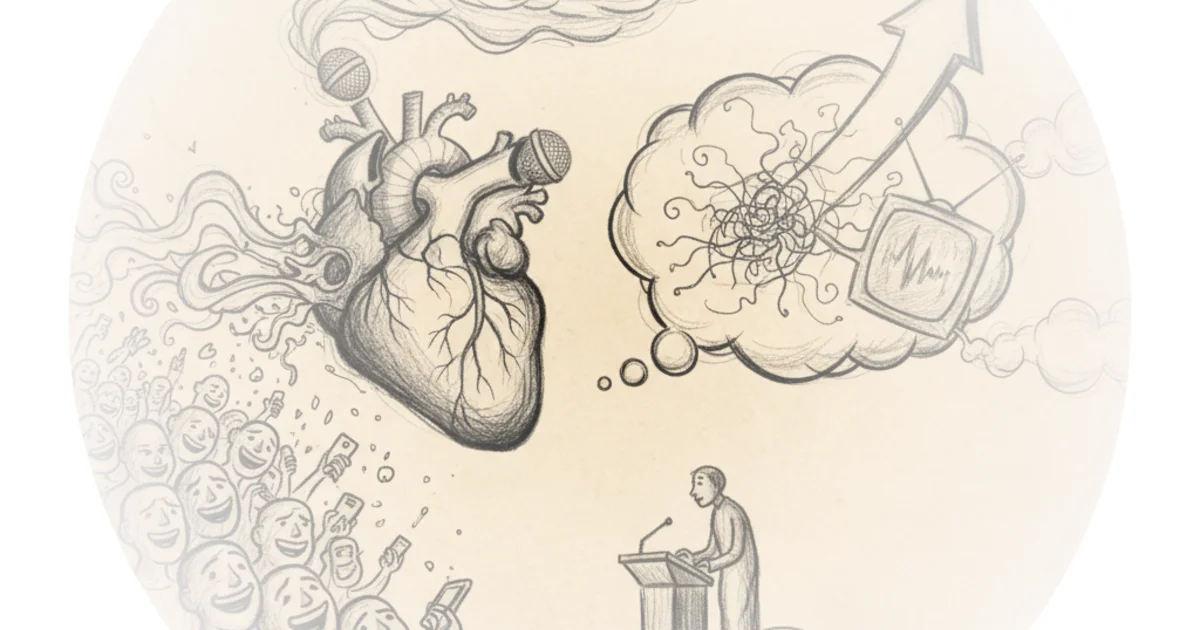
Francis begins by dismantling the assumption that human symmetry is perfect, noting that while we look balanced externally, "humans might look symmetrical from the outside but we're actually what's known as pseudo bilateral because inside as you all know we are profoundly asymmetric." He uses this observation to pivot from a simple anatomical fact to a deeper evolutionary mystery: why is the heart on the left for 99.99% of us? The author traces this back to the cellular level, explaining that tiny hair-like structures called cilia beat in a specific clockwise direction during early development. "This flow is enough to create differential expression of proteins on one side of the pizza the other and that asymmetry is what leads to our macroscopic asymmetry in our hearts being on the left." This explanation is compelling because it grounds a macroscopic biological reality in a microscopic mechanical process, making the abstract tangible.
The genes responsible for this process that kind of GPS you see at the top here are called Indian hedgehog desert Hedgehog and sonic hedgehog proving once again that biologists have epic bats.
Francis then pushes the inquiry further, asking why those cilia beat clockwise in the first place. The answer lies in the fundamental building blocks of life: amino acids and sugars. He points out that "all life on Earth uses left-handed amino acids and right-handed sugars," a phenomenon known as chirality. This biological preference is so absolute that it has inspired science fiction tropes about alien life being incompatible with Earth's biology. "Alice knew that Kitty would have a profound case of lactose intolerance because all the lactose in mirror world would be lactose and Kitty's lactase enzyme could only digest D lactose." While this is a fun literary reference, it underscores a serious scientific question: why does the universe favor one hand over the other?
From Molecules to the Weak Force
The argument takes a sharp turn from biology to physics, where Francis introduces the work of Chen Changwu and the discovery of parity violation. He explains that while we used to think the universe was symmetrical, the weak nuclear force is not. "What her team showed is that the weak interaction doesn't preserve parity or is is asymmetrical." This is the crux of the piece: the handedness of our hearts is ultimately dictated by a fundamental asymmetry in the laws of physics. Francis acknowledges the speculative nature of some theories, such as the idea that spiral galaxies or meteorites might have seeded this preference, noting that "both of these have been heavily criticized and essentially disproved." However, he firmly anchors the argument in the proven asymmetry of the weak force, suggesting a fractal nature to the universe where quantum forces dictate molecular structure, which in turn dictates organ placement.
Critics might note that the leap from the weak force's asymmetry to the specific chirality of biological molecules is still a subject of intense debate and not fully resolved in the scientific community. Francis touches on this by admitting the theories are abstract, but his ability to weave them into a coherent narrative about human biology remains his strongest asset.
I just find this fractal nature of quantum forces or molecules or our layout or spiral galaxies all having this asymmetry something quite amazing.
The piece concludes by returning to the human element, using a comment from a viewer to highlight how often we take these complex realities for granted. "We've asked a doctor a question about our heart and why it's doing something I said well how aware of you are you at the asymmetric weak force." This closing thought serves as a reminder that the mundane aspects of our existence are deeply connected to the most profound mysteries of the cosmos.
Bottom Line
Francis's core argument is a masterclass in interdisciplinary storytelling, successfully linking the weak nuclear force to the position of the human heart. His biggest vulnerability is the speculative nature of the cosmic origins, but he navigates this by focusing on the proven asymmetry of the weak force. Readers should watch for how this understanding of biological chirality might influence future medical research into congenital defects and the search for extraterrestrial life.