Jordan Schneider cuts through the techno-optimism that dominates global AI discourse to reveal a stark reality: in China, artificial intelligence isn't just a tool for efficiency; it is a source of deepening social fracture and existential dread. By triangulating search data from WeChat with on-the-ground interviews, Schneider exposes how the promise of "AI wealth" clashes violently with a labor market where young graduates face obsolescence while state employees cling to analog traditions. This isn't just about automation; it is a crisis of meaning in a society that sold education as a guaranteed ticket to stability.
The Uneven Map of Displacement
The article's most compelling insight lies in its rejection of the standard blue-collar versus white-collar binary. Schneider argues that we must look at "physical presence" rather than job titles to understand who is actually threatened. He writes, "A travel agent and a tour guide diverge sharply on AI exposure despite both being service workers," illustrating how current automation targets desk-based cognitive labor while leaving the vast physical workforce relatively untouched for now. This reframing is crucial because it explains why anxiety isn't uniform; it is concentrated precisely where the Chinese dream was most heavily invested.
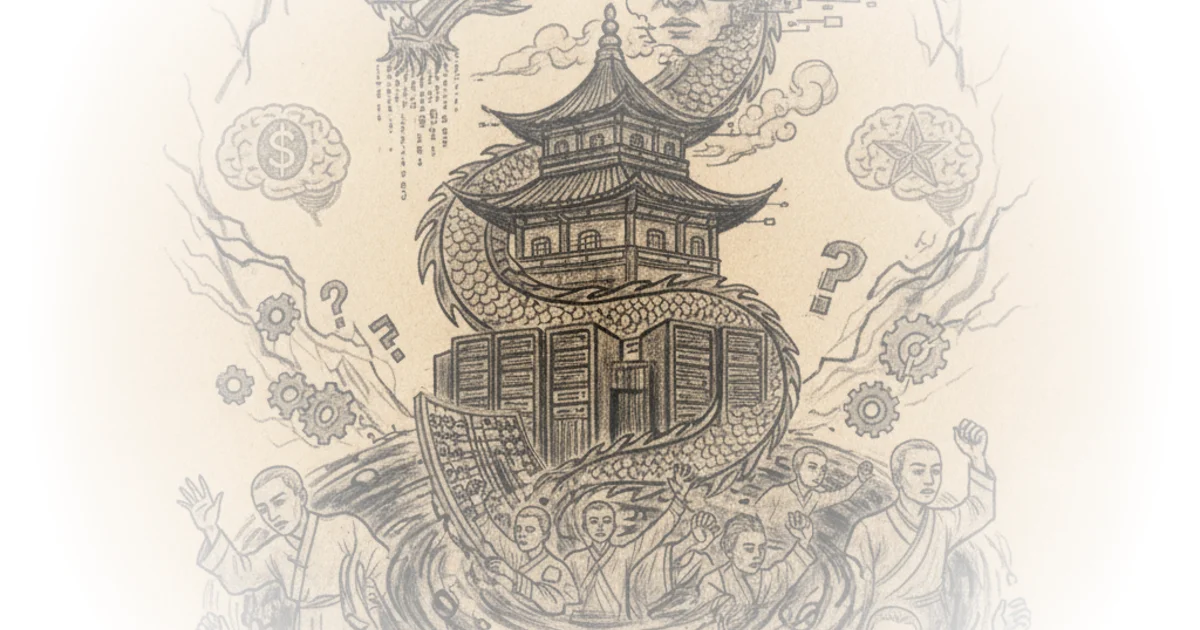
Schneider highlights a disturbing statistic: "Chinese households spend 17.1% of their annual income on education — the highest share in the world — because that investment was supposed to pay off in skilled, desirable employment." The tragedy he identifies is that the finish line has moved just as young people were about to cross it. As Schneider notes, "The education system trained young people to see high-quality white-collar work as the finish line, and now AI threatens to move it at precisely the moment they were expecting it to deliver." This creates a generation feeling betrayed by the social contract, a sentiment that mirrors the disillusionment seen during the Jasic incident, where workers fought for rights in a system increasingly hostile to collective bargaining.
"For young Chinese born in the 1990s and 2000s, the path was clear: study hard, earn a degree, and land a good white-collar job... now AI threatens to move it at precisely the moment they were expecting it to deliver."
Critics might argue that Schneider overstates the immediacy of this threat for physical workers, given how quickly robotics could eventually encroach on manufacturing. However, his distinction between current software capabilities and future hardware constraints remains a vital nuance often lost in global headlines.
The Analog Fortress of the State
Perhaps the most surprising revelation is how the Chinese state apparatus itself resists AI penetration. Schneider observes that while private firms panic, the "pseudo white-collar" workers in government organs and state-owned enterprises are insulated by culture and security protocols. He describes a world where "many meetings still happened in old-style, almost antique conference rooms, with staff coming in every ten minutes to top up tea," noting that nothing is recorded or digitized. This isn't just inefficiency; it's a feature of the system.
Schneider explains that for these roles, "the work of bureaucrats, in reality, is interpersonal... connecting with citizens and securing grassroots support for the regime's policies." Because their power relies on relational labor rather than data processing, AI cannot easily replace them. In fact, the reliance on analog record-keeping—CDs, floppy disks, pen-and-paper—is a security measure that inadvertently protects these jobs from automation. This dynamic creates a bizarre two-tier system where the most vulnerable are the private sector youth, while the state's own workforce remains largely untouched by the very technology they are mandated to promote.
The Impossible Bind of Representation
The piece then tackles the political mechanisms—or lack thereof—for addressing this anxiety. In a democracy, voters might punish leaders for job losses; in China, the only formal channel is the All-China Federation of Trade Unions (ACFTU), which Schneider describes as being in an "impossible task" bind. He quotes sociologist Eli Friedman: "Basically, everybody either dislikes them or just thinks that they're useless because they're given this impossible task of being told by the state: You must represent workers, but you can't do XYZ."
This structural impasse means that when workers protest, as seen in recent autonomous vehicle disputes, the state's response is often to dismiss their fears. Schneider points out that official outlets like Xinhua have labeled opponents of automation "modern-day Luddites," comparing them to sock knitters smashing machines. Yet, as frustration mounts, the tone shifts. The legal system, which theoretically offers stronger protections than the US "at-will" model, only acts when Beijing decides a case has educational value for the public. As Jeremy Daum notes, courts and police are supposed to "seek out the educational value to inform the public," meaning justice is often a tool of governance rather than individual redress.
"Basically, everybody either dislikes them or just thinks that they're useless because they're given this impossible task of being told by the state: You must represent workers, but you can't do XYZ."
This analysis holds up against recent events where the executive branch has had to walk a tightrope between pushing high-tech adoption and maintaining social stability. It suggests that without independent unions or an open press, AI anxiety in China will likely manifest as quiet withdrawal—what Schneider calls a "crisis of meaning"—rather than organized revolution.
Bottom Line
Schneider's strongest contribution is his ability to map the specific contours of Chinese anxiety, showing how it fractures along lines of physical vs. digital work and state vs. private employment. The argument's vulnerability lies in its reliance on current technological limits; if robotics advance as quickly as software, the "physical" buffer for 72% of the workforce could vanish faster than anticipated. Readers should watch not just for policy shifts, but for a growing cultural retreat among China's educated youth who feel the promise of their education has been fundamentally broken.