Eric Schmidt stood before six hundred policy professionals in Washington last April and described humanity's near-term technological future as a journey through the "eye of the needle" — a passage so perilous it could end the species, yet so luminous on the other side that the risk is worth taking. Compact Magazine uses that moment as the entry point for a serious philosophical intervention, one that most AI commentary never attempts: not a critique of a specific technology, but a critique of the belief system that makes all such technologies seem inevitable and good.
The Secular Religion Nobody Admits to Practicing
The piece draws heavily on Lewis Mumford, the twentieth-century critic of technology whose work has aged with uncomfortable prescience. Mumford's argument, developed across decades in books including Technics and Civilization and The Pentagon of Power, was not that technology is bad. It was that the modern world had elevated technological development into a quasi-religious faith — what he called the "myth of the machine" — which he described as the "ultimate religion of our seemingly rational age."
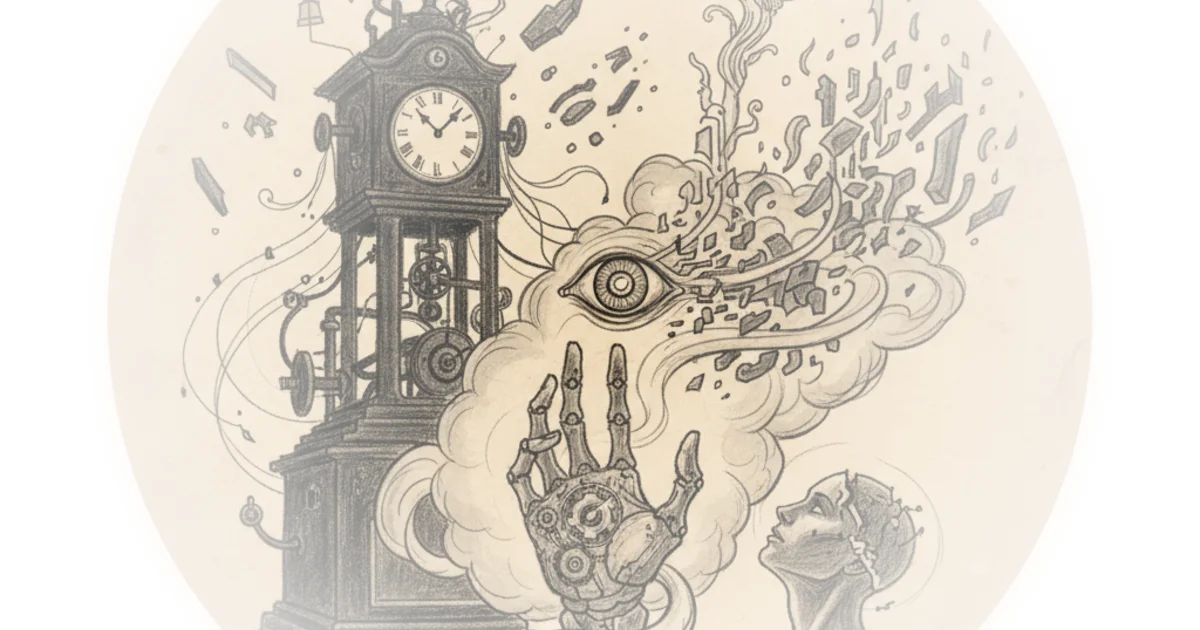
The core of that myth, as the piece explains it, is simple: technological progress and human progress are the same thing. More powerful tools mean better lives. The connection seemed unassailable during Mumford's lifetime — nitrogen fertilizer, penicillin, refrigeration, and air travel helped extend American life expectancy from forty-one years to over seventy-seven. As Mumford himself asked with some irony, "Does any sensible person mourn the passing of the Stone Age?"
But Compact Magazine argues, following Mumford, that this intuition has hardened into an unexamined faith — one that operates precisely because it feels like rationality. The people who attend technology policy conferences do not think of themselves as believers. They think of themselves as extrapolators, as empiricists reading trends. Schmidt's "promised land" language is not incidental; it reveals something about the structure of the thinking.
The Theodicy Problem
One of the piece's sharpest moves is the parallel it draws between the myth of the machine and Christian theodicy — the theological tradition that tries to explain why an all-good God permits suffering. The myth of the machine, the editors argue, performs the same function in secular form: benefits are inherent to the technology, while harms are incidental, the result of human failure or misuse.
This framing explains a lot about how AI discourse actually works. When large language models make students worse at writing, the diagnosis tends to be that schools are obsolete. When workers fear displacement, policymakers propose legislation to help them become "adequately skilled, confident and ready to grasp the full opportunities of AI." The article is pointed in its observation: "The benefits are there, if we can only overcome human incompetence."
Notice how that framing insulates the technology from judgment. If AI produces bad outcomes, the fault lies with people who failed to adapt. If AI produces good outcomes, the technology deserves the credit. The accounting is never symmetric. As Compact Magazine quotes Mumford: most people "still see only the endless bounties and benefits… and have closed their eyes to the varieties of dehumanization and extermination" they enable and promote.
The Transvaluation Nobody Voted For
The piece reaches for Friedrich Nietzsche — specifically his concept of "transvaluation" — to describe what Mumford thought had gone wrong. Nietzsche argued that Christianity had inverted an older moral order, turning weakness into virtue. Mumford saw a parallel transformation in modernity: a shift in which human beings stopped valuing technology as a means to human ends and began valuing efficiency and productivity as ends in themselves.
The evidence the piece marshals for this claim is circumstantial but suggestive. Members of technologically advanced societies are getting married less, having fewer children, maintaining fewer close friendships, participating less in communal life, attending religious services less. This is happening simultaneously with an explosion in technologies marketed explicitly as social connectors — platforms designed to eliminate loneliness and bind people together.
The piece is careful not to claim a direct causal link. The point is different: "when we adopted these technologies, novelty and market success took priority over any consideration of whether they would promote older ideas of the good life." The technologies were not evaluated against measures of human flourishing. They were evaluated against machine values: speed, efficiency, reach, engagement. As Mumford observed, "society submits meekly to every new technological demand and utilizes without question every new product whether it is an improvement or not, since under the present dispensation the fact that the proffered product is the result of a new scientific discovery or a new technological process is the sole proof required of its value."
That sentence was written decades before the app store. It reads like contemporary analysis.
The Accelerationists Prove the Point
The article finds its most uncomfortable evidence in the explicit accelerationist movement — the faction of AI enthusiasts who do not deny the existential risk but embrace it anyway. Where doomers and boomers differ mainly on the odds of navigating the needle safely, accelerationists go further: the risk is not just acceptable but desirable, a necessary price for the productivity gains of artificial general intelligence.
Mumford anticipated this endpoint with some precision. He wrote that the myth of the machine "has so captured the modern mind that no human sacrifice seems too great provided it is offered up to the insolent Marduks and Molochs of science and technology." The accelerationists are not a fringe. They are the myth's logical terminus — the point at which the faith becomes explicit.
But Compact Magazine extends the critique to the skeptics and doomers as well, which is where the argument becomes genuinely unsettling. Organizations focused on avoiding the worst AI outcomes typically promise to "realize the benefits while mitigating the risks." Mumford, the piece argues, would say the first half of that sentence already surrenders the argument. It accepts the myth's fundamental premise — that the benefits are real and coming — and frames the task as removing obstacles. Many AI safety advocates also share, the editors suggest, "a basic misanthropic premise of machine superiority, focusing as they do on the biased, irrational, and flawed nature of human beings that needs machinic augmentation." The doomers and the boomers are arguing about implementation. The myth itself goes unchallenged.
"Technological doom is not something that lies ahead of us. It has already arrived. The demise of humanity is an ongoing process by which we allow ourselves to be colonized by machine values, a gradual disempowerment that is happening all around us."
Where the Argument Strains
Critics might note that Mumford's framework, compelling as it is, has trouble distinguishing between technologies that genuinely improve human lives and those that merely serve machine values. Penicillin saves lives; the infinite scroll degrades attention. The myth of the machine may explain why we adopt both without adequate scrutiny, but Mumford's critique, as rendered here, provides little guidance for how to make those distinctions in real time. The piece would be stronger with a more developed account of how, practically, human flourishing should inform technology adoption.
There is also a tension in using Mumford's framework to critique AI specifically. Mumford's historical sweep covers the Pyramid Age, the medieval monastery, and the Industrial Revolution. If the "myth of the machine" has been operating for centuries, why would the current moment be amenable to the "transvaluation of values" the piece gestures at in its closing paragraphs? The article ends with Mumford's optimistic metaphor — the gates of the technocratic prison will open as soon as we choose to walk out — but does not explain why the conditions for that choice are more available now than they were in 1970, or 1934.
Finally, the piece's rhetorical structure occasionally mirrors what it critiques. The "myth of the machine" framework is itself a totalizing explanatory system that accounts for believers, skeptics, and critics alike. Any resistance to the framework can be absorbed as further evidence of how thoroughly the myth has colonized modern thought. That kind of unfalsifiability is worth naming even in a sympathetic reading.
The Cultural Preparation Problem
What makes Compact Magazine's argument ultimately worth sitting with is the concept of "cultural preparation" — Mumford's claim that the most significant shifts in technological history are not the inventions themselves but the prior changes in how people conceived of the world. The Industrial Revolution did not create the myth of the machine; the myth created the conditions under which the Industrial Revolution became possible and was welcomed.
Applied to artificial intelligence, this means the relevant question is not whether large language models are useful or dangerous. It is what kind of people we are becoming in the act of using them — and whether the answers to those questions are even legible within the frameworks we typically bring to technology policy. The piece argues that machine values — speed, efficiency, productivity — have become so thoroughly internalized that "that something saves time is seen as a good in itself, regardless of its effect on other measures of human flourishing."
Compact Magazine does not offer a policy prescription. Its ambition is different: to make visible a set of background assumptions that most AI discourse treats as ground rather than figure. That is a harder task than proposing a regulatory framework, and a more important one.
Bottom Line
This is one of the more intellectually serious pieces of AI criticism published in recent years — not because it proposes solutions, but because it names the faith that makes the debate's usual terms feel exhaustive when they are not. Mumford's "myth of the machine" is a useful corrective to both the techno-optimist and the techno-pessimist camps, and Compact Magazine deploys it with care. The piece's weakness is its closing: diagnosing a centuries-old cultural formation and then quoting a hopeful metaphor about prison gates is not a theory of change.